Tag Archives: Coast Salish

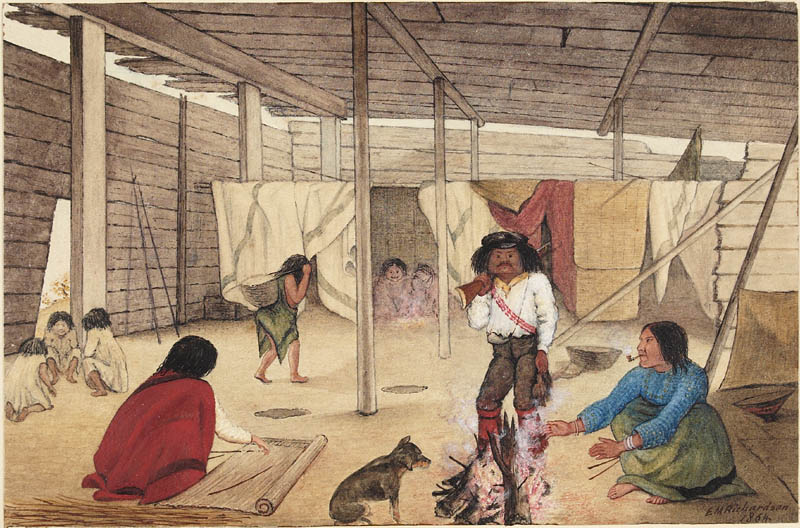
Interior of a Coast Salish Longhouse, 1864

Interior of a Salish Longhouse, 1864. Watercolour by Edward Mallott Richardson.  Locale uknown. Source: Canadian Archives.  Click to enlarge.

Interior of a Salish Longhouse, 1864. Watercolour by Edward Mallott Richardson. Locale uknown. Source: Canadian Archives. Click to enlarge.

Following on from the post about the Salish mausoleum, here is a companion painting by Edward Mallott Richardson from the same year, depicting the interior of a house.  It’s a curious painting, seemingly devoid of close detail.  Where are all the drying fish?!  But at the same time it shows some features of interest which may be worth discussing.  Note the fellow with the gun has a powderhorn, for example, and the basket behind him looks like one of those rectangular coiled ones, only with a tumpline, as shown by the woman entering on the left.  On the far right is a semi-conical object that might be a hat, sitting on a platform within a small compartment.

Continue reading

A Coast Salish Mausoleum, 1864

A Salish Grave, 1864. Watercolour by Edward M. Richardson. No specific locale given. Source: CollectionsCanada.gc.ca

A Salish Grave, 1864. Watercolour by Edward M. Richardson. No specific locale given. Source: CollectionsCanada.gc.ca  Click to enlarge slightly.

“Grave House” is one of those archaeological terms which render slightly creepy a feature that is more or less an everyday experience: the mausoleum, a house for the dead, filled with coffins.

This is a fascinating image I hadn’t come across before: a very early image of a Coast Salish mausoleum.  It highlights the artistry and vividness of these features better than the few sketches or early photographs do. The accompanying text at the Canadian Archives is:

Subject depicts grave boxes in a grave house with guardian figures. The grave house is covered with a roof of wooden planks but has no walls. At the front of the house stands six guardian figures. There are flags to the left and right of the house. On the left hand side of the house a tent is set up and clothes are hanging. A shotgun hangs from the front beam of the house. Item was up for auction in the September 28, 1970 Christie’s sale in Calgary. Lot 31.

The image isn’t very high-resolution but there are still some things to talk about – and there is another Richardson painting I’ll link to in a day or two. (edit: here) Continue reading

Klahoose Arborglyph

Klahoose Arborglyph Ceremony. Source: Klahoose First Nation.

Klahoose Arborglyph Ceremony. Source: Klahoose First Nation.

There has been a mini-flurry of new arborglyphs found in BC – well two of them –  but they are extraordinarily rare.  First up for this blog is the example above, which comes from Klahoose First Nation territory, roughly around Toba Inlet in the extreme NE corner of the Salish Sea (map).  This human face was carved into a tree some time in the 19th century.  It’s in rather stunning condition, setting aside the cut block it finds itself in.  Risk of blowdown is probably why, after appropriate ceremony, it has been moved to the Klahoose offices at T’oq (Squirrel Cove).  As the page describes:

The Klahoose Cultural Leader Norman Harry Sr. and a Tla’amin Cultural Leader Erik Blaney witnessed and performed a ceremony to ensure cultural protocol was observed. The heartfelt moments before the tree was harvested was both moving and surreal on that snowy winter Friday. Needless to say that the emotional event was a historical moment for those who witnessed.

Continue reading

Revisiting the Salt Spring Island Archives

Part of the Charles Sampson collection from Salt Spring Island. Source: saltspringarchives.com

Salt Spring Island is a large island in the Salish Sea, close to Vancouver Island’s southeast corner (map).  Quite a while ago I highlighted the photographs of the “Bob Akerman” museum, which comes via the comprehensive Salt Spring Island archives.  There are a few other photo records of archaeological collections there which I thought were worth a quick look.  For example, the picture above from the Charles Sampson Collection shows some fairly spectacular ground slate points to the left, and what may be a Charles phase (ca. 4,000 year old)  contracting stem point to the bottom right.  It’s not just archaeological collections that the archives has going for it, though. Continue reading

Fieldschool Update, and Public Lectures

Screenshot of Times Colonist article - click to go to the story.

I am in town briefly and see the Time-Colonist has an article and photo gallery about the UVIC-Parks Canada archaeological fieldschool in the Gulf Islands.  It’s a pretty good article with some nice quotes from the students about their experience, and which emphasizes how threatened some archaeological sites are.  It would have been nice to see more acknowledgment of local First Nations and of the hard work Parks Canada’s liaison team is doing to help build relationships around cultural resource management.  It’s very early days for the field school but in the medium term it hopes to be of service to First Nations and their archaeological questions and concerns. A big part of that is the specific focus on archaeological site assessment and management skills being taught by the course instructor, Dr Duncan McLaren, and another big part is the presence of paid First Nations interns who will be taking the field school – only one this year but more in the future it is hoped.  Anyway, the article tells part of the story very effectively and the reporter and photographer had an interesting time with the fieldschool and vice versa.

In related news, I’ll be giving a public talk about Salish Sea archaeology with a fieldschool update this Friday July 30 on Pender Island at 7.00 in the Anglican Hall.  Then, my mini road trip takes me to Saturna Island on July 31 for a talk at 7.30 at the Community Hall.  Otherwise, there probably will be no updates here until the middle of August.

Times-Colonist screenshot - click to go to story.

William Alexander’s Watercolours of Vancouver’s Voyage

Village of the Friendly Indians near Bute's Canal. Watercolour by William Alexander. Source: University of Illinois.

Yesterday I posted an engraved  view of  a village near the entrance to Bute Inlet, the view seen in 1792 during the voyage of Captain Vancouver.  Much as with the earlier posts on John Webber (1, 2, 3), there are multiple versions of these scenes.  The above shows a watercolour rendering made by William Alexander, a well known artist and draughtsman of the late 18th century.  It seems his series of works on the NW Coast was not done from life but was a commissioned finalization of the drawings of William Daniell, who was actually on Vancouver’s voyages, and perhaps other artists/oficer’s sketches.  At least that is the story I’ve been able to winkle out, starting from a position of sheer ignorance.  Nicely, though, Alexander’s watercolours from the Vancouver Voyage series, covering Alaska, the Northwest Coast and some views of California and Chile, are all available online through the Newberry Library at the University of Illinois.  These renderings were not familiar to me and perhaps not to you, either.

Continue reading

Katzie Artifact Gallery

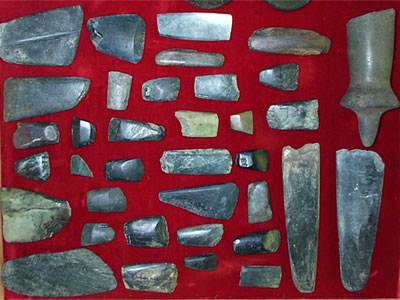
Ground stone celts (adze and chisel blades). Source: Katzie.ca

Hmmm: the pictures are low resolution, there isn’t much annotation, many are of replicas, and the page design HTML is wonky, causing a lot of sideways scrolling.  Yet I really like the Katzie First Nation’s artifact gallery.  And no, its not only because they give ground stone its rightful pride of place.  Though, in the image above, feast your eyes on the uppermost left specimen – an unusual yet definitive example of a broad celt being bisected to form two narrow ones.  In essence, an adze is being turned into two chisels.  Chew on that, Spaulding and Ford. Also check out the specimens in the centre-right, where the sharpened bits differ in colour from the bodies.  These are either patinated specimens subsequently reground and recycled, or speak to a process of heat treating or oiling or similar to enhance the raw material.  You could read all about this in my M.A. thesis if it were online, which it isn’t.  Or wasn’t until five minutes ago.  But I digress.

What I like is the text associated with these images.

Continue reading

Listening to Our Ancestors: An exhibit at the National Museum of the American Indian

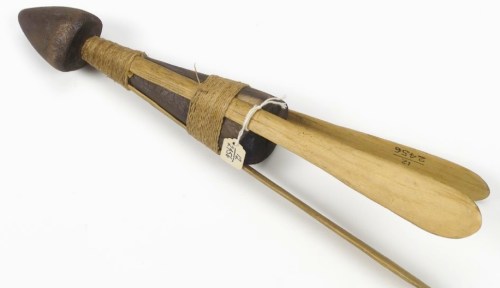
Coast Salish Cod Lure. Source: NMAI

Listening to Our Ancestors” is a nice online exhibit which resulted from a process by which 11 west coast First Nations and Tribes came to the National Museum of the American Indian (a fairly recent, major addition to the Smithsonian Institution in Washington D.C.) and created mini-exhibits reflecting their own worldviews and the categories they deemed important.  As such, each community’s sub-page is a glimpse into their specific cultural heritage and priorities – indigenous curation, you could say.

While much of the focus is on ceremonial items, some communities also choose to focus some attention on their more everyday technology, which is more in line with my own interests.

Continue reading

Salish Villages of Puget Sound

Overview map of Coast Salish Villages of Puget Sound. Click to go to the page of interactive maps at coastsalishmap.org

Tom Dailey has put together a large and very interesting site which documents the Coast Salish villages of Puget Sound.  The core of the site is a series of clickable maps (see the left hand side black/white map grid), each of which is marked with little village icons.  Clicking on these icons takes you to a master document with a synopsis of the settlement name and, usually, a couple of sentences about the village.  These are referenced to scholarly literature and other sources.  It is striking to see all these villages on one map, and notable how many are shown on rivers and lakes.

Continue reading

Lasqueti Island Archaeology

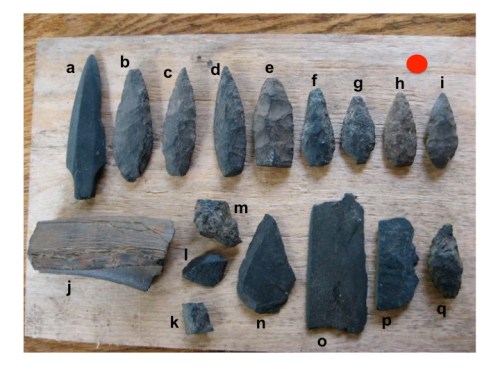
Projectile points and other artifacts from Lasqueti Island.

So many of the Gulf Island of the BC Coast are essentially unknown to archaeologists.  This goes for the larger ones as well as the small: I’d count Lasqueti, Hornby, Texada, Saturna, and Prevost Islands among those, while even major islands like Mayne Island and Quadra Island are often known only from one site, dug long ago.

This doesn’t mean there hasn’t been any work, or that there aren’t interesting and revealing collections of archaeological material already in existence.  So it is great to see that Dana Lepofsky of SFU has put together a small web site on the archaeology of Lasqueti Island.  She deftly combines some ethnographic and traditional practice information with a series of photographs of private collections of artifacts.  Among these are projectile points apparently assignable to the Charles Phase, which dates around 5400 to 3600 years ago.  Also note the beautiful ground stone adze or chisel in this picture: the luminous green nephrite (B.C. “jade”) would have been imported from the Central Fraser River, probably no closer than the Hope area.  This flaked and ground sandstone club is an unusual find, probably used in hunting or fishing, but perhaps also in warfare.

If you click the photographs, then a window will open; if you click the “image details” link on the pop-up window then you will be taken to more information about that photo, if available.  There are also two PDFs linked, one to the role of herring in traditional subsistence, and another on mapping a fishtrap.  These stem from Lepofsky’s ongoing work (and excellent website) in Tla’amin territory on the Sunshine Coast (previously), where she will be running an archaeological fieldschool again this summer.  While this only scratches the surface of Lasqueti Archaeology, it does point to the usefulness of looking at what citizens have picked up over the years as a guide to some of the time depth and activities of an area.

Sadly, of course, some of the artifacts picked up may have resulted from, or even caused, unnecessary disturbances to the archaeological record.  Lepofsky provides a helpful “call before you dig” article as well – specific to Lasqueti yet applicable elsewhere.  In typical Dana fashion, as a Lasquetian herself, the number to call is her own!

Lasqueti Island intertidal fishtrap. Photo: Dana Lepofsky.