Tseycum Repatriation from AMNH

Inside the Tseycum Longhouse.  Click Image for etended video.

Inside the Tseycum Longhouse. Click Image for extended video.

This is old news now that in 2008 the Tseycum First Nation in North Saanich managed to repatriate the remains of 55 of their ancestors who had been removed and sold by Harlan I. Smith.  What I didn’t realize is in addition to the snippet on The National with Wendy Mesley (the file is incongruously called “brown-bones” – WTF CBC?), there is also an extended uncut video of the ceremony in the Tseycum longhouse.   Cora Jacks, who spearheaded the Tseycum repatriation effort and is interviewed here, sadly passed away soon after.

The detailed field notes kept between 1854 and 1910 assisted greatly in tracing the location of the ancestral remains. Museums in the states are required by law to provide information when a nation makes its request. This law called NAGPRA is the Native American Gravesite Protection Repatriation Act and has greatly facilitated the provision of a long list of human remains and sacred objects. (Similar legislation in Canada does not exist.) Historic references show that skulls had been sold for $5 each with similar price tags having been placed on skeletal remains.

Cora had visited New York in 2005 with Vern Jacks Jr. and experienced the deep emotionality of viewing the remains stored in boxes and placed on shelves. The museum had not followed any cultural protocol so that skulls were often separated and Jacks explains the “spiritual restlessness,” which results from this disrespectful treatment. In Chicago Jacks also discovered about 79 sets of remains many of which are probably from this region and most of them were small children who had likely died of smallpox after contact with European settlers. (source).

As the NY Times noted, the Field Museum in Chicago had not yet begun repatriation negotiations with the Tseycum.  While the NAGPRA law in the states is very strong when applicable, it clearly does not apply outside American borders so credit to the AMNH for working in good faith with the Tseycum.

But also: Grant – what the heck – is it really necessary to defend Harlan Smith?  Maybe as a curator of archaeology it is.  I dunno, seems like another relativising moment rather than a chance for an apology or a plain admission that it was wrong, then and now, to steal human remains for profit. But hey, stealing their land was also done in the spirit of the times, so what the heck?  Let’s not forget the RBCM itself is built on top of a village site.

NorthWord Archaeology

Layer 1: snow.  Layer 2: littermat.

Layer 1: snow. Layer 2: littermat.

I just found a pretty good article from NorthWord, a community newspaper that covers northern BC’s coast and interior.  Nice quotes and insights from Rick Budwha, Farid Rahemtulla and David Archer – but what caught my eye was the surreal photo used to illustrate the piece.  Is that a light dusting of snow on the clipboard?  Is that wind down the plumber-butt?  Is that a marginally insane unit location right in the root mat of a huge tree?  Is this winter impact assessment under Oil and Gas Commission guidelines? How did they establish the glorious sidelight?   Is there snow on the soles of their boots?  Could this be a painting?  I want to know more about this picture, dammit!

Speaking of Clovis

Michael Collins' Licence Plate - Just needs a "pre" fix.

Michael Collins' Licence Plate - Just needs a "pre" fix.

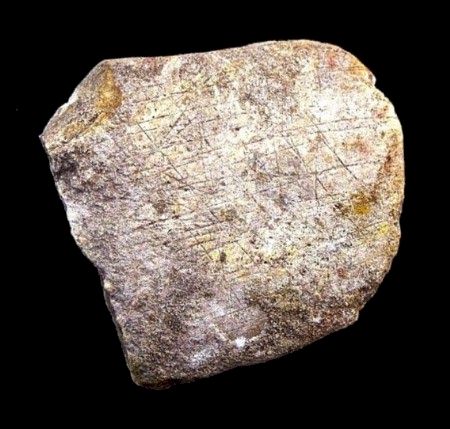
The Gault Site in Texas is a classic Clovis site, though one which awaits full and complete recording.  The site was purchased by old-school Clovis archaeologist Michael Collins to protect it – the previous owners would rent out digging time to pothunters.  Collins  then donated it to an archaeological trust – a stunning example of putting your money close to your mouth!  It has always been on my radar as a big site down in Texas with tons of Clovis stuff but frankly I had never looked into it that closely – other than indirectly through Collins’ excellent studies of Clovis blade technology, and an awareness that it had produced some of the earliest art known in the Americas (2, 3).  Any Clovis site is of interest, not just because Clovis is an unusual archaeological phenomenon, but also because the history of the discipline will see “Clovis First” archaeology as a classic example of a paradigm that got shifted, reluctantly.  And anyone working on the early periods in BC Archaeology is profoundly influenced by Clovis — whether that be the northeastern Ice Free Corridor sites, or on the coast where Clovis ages of 11,000 radiocarbon years ago are a benchmark for first peopling.

So I was interested to learn that there is 400 years of Clovis occupation here — pretty much the whole span of the Clovis Culture as now understood.  That’s not very overkill-and-move-on-ish.  Then I find out the dominant resources at Gault include frogs, small mammals, and turtles — not very big-gam-hunterish.  Now I read the Collins is reporting pre-Clovis deposits at the Gault Site — certainly not very Clovis-Firsty.  As  this article from a local newspaper in Waco states:

The latest evidence to debunk this theory may come from the Gault site. In the dig site now covered by the big white tent, archaeologists took a core sample in 2007 and found something startling: what appear to be manmade stone artifacts that differ from Clovis technology. That could mean Gault was inhabited some 14,500 years ago, Gault School officials said.

“That would be the nail in the coffin of Clovis First,” said Collins, the University of Texas archaeologist who has been the site’s chief excavator.

Collins, 68, said that when he started in archaeology in 1960, almost nobody questioned the Clovis First theory. Collins grew to doubt it, based on new discoveries in Chile and elsewhere, but it took a long time for alternative theories to gain traction in the world of archaeology.

“What I despised most among my colleagues was that they would simply dismiss your argument when they didn’t know anything about it,” he said. “Or they would ignore it.”

Today, the question of the first Americans is a wide-open debate, with scientists such as Collins suggesting Asian and even European colonization by boat between 15,000 and 24,000 years ago.

“When I first started doubting Clovis First a long time ago, maybe 2 percent of professional archaeologists considered the possibility of an earlier date, Collins said. “Now, that number is probably 95 percent.”

Maybe I haven’t been paying attention but, wow.  Gault Site has pre-Clovis and Michael Collins slams the “Clovis Police.  It’s a good day.

Clovis Exceptionalism Craters

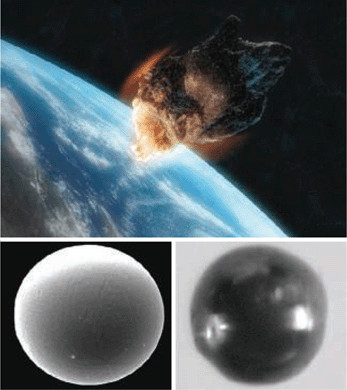
An impactor (top) may have produced magnetic spherules (lower right), but similar spherules (lower left) continually fall from space.

An impactor (top) may have produced magnetic spherules (lower right), but similar spherules (lower left) continually fall from space.

John Hawks has a good writeup about the latest news on the theory put forward a couple of years ago that a comet impacted the Laurentide ice Sheets, overkilling Clovis culture, megafauna, and instigating the Younger Dryas Event to boot.  The new paper by Todd Surovell et al. completely fails to replicate a key bit of support for the theory, namely that magnetic iron spherules, said to be the comet’s smoking gun, were associated with terminal Clovis stratigraphy across the Americas.   Other studies have chipped away at the theory as well. I’m not an expert and it’s hard to judge the state of debate — though as Hawks notes, the paper is unusually unequivocal in its conclusions of ‘no evidence”.

I have to say, I don’t mind seeing more theories of Clovis exceptionalism shot down — it is an unusual archaeological phenomenon to be sure, but it hardly takes white-hot fallout across the Americas to bring it down.  Let’s start looking at Clovis on a more human scale! Enough with the megafaunal overkill models, when the most ubiquitous fauna associated with Clovis are turtles and tortoises.  Enough with the ignoring of plant remains — the Clovis Policemen’s longstanding refusal to accept Monte Verde tells us everything we need to know about their knowledge of ethnobotany.  Enough with the phallocentric failure to look beyond the Clovis Point to see that the rest of lithic Clovis  is pretty much a standard Upper Palaeolithic toolkit.

Smoked mammoth.

Smoked mammoth.

Thinking about that the other day,  I realized that Clovis is (ironically, counter-intuitively) ripe for a post-processualist analysis. Not a critique – an analysis.  Why?  What makes Clovis different is style – widespread projectile point style as a sort of hyperkinetic effort to maintain social cohesion through semiotics, if you like.  When something is so unusual we have to posit its arrival in a river of blood through the parting of a white sea, and then see it off with a rain of fire from heaven, surely it is time to turn it over to the school of archaeology that deals with histories, not generalities.

Surovell TA, Holliday VT, Gingerich JAM, Ketron C, Haynes CV, Jr, Hilman I, Wagner DP, Johnson E, Claeys P. 2009. An independent evaluation of the Younger Dryas extraterrestrial impact hypothesis. Proc Nat Acad Sci USA (early) doi:10.1073/pnas.0907857106 (subscription required)

Akerman Collection – Salt Spring Island

Stone Bowl from Akerman Museum

Stone Bowl from Akerman Museum

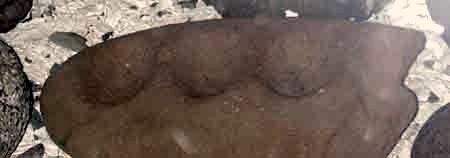
Salt Spring Island has a pretty active museum and archival society, by the looks of it – at least, they are putting a lot of pictures and documents online.  One thing which caught my eye was their photos of the Akerman Museum – which I take to be the private collection at the home of Bob Akerman.  This is a striking carved object (of which I wish there were more photographs) described as: Black stone that they claim had healing power. Shamans used it when they were visiting the sick. Though elsewhere, they show another object with a similar description which appears not to be worked much, if at all.  There’s no real documentation which is too bad — the stone tools in this picture, for example, strike me as more of a neolithic thing than a northwest coast one.  I hope they have the information somewhere.  This is an impressive metal celt, and it looks like he has a good collection of nephrite ones as well, though the picture is exceptionally poor.  (NB – bandwidth is not nearly so much of a concern these days, so don’t shrink your pictures so much!) There are lots of slightly unusual artifacts, like this collection of handstones. All around, it looks like Akerman has a great collection — I don’t want to think too much about where the archaeological material came from, or how he came to have it, and I’d like to think there is a shoebox full of notes somewhere — but all the same it is interesting to peruse and I’m glad the Salt Spring Archives have at least some documentation of it.

Another highlight of the site is Chris Arnett’s short, but lively and informative history of First Nations of Saltspring Island.

dSpace: Dentalia Shells on the Northwest Coast

Dentalia Source "mu7is" in Hesquaht Harbour.  From Barton M.A. p. 116

Dentalia Source "mu7is" in Hesquiat Harbour. From Barton M.A. p. 116

Andrew Barton did an excellent job reviewing the biology of the Scaphopoda, the archaeological record of dentalia use and trade, and the technology available to harvest these small creatures with tusk-shaped shells.  Overall, he brought a lot of nuance to a topic that had been somewhat over-simplified.  For example, there is no real evidence that these shells were only available at depth from the NW corner of Vancouver Island.  Barton reports on attempts to replicate ethnographic dentalia “spears” (more like a rake, or a pasta fork).  You should be able to download a copy of Fishing for Ivory Worms : a review of ethnographic and historically recorded Dentalium source locations from SFU dSpace.

Dentalia necklace by Josephine Ingraham, Clatsop/Chinook Tribes

Dentalia necklace by Josephine Ingraham, Clatsop/Chinook Tribes

Keatley Creak

An unusually strong review of Brian Hayden‘s Keatley Creek excavations on the middle Fraser River, near Lillooet can be found at this site:

” […]Hayden was able to show that the aristocratic owners lived on one side of the house, where the larger hearths, the larger storage pits, and the better tools and ornaments were all found, and their servants or poor relations on the other side.  The bones from the good side of the house were mostly ribs and vertebrae from the best parts of the fish, while the tail bones came mostly from the poor side.  The deer bones were also mostly from the rich side.  So we can imagine the rich folks keeping warm with big fires and eating the best parts of the fish, while their inferiors watched them from the other side of the same room, huddling by tiny fires and gnawing on fish tails.  To this visual image we must add the smell.  Air-drying salmon protects it from harmful rot, but European observers all thought the process left the fish “half tainted.”  The smell in a closed house full of the stuff “was such as nobody who has not grown up with the stench can endure it for even a few minutes.” The more I think about this strange place, the more disoriented and disgusted I become. […] ”

I look forward to more such insight into how the public perceives the fruits of archaeological labours.

Skidegate Haida Model Village

Model of Skidegate (hlgaagilda 'llnagaay) as installed at Chicago Exhibition, 1893.

Model of Skidegate (hlgaagilda 'llnagaay) as installed at Chicago Exhibition, 1893.

The Burke Museum in Seattle is doing excellent work.  I just found the project which they are spearheading, together with the Haida Museum at Kaay’llnagaay and the Field Museum in Chicago, to reassemble the famous model village of Skidegate (hlgaagilda ‘llnagaay) created for the 1893  Chicago World Fair.  This exhibition was organized by Putnam, implemented by Boas, who hired James Deans (a well known Victoria antiquarian) to collect some NW Coast stuff.  Deans outdid himself by arranging for the carving of a complete model of Skidegate Village  – amounting to some 27 model houses (most with frontal poles), 2 model mortuary houses, and 17 free standing model poles.  (Deans also apparently collected three boxcars of other material including an entire house, canoe and other material, but that’s another story).

The Burke Museum now allows you to view an interactive panorama of the model village.

The website is designed both to showcase these model houses and also to help find the 13 houses and poles which have gone missing.   The intention is to return the model village to Kaay in 2011.  Replacement poles and houses will be commisioned for those that cannot be found.   A highlight are the videos of Skidegate residents such as Captain Gold, Niis Wes, Percy Williams, Kii7iljuus, and Kwiaahwah Jones talking about the model village, about family, and above all about being Haida yesterday, today and tomorrow.

House of Contentment, model carved by George Dickson

House of Contentment, model carved by George Dickson

Cook Journal Illustrations from Oz

inside house nootka soundThe Australian National Library has a nice set of the engraved illustrations for the journals of Captain Cook online.   Above is the famous 1778 image of life inside a large house at Yuquot (Friendly Cove) in Nootka Sound.  The image above encapsulates so much about life on the west coast: one group of people on the ground, tending to the fire, looking a little miserable, while another family unit sits on benches in nicer clothes and with their feet dry; the little partition dividing up the large house into dwelling foci; the boxes of stored good and paraphernalia; the fish hanging up in the smoke (and look how they are all different sizes and shapes of fish).  And note the “whaling trophy” at the base of the left housepost, a wooden whale fin apparently studded with sea otter teeth.  A closely comparable example was found at the Ozette site.  That’s the inside of the house — one remarkable thing about the outside of the house is the massive piles of shell midden almost obscuring the dwellings.  We think of middens as flat, but active middens may have been highly mobile, rutted, mounded affairs, which should give us pause, or at least, humility.

Their interface is clumsy (or maybe just slow) and I know you only want the Northwest Coast ones anyhow, so other treats are these masks and frontlets, the well-known man and woman from Nootka, and, below, a sea otter proving that cute overload is no modern invention – thought the listless aspect of the otter suggests that it may have been dead at the moment of portraiture.

cook sea otter

Fieldwork Picture of the Day 9

Danny at the helm,  aaaargh Billy.

Danny at the helm, aaaargh Billy.

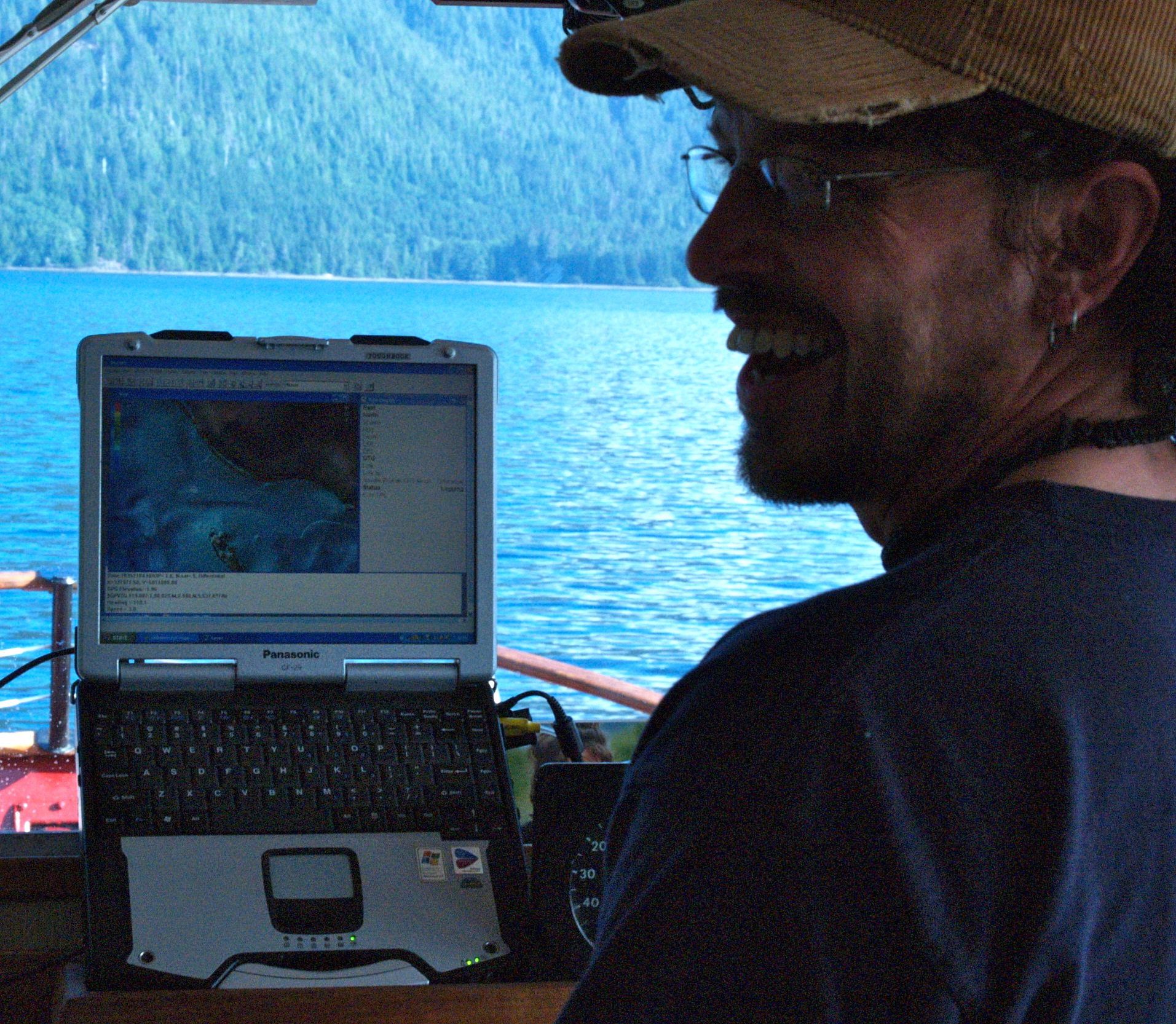
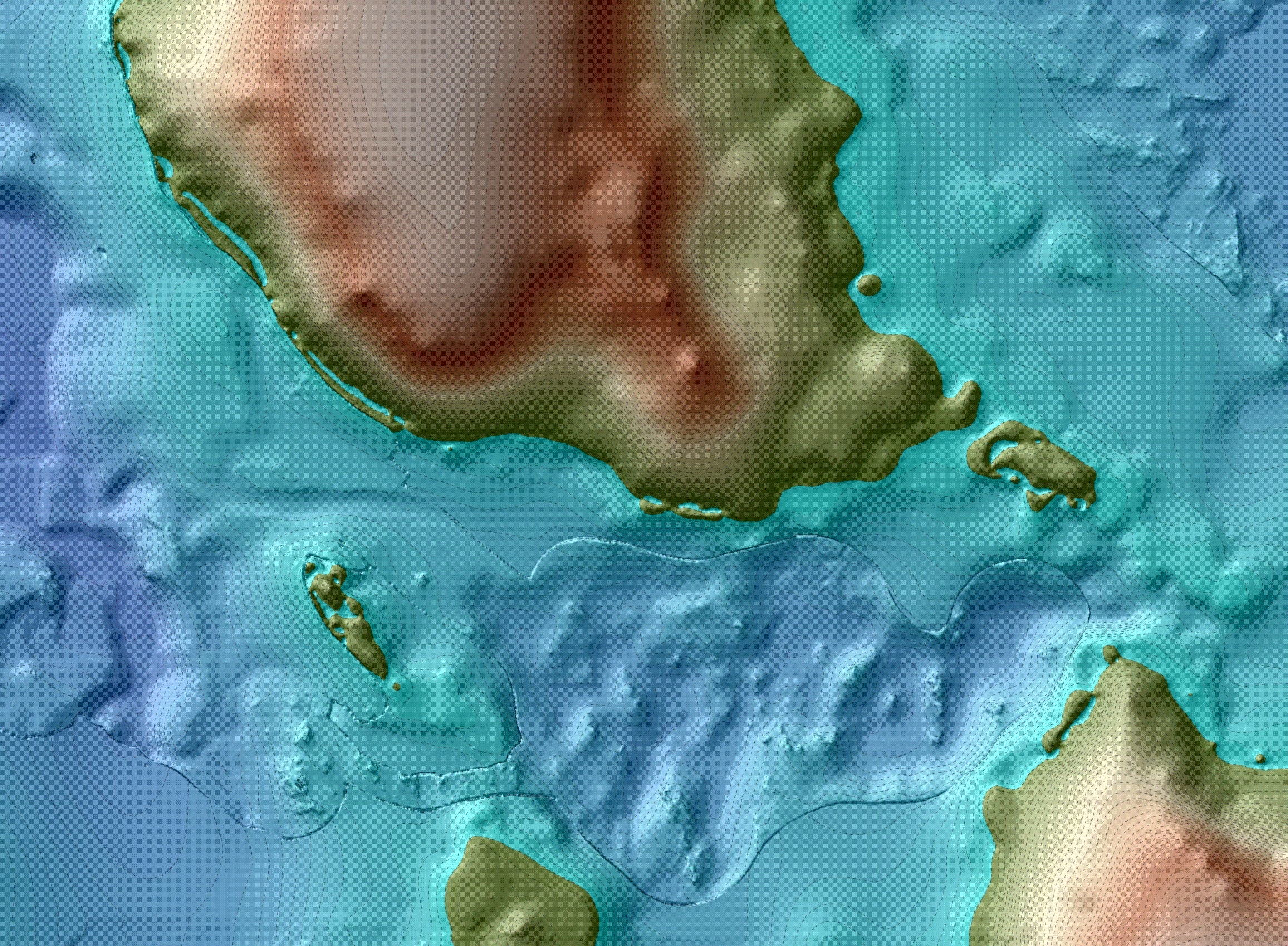
Underwater research at Section Cove, near Gaadu Din. I posted a picture earlier of a diver on the bottom.  Here is a view from topside — Danny, boat skipper, wise-ass and all round rock solid good guy — has a GPS-linked laptop in front of him which is displaying the bathymetry of Section Cove.  (see the image on Danny’s screen here, courtesy of Daryl).  This enables him to tow the sonar fish exactly where required, or, on this occasion, help position a small dredging bucket for bottom sampling purposes.  With differential GPS, you can position the ship to within less than a metre of where you want it, relative to the bottom.  This means measuring the distance between the GPS antenna and the crane and building in an offset, which is trickier than it sounds. The bathymetry is also sub-metre in resolution.  Thus, we can target the bucket exactly where we want it — of course strong currents and bucket flutter can still move it around some.  It has been slow progress on this work but all the pieces are in place for what could be an exciting breakthrough –  a base camp on a small lake, now drowned, dating to sometime older than 11,500 solar years ago would be most welcome considering most of our other sites of this age are rather one-dimensional.

The purpose of the camp could be base camp for bear hunting in the nearby Gaadu Din caves, or more likely sockeye fishing in the lake-stream system that used to flow along the terrain here, under Danny’s  keel.

The lake, the salmon, the cave, the creek.  Green tones are now underwater.

The lake, the salmon, the cave, the creek. Green tones are now underwater. Image prepared by Daryl.