More views of the Museum of Vancouver petroglyph problem

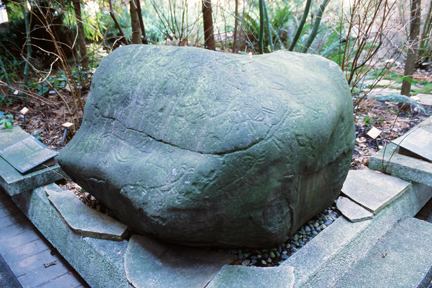
Petroglyph from Lone Creek Cabin, Stl’atl’imx Territory, now in an outdoor courtyard at the Museum of Vancouver. Source: Squamish-Lil'wat Centre.

I’ve posted before on the large petroglyph boulder from the central Fraser River that is being kept in a sub-standard context at the Museum of Vancouver.  I found some more pictures of it, from the website of the Squamish-Lil’wat Cultural Centre (which is excellent).  These additional pictures confirm there is a serious conservation issue at the Museum of Vancouver.  I don’t want to beat a dead horse but I am still mad about this situation. Continue reading

Five Frogs’ Quiver

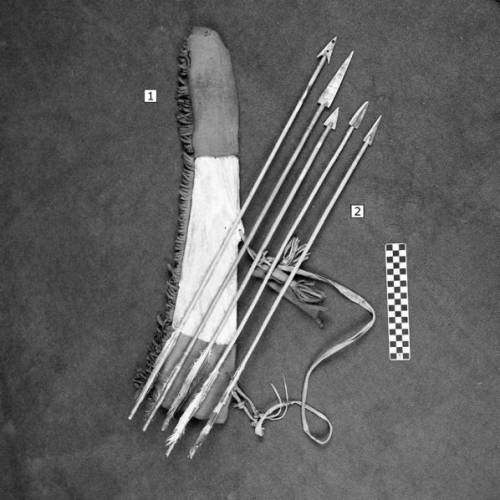
Five Frogs' quiver with five metal-tipped arrows. Source: WSU

The quiver and set of arrows above is from the McWhorter Collection at Washington State University.  It belonged to the Nez Perce warrior Pahka Pahtahank (Five Frogs), who fell in battle in 1877.  Ten arrows in total were in the quiver: five with metal tips, and five with plain wooden tips – or, more likely, unhafted (probably prepared for a side-hafting method).  The wooden five are illustrated below. What I find interesting about this quiver is that no two of the five metal-tipped arrows are the same.  Archaeologists are very prone to a simple “projectile point sociology” whereby the styles of (usually, stone) projectile points are used as proxies for archaeological cultures, or ethnic groups, or as temporal markers:  ‘The side-notch people”;  “The corner notch phase”.

It is therefore a little sobering when we see ethnographic instances of an apparently cavalier attitude towards stylistic consistency.  Sometimes, (at least rarely) being a little sober is a useful mindset.   Did the different arrowheads make no difference to accuracy, or to penetration, or even to their definition as “suitable arrows”?  What are the archaeological implications of Five Frogs’ diverse arrows?  In a classic paper, Polly Wiessner (1983) noted several mechanisms for a similar Kalahari case, including hunters exchanging arrows with each other as a sign of respect and affection.  Closer to home, Glen MacKay, in his excellent UVIC M.A. thesis, suggested diverse projectile points in a short occupation site in The Yukon was a technological mediation of kinship unease:

Was the ‘arbitrary’ technical choice of hafting techniques a subtle way for young men living matrilocally to express their discontent with this institution, a means of communicating a desire to return to the people with whom they learned to make spear points and hunt? Several contextual details fiom the KdVo-5 hunting stand support this proposition…..

Emotion in archaeological interpretation!  Stamp it out.

Tips of Five Frogs' wooden arrows. Source: WSU
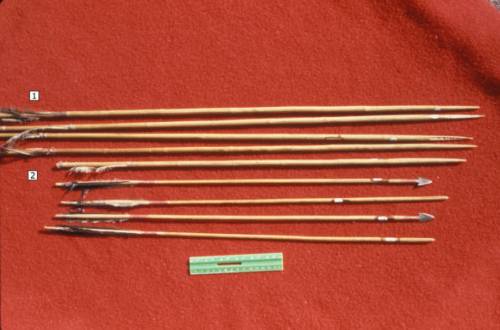
The top five arrows are from Five Frogs' quiver. The bottom four are from another Nez Perce warrior, Yellow Wolf (Hemene MoxMox), made as deliberate replicas. Source: WSU/

References:

Wiessner, Polly   1983.  Style and Social Information in Kalahari San Projectile Points.  American Antiquity, Vol. 48, No. 2 (Apr., 1983), pp. 253-276

MacKay, Glen R.   2004.  The Nii’ii hunting stand site : understanding technological practice as social practice in subarctic prehistory.  Unpublished M.A. thesis, Department of Anthropology, University of Victoria.  Download.

A Saanich Peninsula short-faced bear

Post removed by request.

Continue reading

Swan Down

Watercolour by James Gilchrist Swan (1818-1900) of the Klallam people of chief Chetzemoka (nicknamed 'the Duke of York'), with one of Chetzemoka's wives (nicknamed 'Jenny Lind') distributing potlatch at Port Townsend, Washington, USA. Source: Yale, via Wikipedia.

James Gilchrist Swan

lived one of the most varied and colorful lives in the early history of Washington Territory. He was variously an oysterman, customs inspector, secretary to Congressional delegate Isaac Stevens, journalist, reservation schoolteacher, lawyer, judge, school superintendent, railroad promoter, natural historian, and ethnographer. Above all, Swan was a chronicler. He wrote one of the earliest books describing life in Washington Territory, two Smithsonian monographs, many newspaper articles and technical publications, and more than 60 volumes of still-unpublished diaries. These works document not just pioneer society but also the Northwest Indian cultures that pre-dated white settlement and existed along-side it. Swan’s appreciation of and efforts to record Indian art, technology, history, legends, and language made him a rarity among early Washington settlers.

No doubt Swan wrote some of the most important and interesting accounts of early aboriginal life on the Northwest Coast and you would be lucky to own any of them as hardcopy editions. They are informative and vivid.  While they contain some of the biases of the day, there is absolutely no doubt that Swan was a sincere friend and companion of the Makah, Klallam and other Olympic Peninsula Tribes and he set out to tell their story fully in a way of which many anthropologists of the day would be proud.  Consider for example, this account of a Makah method of catching flatfish: Continue reading

Reminder: RBCM Open House

If you are in Victoria, this is a reminder that the RBCM open house is today and tomorrow, at which they will explain about their “zoning application”, which I hope means they will also be ready to explain what they plan on doing with the rezoned land (I commented on this previously).  I see in today’s Times-Colonist they lost $491,000 last year, and are projecting no travelling shows until 2012, except the Terracotta Army.  That and the British Museum exhibit each cost about 3 million dollars to mount, as an off-the-shelf travelling exhibit here for a few months.  How much permanent exhibit could one buy for $3,00,000, which would pay for itself every day of the year?  I know they have been forced into a particular niche by funding constraints and all – but it seems to me they are in a financial and existential crisis.  Therefore I hope they are sincere about gathering meaningful public input because I suspect regular readers of this blog have a lot to say about it.

When:  March 6 & 7 2010
Where:  Royal BC Museum
675 Belleville Street
Newcombe Conference Hall

What to Expect: Open House hours between Noon – 3:00 pm.  Zoning project team members will be on-site to answer any questions, and/or have a conversation with you about zoning the Royal BC Museum site.

Fluted Points from the Bering Land Bridge

Fluted points from the Serpentine Hot Springs Site, Seward Peninsula, Alaska. Source: Bering Land Bridge NPS

For many years, archaeologists considered the so-called “Clovis” Culture to be the remains of the first humans to enter the Americas.  These people were said to come via the Bering Land Bridge, a subcontinental land mass which joins North America to Northeast Asia.  Clovis culture was distinguished by a very characteristic type of stone spear point which had a long flake removed from the base on each side, forming a “flute” which considerably thinned the base of the point. Such fluting was a hallmark of Clovis and another, slightly more recent, culture: Folsom.

Clovis was thought to have arrived into the Americas from the present-day Yukon area through an “ice free corridor”.  However, for many years,  Clovis points and the rest of Clovis culture, were unknown from north of the ice sheets and there was a sustained research agenda to find Clovis, or to find Clovis antecedents, in Yukon, NWT or Alaska.  While the occasional fluted point became known from surface finds, those from solid archaeological context did not.

It is therefore interesting to see a site, Serpentine Hot Springs, has come to light on Alaska’s Seward Peninsula (the bit that sticks out closest to Asia – map) which has revealed numerous fluted points.  Continue reading

dSpace: Adams on Gabriola Petroglyphs

Gabriola Petroglyph Design Elements. Source: Adams 2003.

One recent M.A. thesis I was really looking forward to reading is by Amanda Adams entitled Visions cast on stone : a stylistic analysis of the petroglyphs of Gabriola Island, B.C., from UBC Anthropology 2003, and available for free download here.

I was particularly interested to read the instructions she received on proper deportment when visiting the rock art:

Sites were visited in a manner and with a personal code of conduct adhering to Snuneymuxw wishes. Petroglyph sites were not visited at either dawn or dusk. A respectful demeanor was expected as was an “open heart and mind” (Bill Seward, Snuneymuxw elder, personal communication 2002). I was asked to give my full attention to the petroglyphs and their sacredness, not allowing daily distractions to interfere with my concentration on the ancient imagery. These expectations were met to the best of my ability. (18-19)

While many archaeologists are under the impression that there is little to no ethnographic information about petroglyphs, I have long felt that more likely such knowledge is private or highly privileged and not readily shareable.  In this self-serving sense, it was gratifying to see that Adams was able to record some such information:

Snuneymuxw Elder, Bill Seward, asserts that many petroglyphs were made by shamans, hunters and vision seekers (personal communication 2002) while Elder Ellen White maintains that the carvings were places where people both sought and gained power. She explained that “men would be stripped – even in cold weather and laid on top of each petroglyph – learning the spirit world, connecting to the area.” She also noted that the pitted ‘dots’ surrounding several of the carvings were “points of access”, places where one could dip their fingers into pools of “energy” and reservoirs of strength (Archaeology Forum group tour 2002).  (p 13)

Another welcome aspect of Adams’ thesis is her direct comparison to portable art.  Continue reading

Historic Sketchbook of Heywood W. Seton-Karr

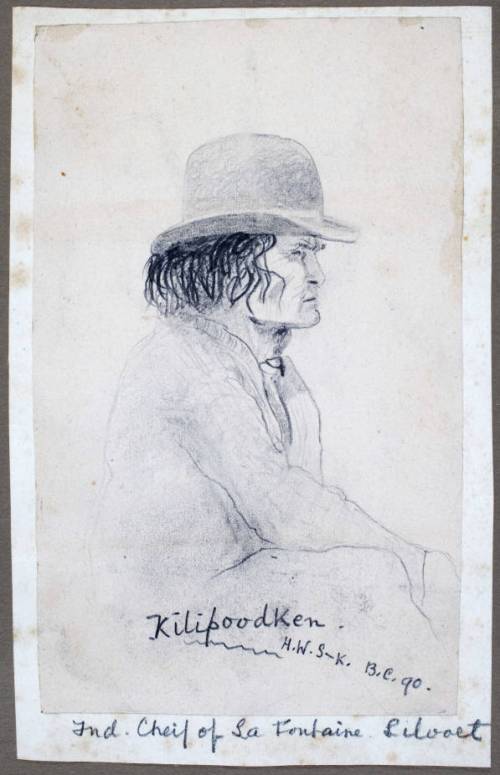
Portrait of Kilipoodken by Heywood Seton-Karr, ca. 1890. Source: Alaska Digital Archives.

I’ve just come across a remarkable sketchbook in the Alaskan digital archives.  It covers the wide-ranging travels of one Heywood W. Seton-Karr, a British Army officer, big game hunter, amateur archaeologist, and talented artist (about whom, more below).  While I could probably fill 10 blog posts from this sketchbook, (and may do so!) a very interesting find is the portrait sketch above.  The caption reads,

Kilipoodken. Ind. [Cheif]  of La Fontaine Libooet. H.W.S-K. B.C.90.

This certainly refers to the Xaxli’p First Nation, also known as the Fountain First Nation, one of the Lillooet (not Libooet!) Tribal Council from the central Fraser River region of British Columbia.  Since googling for “Kilipoodken” only returns the Alaska Digital archives source, it seems to me possible that this mislabelled portrait is unknown to the Xaxli’p Nation, where it is more than likely some of this Chief’s descendants still live.   I hope they find this portrait.

Otherwise, there is much of interest in these sketchbooks. Continue reading

Green cod heads and the case of the missing halibut

Copper kettle full of cod heads. Source: Alaska OHA.

I was feeling sick yesterday and this picture didn’t help: from the Castle Hill excavations at Sitka, Alaska (previously 1, 2) is the nearly complete copper kettle.  Inside, the archaeologists found the green-stained bones from the heads of three codfish (true cods, Gadidae, are 35% of the fish assemblage).  One of the great things about archaeology is to get these tiny slices of life: someone’s kettle of fish, set aside one day 200 years ago.

At a bigger scale, archaeology isn’t always so straightforward though.  Interestingly, from the site as a whole, only 1% of the fish bones are from halibut (11 bones in total).  This is despite the fact that:

Cod dominated the Castle Hill assemblage, and yet, Emmons (1991:148) stated that cod was considered an unimportant part of the Tlingit diet if salmon and halibut were available. Historic records confirm that cod was popular in Sitka, because it was available almost year around (Gibson 1976:40, Khlebnikov 1994). Halibut was also popular because of its year around availability and was sold to the Russians in large numbers. Between 22,000 and 138,000 pounds of halibut were purchased each year from the Tlingit from 1846 to 1866 in addition to the yearly average of 13,000 pounds of halibut the company procured itself (Gibson 1987:94). The emphasis on halibut brought to Sitka and sold to the Russian-American Company would lead to the prediction that halibut should dominate the assemblage, yet this is not the case. It may be a case where cod were readily available and not worthy of special consideration in historic documents.

Two things strike me about this.  One is that the Tlingit, using largely traditional methods at the time, were able to produce up to 138,000 pounds of excess halibut for trading purposes.  That’s a lot of fish.  The other is that so much halibut renders down to so few bones.  Halibut is long known on the NW Coast as being strongly under-represented in archaeological sites, probably because it may have been butchered on the beach and the bones, which separate cleanly from the meat, would end up in the intertidal zone and be washed away or eaten by dogs.  It also seems possible  that the Tlingit were trading in dried, boneless halibut (which makes the tonnage involved all the more impressive).  And certainly the entire site was not excavated, so there may be a mother lode of halibut bones somewhere.  But this case makes an interesting cautionary tale in zooarchaeology: we seldom have an accurate sense of the scale of the incoming fish quantities to compare to what is left in the ground, and when we do, the degree of difference between the written and material records is often quite startling!

Tlingit women and children cleaning fish on the beach, ca. 1907. Ignore the racist caption. Source: U. Washington.

Squamish and Lil’wat Cultural Journey

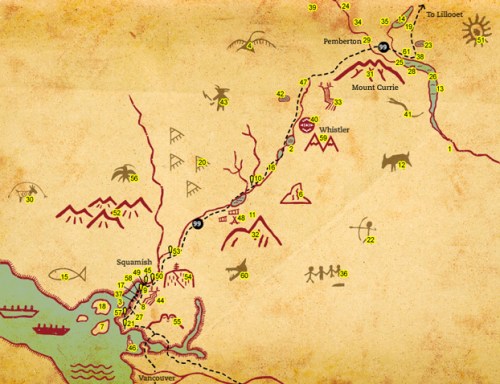
Squamish Lil’wat Cultural Journeys Map. Click to go to the site.

The Squamish and Lil’wat First Nations have jointly produced a really nice website which explores the cultural landscape of their traditional territories, which lie just north of Vancouver. Edit: it looks like their website now sells kitchen products – obviously they did not keep their registration up to date.

The interactive map has dozens of “clickable” elements, taking you to place name information, to the description of rock art motifs, and to landscape features imbued with stories from history and the supernatural.  Some of these include simple but effective animations, and the overall site design is clean and harmonious.

It seems that seven highway pullouts have also been designed with this information: aboriginal cultural tourism out on the land is something I have long thought has enormous potential in B.C.  Looking at a book or a website is one thing, but having the information available, provided by the First Nations, at the place where the story happened or the traditional use occurred, seems like it would be very effective, and popular, way of educating the public about the thousands of years of cultural history on either side of the Olympics.

Supernatural serpent emerging from Ts’zil (Mt. Currie). Screenshot from culturaljourney.ca