Category Archives: Technology

Seward Peninsula Mastodon Tusk – “too old”, therefore Too Old.

Worked 35,000 year old mammoth tusk from Alaska. Note scale! Source: Gelvin-Reymuller et al.

This is getting a little out of the area, but I’ve just run across a report by Gelvin-Reymuller et al.  (download PDF) on the finding of a worked mammoth tusk from the north side of the Seward Peninsula.  That is on the west-central Alaska coast near the closest approach to Asia, and hence smack in the middle of Beringia.  The tusk is interesting in its own right, of course, but doubly so when we see that it was dated to well before the last glacial maximum:

Though the age of the tusk is only peripherally relevant to the significance of the reduction described in this paper, the tusk was sampled for dating. A single bone collagen sample from the tusk was dated by Beta Analytic, Inc. following standard pretreatment and analytical procedures. A 5.2 g of sample was first removed from an inner area, well beneath a surficial treatment of Elmer’s Glue-All which the tusk’s discoverer had initially applied to the surface. The resultant AMS date was 35,150 +/- 530 BP (Beta-189092). …… The latest mammoth remains in mainland Alaska are dated to around 11,400 BP.   Since the age of this tusk places it beyond the range of initial human habitation in the New World, as currently understood, we posit that the tusk was worked by later inhabitants of the area.

The authors note that it is possible to diagnose from the reduction strategies used whether ivory was worked when fresh/green or when already subfossilized,  though curiously they draw no such conclusions about this particular piece.  I find it intriguing how a central Beringian artifact made on a 35,000 year old material is so readily characterized as a recent manufacture.  While this piece would pre-date the earliest known record of extreme NE Asia and while I wouldn’t second-guess the authors nor impugn their motives and while it is certainly possible that a fossil mammoth tusk was worked at a much later date, I’m, uh, just sayin’.   This paper is interesting on a number of levels, not least as an example of stickhandling around competing paradigms.

Detail of working method of Alaskan tusk. Source: Gelvin-Reymuller et al

Mt. Rainier Archaeology

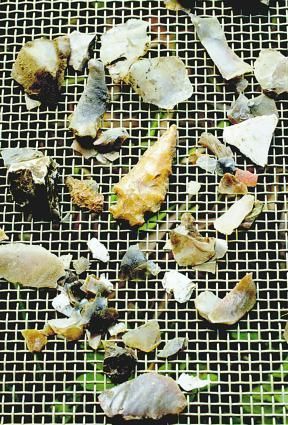
Some artifacts from Mt. Rainier. Source: Tacoma News-Tribune.

The Tacoma News-Tribune has a nice story about high-altitude archaeology on the flanks of Mt. Rainier.  Sites date back to over 9,500 cal.BP (presumably cal. BP, that is) and some include microblade technology.  If I read the article right, the microblade component dates to about 7600 years ago.  There is an older report on Mt. Rainier archaeology here by Greg Burtchard, but it seems this recent work is what has produced the older dates.  It’s also very intriguing to see ancient “cooking pits” including some that the authors suggest were continuously used for the full 9,600 years of occupation:

The site has also produced other ash evidence, coming from cooking pits.

“They’re small and not elaborate, but pretty clearly they were cooking with hot stones. But I don’t know what they were cooking,” Mierendorf said. “That implies more than just traveling through the area.

“These are repeatedly used, including one individual pit used and reused for all 9,600 years. I’ve never seen anything like that in 40 years of professional archaeology.”

It’s good to see work done in the higher elevations, and is reminiscent of Rudy Reimer‘s more theoretically-driven  work in the highlands of Squamish territory. It will be great to see if there is a full report put out soon so I can see the microblades and the cooking pits – if it is put on the web like the earlier report, so much the better!

Cache of Celts

tongass stone tools

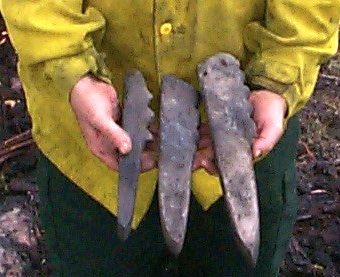
Cache of stone woodworking tools found in Tongass National Forest

So maybe I am obsessed with ground stone celts, who isn’t, but nonetheless I liked this story of the lucky discovery of a cache of large pecked and ground stone woodworking tools in Tongass National Forest in the Alaska Panhandle.   The  article claims the hafting grooves are finger grips, which I think is unlikely.  More likely these are from elbow adzes, such as this one.

tongass stone tools detail


dSpace: Caldwell on Comox Harbour Fishtraps

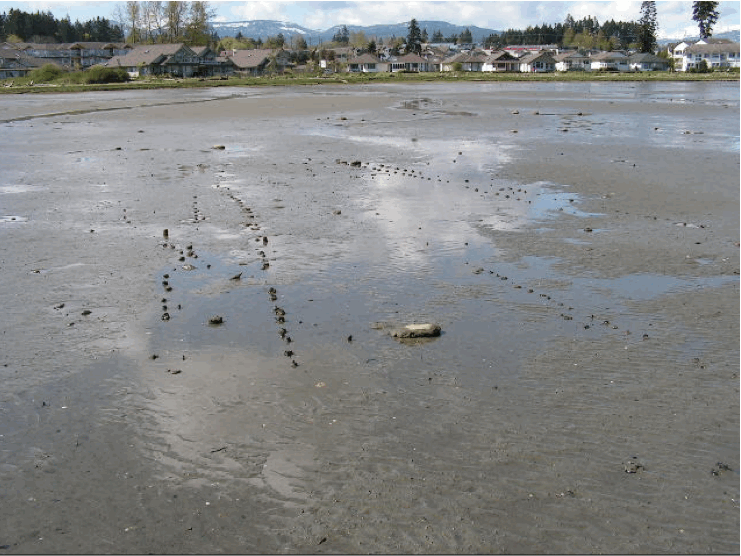
Chevron-shaped fishtraps in Comox Harbour. From Caldwell 2008.

The University of Manitoba is in on the dSpace trend.  The most notable thesis I found there was Megan Caldwell’s excellent analysis of some Comox Harbour fishtraps in relation to the Q’umu?xs Village site (DkSf-19).  Sixteen carbon dates are now available on these traps, thanks mainly to the work of Nancy Greene.  Caldwell takes a theoretical stance of Optimal Foraging Theory, arguing that fishtraps amount to “artificial patches” which can alter choices made under Patch Selection principles.  Essentially, a similar and more holistic argument could be made using principles of the “built environment” in an Ingoldian sense, but OFT is more structured and maybe more suitable for an MA thesis.  Interestingly, Caldwell’s work on auger sampling of the Q’umu?xs Village site shows a preponderance of herring, which is also interpreted as the target prey of the fishtraps.  This runs against the grain of the ethnographic work she conducted, where she was told that salmon were more important — mind you, salmon have difficult taphonomy and site formation processes, which she acknowledges.  In any case, this is a well organized, focused thesis which reflects a lot of high quality original work and while I haven’t read the whole thing I intend to do so!  Caldwell mentions Nancy Greene is still working on her fish trap study and I hope to see the results of that soon as well — these Comox Harbour trap complexes are very likely the finest of their type anywhere on the Northwest Coast and may well offer key insight into cultural construction of the landscape and its resources.  Download her thesis here!

Map of Fishtrap Stakes in Comox Harbour. From Caldwell 2008.

Schematic of two basic fishtrap designs. From Caldwell 2008.

Single Hook

Pomeroy polynesian hook 1

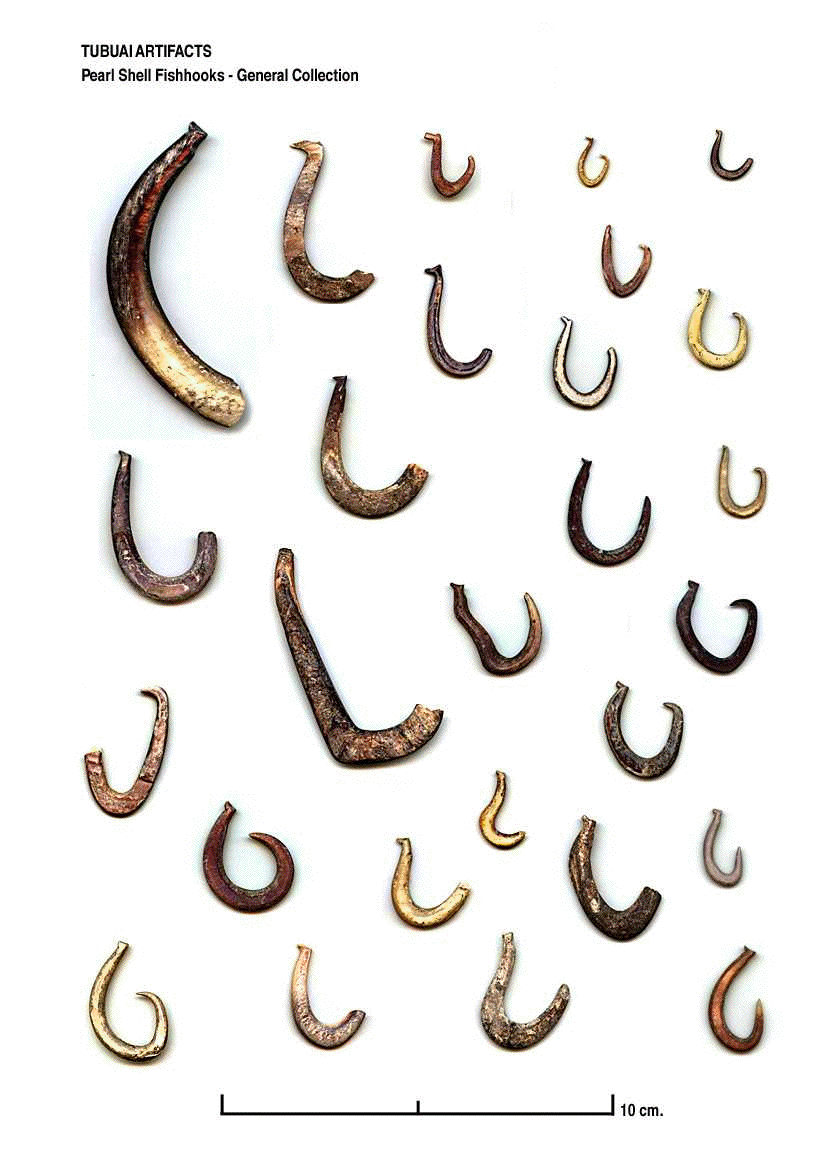
Polynesian-style fish hook found at McNaughton Island

John Pomeroy found this unusual shell (“scallop”) artifact at McNaughton Island (ElTb-10) on the central coast in 1972 (Pomeroy 1980: 321b).  It strongly resembles some Polynesian fish hooks, and is also similar to some Californian ones.  While no scale is given, by comparison to the text it appears about 5 cm long by 4 cm wide. Pomeroy offers three suggestions:

Pomeroy polynesian hook 2

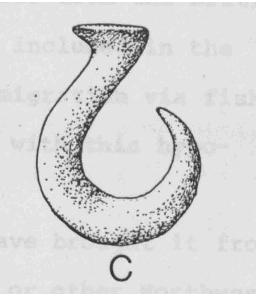
Polynesian fishook from Beasley (1928) via Pomeroy (1980)

1. That it was traded from California

2.  That it was brought from Polynesia by early European explorers.

3. That it arrived inside a tuna.

He notes that there are no tuna remains at this site, which makes (3) less likely though not impossible.  While trade from California is possible, Pomeroy  notes that this specific artifact most closely resembles some from Polynesia and not from California – namely the one to the right from Beasley (1928).  The fact that it was found at a depth of 1.7 metres suggests that (2) is unlikely.  There is a date for about one metre below the surface at this site of 900 BP.  While the exact relationship of the date sample to this artifact is uncertain on my brief reading, it is most likely the date is above the artifact and thus more recent.  Certainly this general time frame of less than 1500 years is the time when eastern Polynesia is being settled and there may have been greater opportunity for drift items or other accidental contact to occur.  On the other hand, this is also said to be the time that the Californian examples arise.

Pomeroy leaves the matter unresolved.  I’m going to keep my eyes open for other examples including fragments that might be misclassified.

polynesian fishhooks

Polynesian Fish Hooks.

dSpace: Dentalia Shells on the Northwest Coast

Dentalia Source "mu7is" in Hesquaht Harbour.  From Barton M.A. p. 116

Dentalia Source "mu7is" in Hesquiat Harbour. From Barton M.A. p. 116

Andrew Barton did an excellent job reviewing the biology of the Scaphopoda, the archaeological record of dentalia use and trade, and the technology available to harvest these small creatures with tusk-shaped shells.  Overall, he brought a lot of nuance to a topic that had been somewhat over-simplified.  For example, there is no real evidence that these shells were only available at depth from the NW corner of Vancouver Island.  Barton reports on attempts to replicate ethnographic dentalia “spears” (more like a rake, or a pasta fork).  You should be able to download a copy of Fishing for Ivory Worms : a review of ethnographic and historically recorded Dentalium source locations from SFU dSpace.

Dentalia necklace by Josephine Ingraham, Clatsop/Chinook Tribes

Dentalia necklace by Josephine Ingraham, Clatsop/Chinook Tribes

Harpoon Head from the Hunterian

I have to say, I disagree with your description.  Based on size alone, at 14 cm this is much too large to have been for salmon fishing.  Stylistically, fish harpoons tend not to have a blade bed, but rather some kind of cylinder formed by the two valves.  Flat beds such as this one are more consistent with large arming points made of ground slate or ground mussel shell.  If intended for a fish, this would be more suitable for Fraser River sturgeon, say.
But I doubt it.  I’d suggest in size and manufacture this is much more consistent with a sea mammal harpoon head.  I don’t recall seeing any of this size in Coast Salish archaeological sites.  If your provenance traces to Laskey and thus to Cook, I’d suggest it is much more likely to be from the Nuu-chah-nulth (Nootka) area of western Vancouver Island, where Cook occupied himself much of the time he spent on the NW Coast proper, and with which it is stylistically consistent.  Indeed, even without provenance that is where I would assign it.  And I would suggest in size and manufacture it is more likely to be a large sea mammal – probably whale – harpoon head of a kind we describe out here as “Composite Toggling Harpoons”, composed of two valves forming the barbs with an allowance (usually) for an inset arming point.  Something like a sea lion harpoon I would expect to be about 2/3 of this size.   Further, Cook never really had much interaction with Coast Salish groups.
Normally too I would expect the valves on one of this size to be made of antler or of wood (yew, or Douglas fir) and not bone so that is an interesting difference.
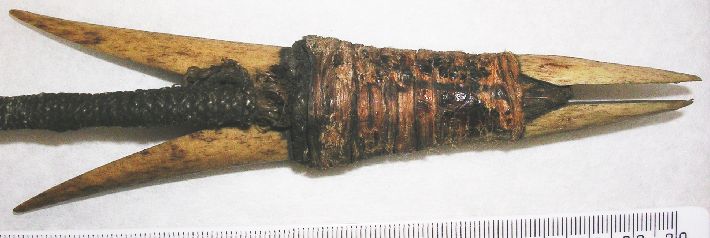
Anyway, all this is by way of saying, it appears the lanyard extends up one side, then crosses through the notch (blade bed) to the other side where it fastens.  I’d be interested in knowing if this is the case since it would be an interesting functional design aspect encouraging the harpoon head to toggle when pressure is put on the lanyard.  If you had higher resolution pictures I would love to see them.
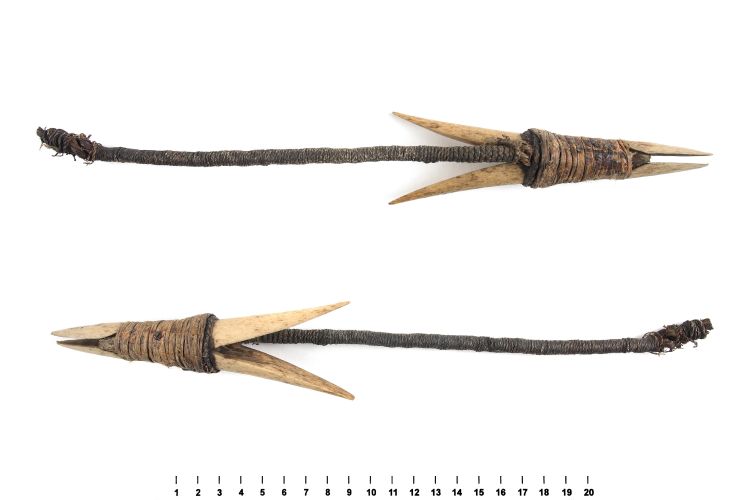
Composite Toggling Harpoon with lanyard.

Composite Toggling Harpoon with lanyard.

This item from the Hunterian Museum in Glasgow traces its provenance provisionally to Captain Cook:

This harpoon head has one large split point, with a curved split socket with pointed tips. It has twisted sinew lashing around the middle and a line of vegetable fibre attached. This type of harpoon would have been used to catch salmon and is stylistically attributable to the Salish people of the North West Coast of America. The harpoon was originally accessioned as donated by Dr. G. Turner, however there are no items from the North West Coast on the 1860 donation list. It may be one of the hooks mentioned by Captain John Laskey in his 1813 account of the museum, in which case it may have been collected on one of the three Pacific voyages of Captain James Cook.

I have to say, I disagree with the description. Based on size alone, at 14 cm for the head, this is much too large to have been for salmon fishing. Stylistically, fish harpoons tend not to have a blade bed, but rather some kind of groove formed by the two valves which supports a cylindrical bone point.  Flat beds such as this one are more consistent with large arming points made of ground slate or ground mussel shell. If intended for a fish, this would be more suitable for Fraser River sturgeon, say.

But I doubt it. I’d suggest in size and manufacture this is much more consistent with a sea mammal harpoon head. I don’t recall seeing any of this size in Coast Salish archaeological sites. If the provenance traces to Laskey and thus to Cook, I’d suggest it is much more likely to be from the Nuu-chah-nulth (Nootka) area of western Vancouver Island, where Cook occupied himself much of the time he spent on the NW Coast proper, and with which it is stylistically consistent. Indeed, even without provenance that is where I would assign it.

And I would suggest in size and manufacture it is more likely to be a large sea mammal – probably whale – harpoon head of a kind we describe out here as “Composite Toggling Harpoons”, composed of two valves forming the barbs with an allowance (usually) for an inset arming point. Something like a sea lion harpoon I would expect to be about 2/3 of this size. Further, Cook never really had much interaction with Coast Salish groups.  These harpoons work by an analogous process to the toggles on a duffel coat: insert the toogle narrow-ways, then it turns side-ways and won’t pull through the loop.  For toggle, read “vicious harpoon” and for loop, read “flesh”.  Because most maritime hunting and fishing technologies require immobilization of the prey and retrieval, the technology tends to quite a bit more complex and intricate and well-engineered than terrestrial hunting technology which is more single purpose (kill!).  The composite harpoons are a great example of this.

Normally too I would expect the valves on one of this size to be made of antler or of wood (yew, or Douglas fir) and not land mammal bone so if these valves are land mammal that is an interesting difference.

Anyway, all this is by way of saying, it appears the lanyard extends up one side, then crosses through the notch (blade bed) to the other side where it fastens. This would be an interesting functional design aspect encouraging the harpoon head to toggle when tension  is put on the lanyard.  (I emailed the Hunterian to see what they think)
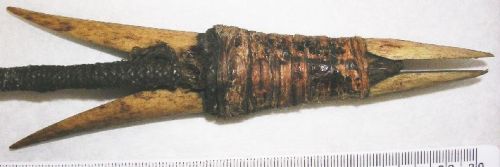
What is that organic matter between the valves? The lanyard?

What is that organic matter between the valves? The lanyard?

dSpace: Labrets by Marina La Salle

Tlingit Woman with Labret, Yakutat 1837

Tlingit Woman with Labret, Yakutat 1837

Labrets, decorative inserts worn in the lip, are an extraordinary artifact type.  It is hard to think of a more intimate or personal artifact, or at least, one that is routinely found.  Further, archaeologists have seized on labrets as status markers and routinely use them for interpretive ends.  Indeed, they are seen as a sign of “achieved status”, since one could (in theory) start wearing a labret at any age, and this has been contrasted with cranial head deformation, which must be initiated in infancy.  This distinction has been claimed to characterize the Locarno Beach to Marpole transition about 2000 years ago in the Salish Sea, for example.   And yet, for all the talk about them, they have languished through the years with only small reports and descriptive accounts of small collections given (an exception after a fashion is Grant Keddie’s catalogue of them downloadable here).  So it is very welcome to see a 2008 UBC MA thesis on labrets by Marina La Salle (4 meg PDF; click on “view/open” near the bottom of the page).  Moreover, this is a thesis which treats them with a suitable dose of social theory and strives for subtlety and nuance vs. the  over-determination of status so often seen in NW Coast Archaeology..

From La Salle 2008 MA Thesis

From La Salle 2008 MA Thesis

Apart from some solid work on their metric dimensions, typology, and a documentation of the astonishing variety of raw materials used to make labrets, there is also welcome and innovative discussion of identity formation and the negotiation of status as active, cultural processes.  This contrasts with earlier studies or casual reference to labrets as simplistic and unambiguous markers of status, worn non-problematically and being basically a badge of identification vs. a negotiable brand.  I wish La Salle had done a few small things, such as always give the artifact numbers in figures and table, and give repositories where possible (follow up work is made so much easier), and her colourful tables are entirely inscrutable, but I credit her very much with taking a fresh approach to an important, perhaps crucial artifact type.  She has a lot to say and I sense a certain frustration (or maybe this is just projection) with UBC’s restrictive 50 page limit on MA theses.  This thesis checks in at over 200 pages anyway, but a limited space for discussion of a lot of data.  Does this mean that MA students now produce more data than they can use and is this a kind of serfdom?  Discuss.

Crafting an Antler Harpoon Point

Amy Margaris has a nice video online showing the making of a replica barbed bone point, typical of ones used by the Alutiiq People of Alaska’s Kodiak archipelago.  There are lots of flint knapping videos on the web but this is one of the only bone/antler ones I have come across, at least for this area. Shethen  illustrates the different properties of organic materials by hurling them from buildings, which is a nice touch. Following Dr Margaris’ links takes us to the Alutiiq Museum website, which is a very well done set of pages, informative and up to date, covering everything from collections management to repatriation and reburial to mini-reports on digs such as the well-illustrated one at Horseshoe Bay.  My only complaint is, Alutiiq web site folks: don’t bother with the little flash gizmo to make the pictures pop up, they are annoying. They are doubly annoying when the pop-up picture is no bigger than the thumbnail!  What is wrong with people putting these tiny thumbnails up and restricting access to anything finer — you are selling your own research short and making it less likely your website will be visited via links.  If it goes on the web, it is implicit you want people to know, so can the obfuscation and speak in your very best voice!