Category Archives: anthropology

Stone Fish

From the Hunterian, labelled as 19th Century.

From the Hunterian, labelled as 19th Century.

I can’t get enough of this Haida argillite fish which the Glasgow Hunterian Museum has in their collection. Well, they say it’s a fish but it looks like it has flukes and large fins and if anything it looks like a harbour porpoise.   On the other hand, there is a lateral line as well and the proportions are more like a herring. In any case, it is utterly charming and I have never seen a comparable carving.  It looks to be about 30 cm long, which is quite large.  More from the Hunterian in due course.

University of Washington Digital Collections

Makah codfish spear (or, more accurately, harpoon)

Makah codfish spear (or, more accurately, harpoon)

The University of Washington has a superb digital collection online, transcending all kinds of different historical, archaeological and popular culture niches.  Searching on “artifact” brings up some 583 images (some of which are links to text etc).  These are downloadable and have stable URLs to which one can link. The resolution could be higher, but the pictures are sharp and clean, at least for those ones they have apparently taken themselves, and they don’t plaster watermarks all over them.  Good work.  The amount of metadata is impressive, and the fact that is is clickable renders this site a fantabulous timewaster of the highest order.  To the left, I was just having a discussion with a student about harpooning fish.  I am under the impression that harpoons were used on large lingcod – after the lingcod were lured to the surface using a cunning little shuttlecock-shaped rising float.  This picture is labelled “Makah codfish spear” though it is self-evidently a harpoon and lanyard.  More (vindication) coming from this excellent site as time goes by.

Archives of “The Native Voice”

Native Voice banner

2018 edit: it appears the PDFs are now only available through the Internet Archive here.

The Native Voice is the official organ of the Native Brotherhood of British Columbia, an organization which has been active since 1931 and continues to do good work, especially in relation to aboriginal fishing rights, and aboriginal fishers themselves.  The NBBC has put PDF copies of  many editions of the Native Voice online from the years 1947-1955.  These archived issues offer a fascinating glimpse into the the mid-20th century state of First Nations politics, and everyday life besides.

To the right, for example, click on the text image to go to an issue wherein the NBBC riffs (positively, in this case) on  a Ruth Benedict article.

The Dionysians Strike Back

The Dionysians Strike Back

It is rare to see such responses (positive or negative) to the Anthropological Literature. Scroll lower in that article for 1947 ‘News from Ahousat”, a statement on segregation in PRince Rupert cinemas, and an odd “humour” column which seems rather offensive and patronizing in retrospect.    I am looking forward to trawling, or trolling, through these archives as the days go by.  Kudos to the NBBC for not only putting these documents online, but for the excellent, clear digitization — clearly someone took care making these files.

High Resolution Pictures from the Smithsonian

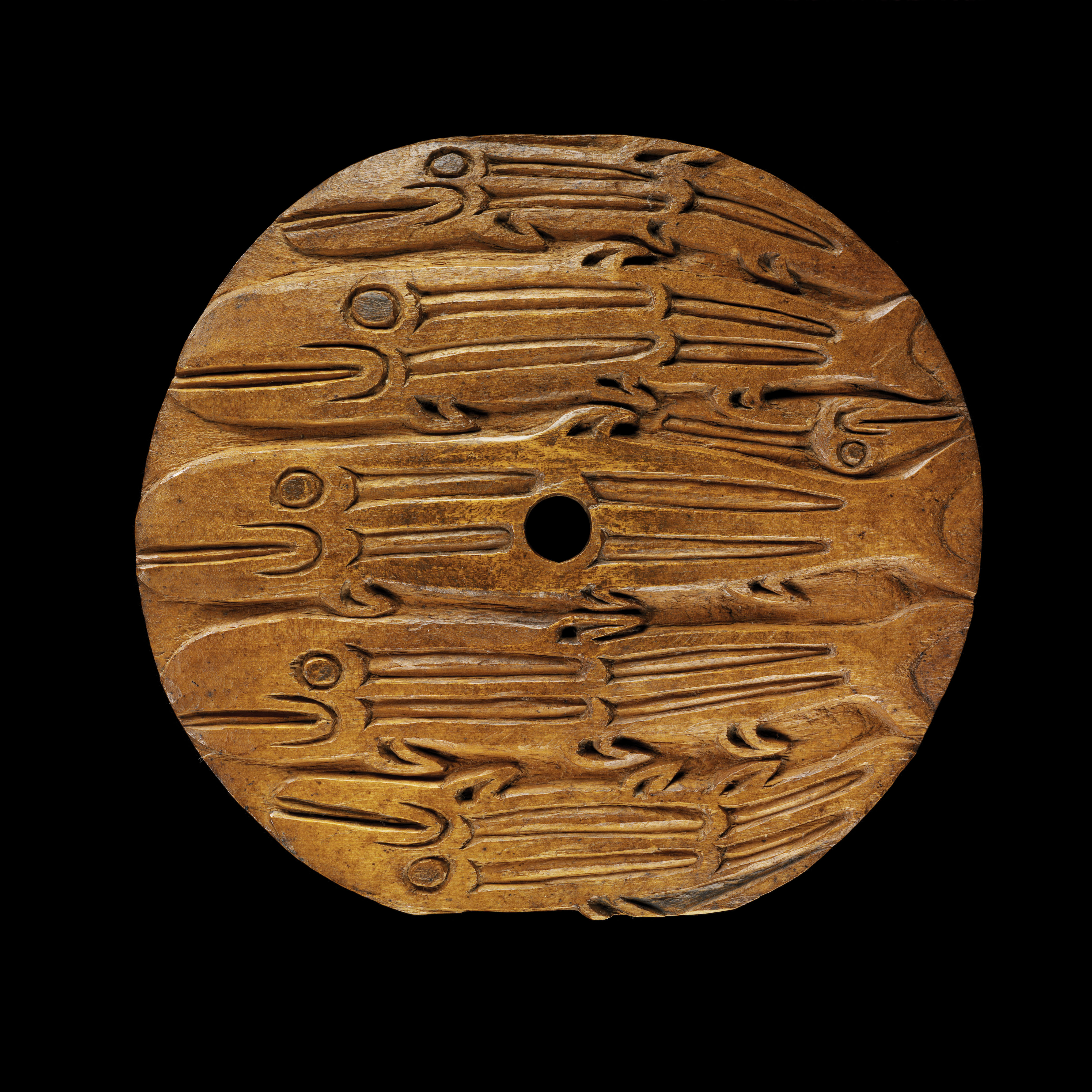
Cowichan Spindle Whorl, ©National Museum of the American Indian, Smithsonian Institution (15/8959)

Cowichan Spindle Whorl, ©National Museum of the American Indian, Smithsonian Institution (15/8959)

These seem to be squirreled away on the website in the “media releases” section at the Smithsonian! It is well worth getting the high-resolution images.  There is one solid, NWC art page here (from where the lovely Cowichan spindle whorl to the left is from)  but additionally here are high resolution pictures of:

an Alutiiq (Koniag) hunter’s hat, ca. 1950  Kodiak Island, Alaska (Spruce root, paint, glass beads, dentalium shells, wool cloth, sea lion whiskers National Museum of the American Indian, Smithsonian Institution Image: 6/9253)

Quinalt woman’s dentalia breastplate ca. 1880 Washington state (Hide, dentalium shells, glass beads, cordage National Museum of the American Indian, Smithsonian Institution Image: 2/7703)

Tlingit Rattle, ca. 1880 Alaska  (Alder or maple wood, hide National Museum of the American Indian, Smithsonian Institution Image: 8/1650AQ)

Raven Steals the Sun (in blown glass! by Preston Singletary (Tlingit) Seattle, Washington, 2003)

Continue reading

Grover Krantz

Dr Krantz, a professor of Anthropology at WASU, was best known in NW Anthropology circles for his Sasquatch research.  The reputation he gained from this unorthodox pursuit followed him to his involvement with the Kennewick Man case.  Now I find out, via John Hawks, that Grover Krantz was “buried” in a drawer at the Smithsonian Institution, along with his dogs.  The Washington Post has an article and jawdropping slideshow of Krantz’s  skeleton mounted and on display at the Smithsonian, along with his dog, Clyde.  (This older article has some nice background and a picture of Grover and Clyde at rest in their usual home).  Is it any wonder  Umatilla eyebrows were raised about his Kennewick involvement and resistance to repatriation of human remains?