Monthly Archives: March 2010

Green cod heads and the case of the missing halibut

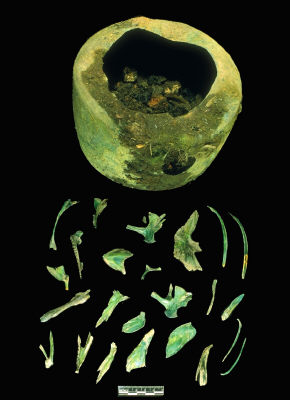
Copper kettle full of cod heads. Source: Alaska OHA.

I was feeling sick yesterday and this picture didn’t help: from the Castle Hill excavations at Sitka, Alaska (previously 1, 2) is the nearly complete copper kettle.  Inside, the archaeologists found the green-stained bones from the heads of three codfish (true cods, Gadidae, are 35% of the fish assemblage).  One of the great things about archaeology is to get these tiny slices of life: someone’s kettle of fish, set aside one day 200 years ago.

At a bigger scale, archaeology isn’t always so straightforward though.  Interestingly, from the site as a whole, only 1% of the fish bones are from halibut (11 bones in total).  This is despite the fact that:

Cod dominated the Castle Hill assemblage, and yet, Emmons (1991:148) stated that cod was considered an unimportant part of the Tlingit diet if salmon and halibut were available. Historic records confirm that cod was popular in Sitka, because it was available almost year around (Gibson 1976:40, Khlebnikov 1994). Halibut was also popular because of its year around availability and was sold to the Russians in large numbers. Between 22,000 and 138,000 pounds of halibut were purchased each year from the Tlingit from 1846 to 1866 in addition to the yearly average of 13,000 pounds of halibut the company procured itself (Gibson 1987:94). The emphasis on halibut brought to Sitka and sold to the Russian-American Company would lead to the prediction that halibut should dominate the assemblage, yet this is not the case. It may be a case where cod were readily available and not worthy of special consideration in historic documents.

Two things strike me about this.  One is that the Tlingit, using largely traditional methods at the time, were able to produce up to 138,000 pounds of excess halibut for trading purposes.  That’s a lot of fish.  The other is that so much halibut renders down to so few bones.  Halibut is long known on the NW Coast as being strongly under-represented in archaeological sites, probably because it may have been butchered on the beach and the bones, which separate cleanly from the meat, would end up in the intertidal zone and be washed away or eaten by dogs.  It also seems possible  that the Tlingit were trading in dried, boneless halibut (which makes the tonnage involved all the more impressive).  And certainly the entire site was not excavated, so there may be a mother lode of halibut bones somewhere.  But this case makes an interesting cautionary tale in zooarchaeology: we seldom have an accurate sense of the scale of the incoming fish quantities to compare to what is left in the ground, and when we do, the degree of difference between the written and material records is often quite startling!

Tlingit women and children cleaning fish on the beach, ca. 1907. Ignore the racist caption. Source: U. Washington.
Squamish and Lil’wat Cultural Journey

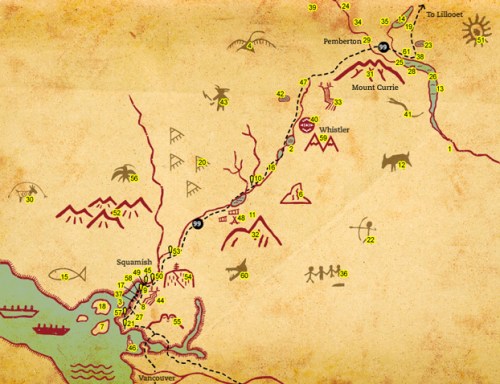
Squamish Lil’wat Cultural Journeys Map. Click to go to the site.

The Squamish and Lil’wat First Nations have jointly produced a really nice website which explores the cultural landscape of their traditional territories, which lie just north of Vancouver. Edit: it looks like their website now sells kitchen products – obviously they did not keep their registration up to date.

The interactive map has dozens of “clickable” elements, taking you to place name information, to the description of rock art motifs, and to landscape features imbued with stories from history and the supernatural.  Some of these include simple but effective animations, and the overall site design is clean and harmonious.

It seems that seven highway pullouts have also been designed with this information: aboriginal cultural tourism out on the land is something I have long thought has enormous potential in B.C.  Looking at a book or a website is one thing, but having the information available, provided by the First Nations, at the place where the story happened or the traditional use occurred, seems like it would be very effective, and popular, way of educating the public about the thousands of years of cultural history on either side of the Olympics.

Supernatural serpent emerging from Ts’zil (Mt. Currie). Screenshot from culturaljourney.ca

Two Views of Double-Headed Eagles

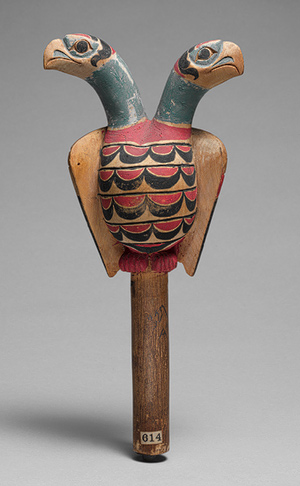
19th century Tlingit double-headed eagle rattle. Source: Metropolitan Museum

The image above is of a Tlingit rattle, with the motif of a double-headed eagle.  With the vast repertoire of supernatural beings who could be invoked in the Northwest Coast art, one could be forgiven for thinking this was another of these figures from the rich mythology and history of the Tlingit people.

In fact, this Tlingit rattle is undoubtedly based on the Imperial Russian coat of arms.  As I noted yesterday, the Russians were the earliest Europeans into many parts of Alaska.   After the Russian-Tlingit Battle of Sitka in 1804, peace talks were conducted and Aleksandr Baranov, the first governor  of colonial Russian Alaska and manager of the Russian-America Company, presented the Kiks.adi Sitka Tlingit leaders with a large medallion, on which was found the Russian imperial symbol (below).

Tlingit accounts of the treaty have been presented by Alex Andrews and Mark Jacobs, Jr. In a transcribed interview, Alex Andrews (1960:6-7) explains that the Indians did not know the value of the plaque presented by the Russians, and it was believed to be a retribution or atonement for the dead. He further stated that Baranov came to Peril Straights to negotiate the treaty. Mark Jacobs account of the treaty was related in a speech at the Second Russian-American Conference in 1987:

It was finally decided by the Kiks.adi’s to return and sit down for the peace talks. It was at this peace treaty that the present Castle Hill was given to Baranov in exchange for a double-headed eagle badge, which is depicted on the totem pole [in Totem Square, Sitka]. It was explained to mean, “From now on and forever, we will be brothers. You look one way and we the other way.” The round knob on the bottom of the totem pole represents Castle Hill. The only piece of real estate ever given to the Russians [emphasis in original document]… The double-headed eagle badge, received from the peace talks, is now in the State of Alaska Museum in Juneau [Jacobs 1987:9].

Since that time, the double-headed eagle has been a  motif widely used in Tlingit art.

I like to think that the Russians did not fully know what they were doing.  Early treaties commonly took advantage of very different indigenous views on the nature of property and land ownership  in order to dispossess people of their land under the fig leaf of western law.  In this case though, I wonder if the shoe is not on the other foot.  Crests were inherited rights on much of the Northwest Coast, yet they could also be traded or shared or given away.  The right to display a Crest was a valuable property right that helped establish a lineage’s relative status.

By acquiring the Crest of the Imperial Russian lineage as compensation for their dead, the Tlingit Chiefs may have in effect subordinated the entire Russian aristocracy: a stunning coup in Tlingit terms.  The Russians may never have noticed that they had become Lesser Chiefs in their own colony.

Imperial Russian medallion presented by Baranov to Sitka chiefs in 1804. Source: Juneau Empire.

The top image is from the small but sweet exhibition of NW Coast musical instruments at the Metropolitan Museum of Art.