Tag Archives: CRM

Tse-whit-zen interactive pages and slide show

Whale vertebrae modified into a spindle whorl, from the Tse-whit-zen site. Source: Seattle Times

I mentioned the Tse-whit-zen site a few days ago, in reference to the recent discovery of a small whale sculpture found there in 2009.  The Seattle Times had a superb web site on this ancient Klallam village, but unfortunately, many of the links are broken (how does that even happen, anyway?).  But the four part illustrated slide show with extensive audio commentary by Klallam, archaeologists and other people is still available and is well worth watching – in fact its one of the best such slideshows I’ve seen.  The Interactive Village component of the site is still active as well, and also definitely worth checking out.

As with so many of these sad stories of site disturbance through development, there is a silver lining as the dig itself, and the objects found, have contributed to a vitalization of Klallam traditional practices and increased interest in Klallam traditional culture within their younger generation.  At a severe price, though: over three hundred burials were excavated and removed from the site before the project, a massive graving dock, was brought to a halt – a halt which, according to some, cost over 100 million dollars.  I’m posting some of the pictures in case the Times site loses even more functionality.

Comb recovered from Tse-whit-zen site. Source: Seattle Times.

One of the more than 800 remarkable etched stones found at Tse-whit-zen, some in association with human remains. Source: Seattle Times

More than 300 human burials were disturbed by the graving dock project. Here, some await reburial in a warehouse on site. Source: Seattle Times.

Lousy conservation at the Vancouver Museum?

Shoddy conservation of magnificent petroglyph boulder at the Vancouver Museum. Screenshot from VM website.

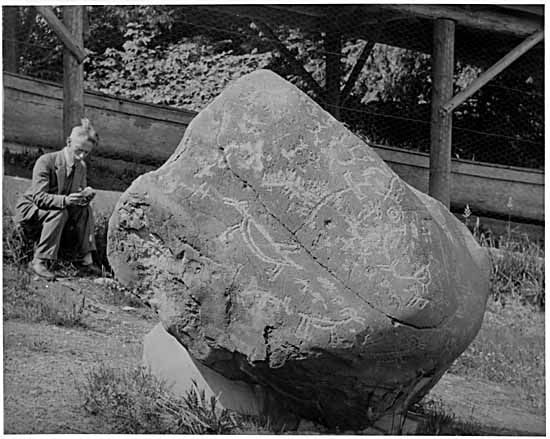
For some reason mistreatment of rock art just makes me spitting mad.  I posted the other day about a magnificent petroglyph boulder that was removed from its home on the central Fraser River near Lillooet in 1926.  Bad enough that this work of art was ripped from its setting to be a curio in an urban park.  Petroglyphs are not ornaments for your outdoor rock garden any more than they are lifestyle amenities deployed as advertising copy, even if you are a museum.

Now my spies tell me that this petroglyph boulder was moved to the Vancouver Museum in 1992.  Pictures of the boulder on the VM website show it to be in absolutely appalling shape.  It is covered with moss, the designs are visibly eroded and faint, there are signs of exfoliation, and the large crack seen in 1926 seems to be getting larger.   The Vancouver Museum appears to be keeping this treasure in a damp, shady, spot in the outdoors (as they say, it is in a “lower level garden courtyard”) and there is no sign of any attention to basic, fundamental conservation responsibilities. They even have the gall to note in their website description “Today archaeologists are reluctant to reveal the locations of petrogylphs, lest they be disturbed.”  Well I am revealing the location of this petroglyph, which is being disturbed by careless curation!

Seriously: this boulder is one of only a few petroglyphs from that part of the province, where pictographs are much more common.  It was in pristine condition in 1926.  Now it is a moss-ridden crumbling mess.  This boulder is a cultural masterpiece.  It is a provincial treasure.  It is a national treasure.  It is of international significance.  And yet it is being absolutely neglected by a leading cultural institution.  Imagine an Emily Carr painting being treated so poorly.  Imagine a Bill Reid sculpture  treated so shabbily.  It would never happen.  Yet this boulder is as important, is MORE important, and is consigned to rot away metres from state of the art curatorial facilities which are being devoted to white leather pant suits (!!).  It is astonishing to me that they put this boulder on the web at all, suggesting that they don’t see a problem and are therefore unworthy to be in possession of it.  They should make arrangements immediately to have it transferred to a suitable institution or have it returned to its original setting, in what I take to be St’at’imc territory

Vancouver Museum, you have a responsibility of professional stewardship.  Are you living up to it?

Note the eroded engravings and extensive moss/algae cover. Source: VM website screenshot.

The boulder in the early 1930s, soon after it was brought to Stanley Park. Note the crispness of the designs and the lack of moss.

Capital Regional District Report

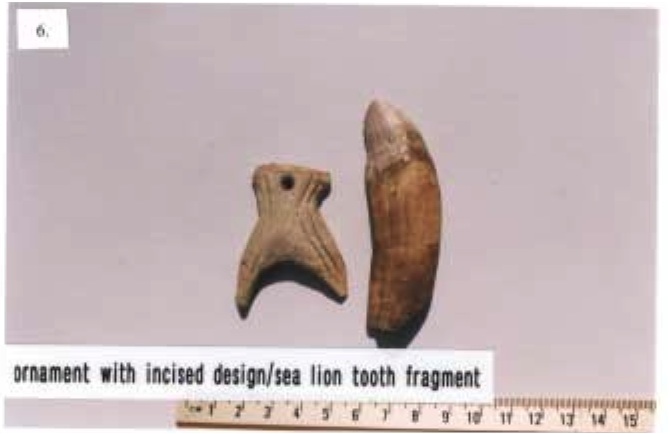
Decorated antler?, and a worked sea lion tooth from the Elchuk collection, Mill Hill.

I just came across this interesting document from 1999 by Liz Crocker (PDF) which is a cultural history of three CRD Parks: Mill Hill, Francis/King and Thetis Lake.  While I wouldn’t put a lot of stock in the archaeological component of this report, there are at least two notations of considerable interest.

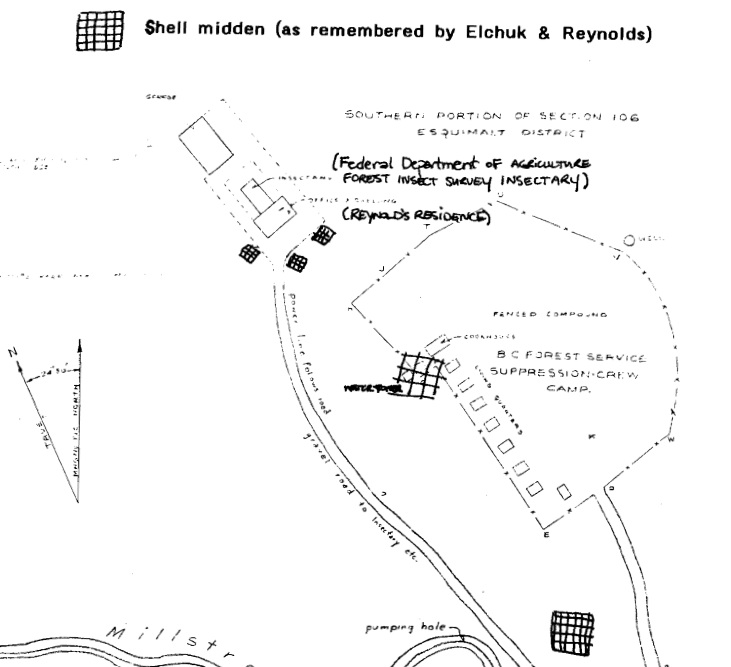
The first is the documentation of an unrecorded shell midden at Mill Hill, not DcRu-70 but another site, including a sketch map of the location which is about 2 to 3 kilometres inland.  There are also reports of unrecorded inland shell middens at Thetis Lake Park. Since such sites are rare and poorly know,  then this is something worth following up.  Indeed, I wish the CRD took their stewardship role seriously enough to commission an intensive, comprehensive, and professional inventory of the archaeological heritage of all their Parks.  This kind of baseline information is so essential that I honestly don’t understand how they think they can discharge their duties without it.

The other point of interest in Crocker’s report is the documentation of a fairly large private collection, also from Mill Hill and also well inland.  Included in this collection are Locarno-style artifacts as well as more recent ones such as a flat-topped handmaul.  Appendix 2 of the linked report includes some snapshots  of this collection.  Despite the poor quality, it is great to see private collections being documented.  The small decorative piece shown above is interesting and unusual, and the abundance of organic remains suggests again that these were collected from or near a shell midden.  Again, something to follow up. If only there were a Ph.D. student at UVIC, say, who was interested in inland shell middens…..

Sketch map of reported but unrecorded inland shell midden patches at Mill Hill.

Victoria-Songhees reburial

Mayor Fortin builds a bridge to the Songhees First Nation. Picture: Johnstonstreetbridge.org

Last summer there was a sad incident with human remains being disturbed in the Dallas Road area of Victoria. The remains, of a young SLENI (woman) were subsequently reburied and since then a burning ceremony has been held.  I’ve been privileged to attend burning and reburial ceremonies and they are powerful and sincere events.  Interesting then to see this news snippet today , focusing on the cost ($9,400) — I can hardly wait for the informed and balanced commentary to ensue.  But kudos to Dean Fortin for doing the right thing – it is no more (or less) than most developers have done over the last decade when human remains were disturbed.  I have to say, though, it is disingenous for Mayor Fortin to note the Songhees reserve is not in the City of Victoria — memo to the Mayor: Victoria is within Songhees territory; the remains are from Songhees territory, the current reserve boundaries are completely irrelevant to this issue.

Victoria News

The cost of being freindly [sic]

By Lisa Weighton – Victoria News

Published: January 11, 2010 3:00 PM

Updated: January 11, 2010 3:34 PM

Mayor Dean Fortin is making First Nations relations a priority.

Last month, the city invested $9,400 in a traditional reburial ceremony after discovering 300-year-old human bones during a sewer retrenching project on Dallas Road, Aug. 27.

“We feel like we have an obligation to work with all other levels of government including our First Nations,” said Fortin.

The cost was a drop in the bucket in the overall $2.4 million-project said Derk Wevers, the city’s sewer and storm water quality technician.

Following consultation with Esquimalt First Nation elder Mary Anne Thomas and Songhees First Nation elder Elmer George, a reburial service was held Dec. 8.

The city also financed a traditional burning ceremony and feast on the Songhees First Nation reserve late last month, which included wages for a city contractor, gifts, food and the gravestone.

Fortin said he was eager to take part despite the reserve not being within Victoria’s boundaries.

State Underwater Archaeology Overviews

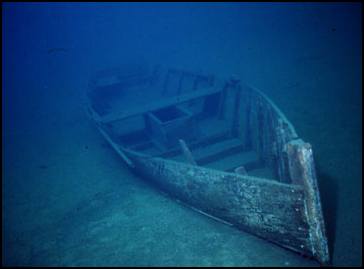
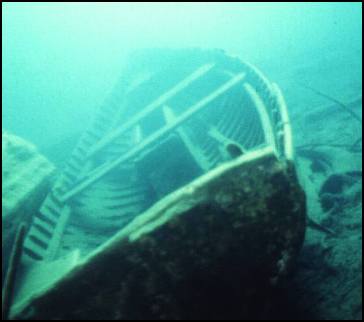
Part of a sunken fleet of recreational dories, Emerald Bay, California.

The US National Parks Service has a useful page summarizing policies and laws regarding “submerged resources” – which includes underwater archaeological sites.  The sections most of interest to the six readers of this blog are probably the pages on Washington State, Alaska, Oregon and California — though the fact that Idaho has a page is, at least, surprising until you remember the importance of paddle-wheelers in the earlier interior historical period all over the west.

Another Emerald Bay dory. Source: http://www.parks.ca.gov/default.asp?page_id=22707

Speaking of Wilson Duff and Bill Reid

Roy Jones of Skidegate climbs a pole at SGang Gwaay. Source: CBC.

Yesterday I noted the upcoming musical about the Bill Reid-Wilson Duff expedition to “rescue” carved poles at the Haida Village of SGang Gwaay (Ninstints).  I’ve just found that the CBC has posted online a short documentary, (2013:edit, use this link)  first broadcast in 1959 and narrated by Bill Reid, showing the removal of these poles to the Museum of Anthropology at UVIC.  The expedition also included Wayne Suttles and Michael Kew, as well as Wilson Duff of course.  The Haida crew consisted of Roy Jones, Clarence Jones and Frank Jones of Skidegate. Some aspects of the trip are recounted in the BC Provincial Museum Annual Report of 1957, which I will scan and post some other day.

The spoken component of the documentary is a fascinating account by Reid, at that time just beginning his carving career, but the real jaw-dropping element is the depiction of the use of axes and saws and climbing spikes to log this forest of poles.  Necessary, of course, but jarring nonetheless.

Broadcast Date: May 21, 1959

A small boat ferrying Bill Reid and a team of anthropologists approaches the southern tip of the Queen Charlotte Islands. Reid documents the rescue mission to salvage and relocate the last of the crumbling Haida totems as revealed in this CBC documentary. With a sense of excited urgency, Reid describes and catalogues the enormous poles on the approaching shore. As they are gently felled, the majestic cultural landmarks will creak and groan before they are prepared for transport.

It’s low resolution and grainy, but the general impression is a very powerful one.

Felling a tree, surely, not a pole at SGang Gwaay. Source: CBC.

Somenos Creek: Update 2

CHEK-TV video clip on the Somenos Creek archaeological situation. Click to play.

Someone passed along this CHEK-TV news item showing George Schmidt of TimberCrest Estates, Ltd., the development company wishing to put houses on top of a major archaeological site in the Cowichan Valley at Somenos Creek, which I’ve written about before: 1, 2.

Listen to the favourable treatment he gets from the newscaster. Loaded language like “In limbo”. “Pony Up”.

Hey, CHEK-TV, since you’re the voice of the people now and all that and also “journalists”, how about you dig around in the zoning history of the land before you just repeat the mantra “government must pay”.  Did the developer buy this land already zoned for residential development?  How much did he pay in 1972?  Does he deserve compensation for having a risk turn out the wrong way for him?  Does he have the right to destroy a cemetery?  Is he, in fact, losing anything that he already had, or is he losing a perceived entitlement?  He took a risk, he has gained mightily, and now he wants a slice of the First Nation’s pie as well.

I’d seriously suggest CHEK-TV also looks into the $500,000 amount he claims to have spent on archaeology at Somenos Creek.  From what little I know of the site, I am very skeptical about that figure.

Truly, there needs to be a mechanism by which true hardship cases of conflict between development and archaeology, or where the impact assessment process has failed, can be resolved.  That, indeed, may mean some government financial input.  But these should be reserved for instances where other options have run out and where there is demonstrable financial hardship.  This case does not pass the smell test – vast profits have assuredly been made and now legal and moral constrains are drawing a line under this development.

I say this company should stop going cap in hand to the government and just give the land up as a heritage park in return for a tax receipt.  Unless I am mistaken, most entrepreneurs are not socialists, and I  am sure the last thing the typical developer would want is to be perceived as a corporate welfare bum.

Somenos Creek: Update

Somenos Creek site. Picture this with 20 houses on it. Photo credit: anonymous.

Further to my post below, here is another news item on the Somenos Creek (Cowichan Valley) situation.  It mostly rehashes the Times-Colonist piece but does have new comments from Eric and from the developer, notably:

Schmidt, who has tried but failed to have the six-acre site, known as Lot B, rezoned for development, said it would be worth up to $3 million if it weren’t for the presence of the artifacts and burial site.

Timbercrest has built about 300 homes on the land so far and would like to put up another 20 on Lot B.

So, lets see 20/300 = 6.7% of the 100 acres.  The 100 acres was bought in the 1970s.  I am going to go out on a limb and suggest that much less than 1 million was paid for the 100 acres back then.  The current valuation of these six acres would value the entire parcel at 45 million.  Let’s halve that:m 22 million.

So this developer has turned a one million dollar piece of land into a 20 million dollar piece of land.  A 2000% return.  And he wants financial consideration and compensation from the public because he happens to have a legally-protected (and morally protected, I might add) site of the highest archaeological significance on the residual piece?

This is the 21st century: Greed is no longer good, Timbercrest Estates Ltd.  Give the land up, get a tax writeoff, and count your blessings you live in a country that is so extremely friendly to rampant development of land, enabling fortunes to to be made.

Heather Pringle: Dogs for the Dead

Smell a corpse, not smell like one, Arbuthnot.

B.C.’s own Heather Pringle has a new blog these days, and her recent post on the use of forensic dogs to detect archaeological sites and human remains in particular, in Washington State, is worth a read:

According to the staff at the Institute for Canine Forensics, dogs can smell human remains that are buried as much as nine feet below the surface.  And they can detect remains as old as 2000 years.  ”Human remains have a scent that never,  ever goes away,  especially a bone,  even after it dries out,” one of the institute’s staff members told The Peninsula Daily News.

Somenos Creek CRM

Diagonal exposure of apparent 2000 BP house at Somenos Creek.

I don’t know too much about the Somenos Creek development in the Cowichan Valley which is discussed in this column in the Times-Colonist:

The North Cowichan story goes back to 1972, when Schmidt was among the developers who bought 100 acres of farmland. About 300 homes eventually arose on what became Timbercrest Estates. Not developed was a six-acre piece where human remains were found in 1992, and where archeological investigations later turned up a feature — a hearth, perhaps, or a house foundation — dating back to the time of Christ.

The Cowichan Tribes think there’s more to be found, that it is important to preserve all six acres, perhaps use it for educational purposes, but Schmidt thinks a dozen houses can be built around the perimeter of the area of proven archeological significance. The natives’ hope now is that government will recognize the importance of the property and buy it, an idea they pitched to cabinet minister Kevin Krueger last week. His reaction? “It wasn’t negative, so I think that’s positive,” says Cowichan Tribes lands-research director Diane Hinkley.

Krueger says there isn’t money to buy such lands outright, but he wants to see what can be done to work things out.

For his part, Schmidt just wants to be done, one way or the other. Either the province or Ottawa buys the land, or he applies for a development permit. “I’m into it too deep to just let the land sit there.”

One of the researchers sent me a copy of the report, and there is a fairly compelling set of features unusual in (a) being inland (b) including an inland shell midden component and (c) including a large subsurface sub-rectangular, sharply defined feature which appears to be the remains of a house dating to ca. 2100 BP.  This makes the site of unusually high archaeological significance – not to mention there are numerous human burials (analysed in Doug Brown’s MA thesis) and extensive archaeological deposits of other kinds.  The house feature is remarkably similar to a contemporaneous feature I saw being excavated a few years back at Esquimalt Lagoon.  We know very little about houses from this period, particularly houses found in inland contexts.  What is striking about the newspaper column above is that it reports the developer has managed to put houses onto 94 of 100 acres, and is now champing at the bit to develop, or be compensated for, the last 6 acres.  I mean, seriously, George Schmidt of Timbercrest Estates, you have achieved 94% of the development you sought.  How about leaving the burial ground alone?  You bought the land in the 1970s.  Surely you have made your money back many many times over. A donation of this small parcel as a heritage park would be a classy move.

Somenos house? feature

Somenos feature - note sharpness of vertical section indicating probable use of plank retaining.