Tag Archives: clovis

Puget Sound Clovis

In Red: Surface Finds of Clovis Projectile Points. After Croes et al. 2008.

I posted yesterday about the Manis Mastodon site and its possible status as a pre-Clovis site on the Olympic Peninsula.  Clovis projectile points are so distinctive that most archaeologists have no problem assigning even an isolated find of such a point, lacking in any kind of stratigraphic context or any associated dates, to the Clovis archaeological culture.  We know from sites elsewhere in North America that Clovis dates to a pretty narrow window, perhaps only 13,200 to 12,800 calendar years ago.  It has always been very closely associated with the ice-free corridor route for the First Peopling of the Americas and is predominantly known from classic sites in places like Colorado, New Mexico and Texas. So it may come as a surprise to some that Clovis is pretty well represented in Puget Sound and north to Bellingham Bay, although only from surface or other finds without provenience.

Continue reading

Yank that sucker out!

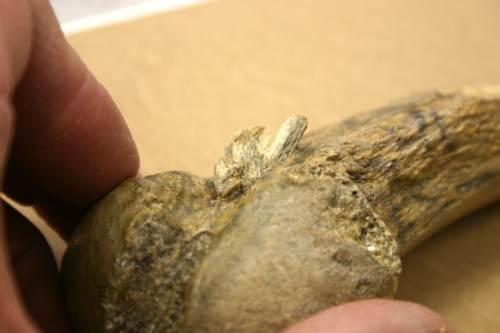
Mastodon rib from Manis site, showing protruding end of an intrusive object. Source: CSFA

The Manis Mastodon site near Sequim on the Olympic Peninsula (map) is one of the great enigmas of Northwest Coast archaeology.  The site has been known since the 1970s and is purportedly a Mastodon kill-butchery site.  With radiocarbon dates (on plant material associated with extinct mastodon) of 13,500 to 13,900 calendar years ago, the site is clearly pre-Clovis.  As a pre-Clovis site on the Northwest Coast, Manis  should be of comparable stature to, say, the Clovis-killer Monte Verde site in Chile, which dates to about 14,500 calendar years ago.

Doubts remain about this site, though, mainly because it is not yet completely reported.  A preliminary report by Gustafson et al. in the Canadian Journal of Archaeology (which I don’t have handy — hey CAA, I know you sell CDs of your back issues, so how hard can it be to put them online?) was equivocal about the association of some flake and cobble tools with the skeleton, and while interesting conclusions were drawn about the fragmentary nature of the skeleton, nothing conclusive was resolved.  This is despite one of the clearest possible “smoking guns” one could hope for in archaeology.

Continue reading

Fluted Points from the Bering Land Bridge

Fluted points from the Serpentine Hot Springs Site, Seward Peninsula, Alaska. Source: Bering Land Bridge NPS

For many years, archaeologists considered the so-called “Clovis” Culture to be the remains of the first humans to enter the Americas.  These people were said to come via the Bering Land Bridge, a subcontinental land mass which joins North America to Northeast Asia.  Clovis culture was distinguished by a very characteristic type of stone spear point which had a long flake removed from the base on each side, forming a “flute” which considerably thinned the base of the point. Such fluting was a hallmark of Clovis and another, slightly more recent, culture: Folsom.

Clovis was thought to have arrived into the Americas from the present-day Yukon area through an “ice free corridor”.  However, for many years,  Clovis points and the rest of Clovis culture, were unknown from north of the ice sheets and there was a sustained research agenda to find Clovis, or to find Clovis antecedents, in Yukon, NWT or Alaska.  While the occasional fluted point became known from surface finds, those from solid archaeological context did not.

It is therefore interesting to see a site, Serpentine Hot Springs, has come to light on Alaska’s Seward Peninsula (the bit that sticks out closest to Asia – map) which has revealed numerous fluted points.  Continue reading

Paisley Cave Update

Paisley Cave human coprolite dating older than 14,000 cal BP. Source: PBS.

There is a tantalizing news item in a recent edition of Nature indicating that the team led by Dennis Jenkins has found a bone tool in the old layers at Paisley Cave in southern Oregon.  This cave already returned a number of pre-Clovis dates on human coprolites.  Although there was some vociferous opposition to this finding, a vigorous defence of these feces was mounted and to my mind was effective.  (Note that one of those claiming the human poop is actually camel poop posts a slightly hysterical online comment on this Nature news item.  This charge of excess fibre is dealt with in Gilbert et al’s 2009 rebuttal in Science, which is not mentioned in the Nature comment.  Clearly there is a new generation of data-selective Clovis Police being groomed out east.)

Anyway, this bone tool, which I assume will be published soon, is said in the Nature article to date to 14,230 cal. BP, from which I infer a 14C estimation of about 12,250 – exactly contempraneous with the poop.  According to the article,

The dating of the bone tool, and the finding that the sediments encasing it range from 11,930 to 14,480 years old, might put these questions to rest. “You couldn’t ask for better dated stratigraphy,” Jenkins told the Oregon meeting.

Seeing the tool itself will of course be very interesting and hopefully definitive, as there is a long history of bone pseudo-tools in North American archaeology.  So far this date has only been announced at an unspecified “meeting” and peer reviewed publication will be essential to form a final judgment.

You can watch a PBS news clip on the poop discovery from a link here which gives a good idea of the setting of the cave, and also includes nice footage of Luther Cressman!

Camel astragalus from Paisley Cave. Source: U of Oregon.

Reference:

Dalton, Rex. 2009. Oldest American artefact unearthed: Oregon caves yield evidence of continent’s first inhabitants.  Nature: doi:10.1038/news.2009.1058.

Another snag for “Clovis First”

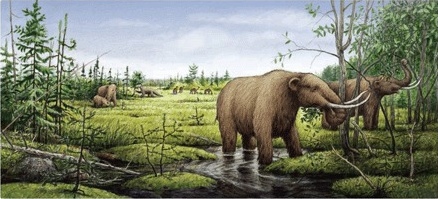
Mastodon! From: Science 20 November 2009

Abundant megafauna are important to the Clovis-First model of the peopling of the Americas because the mechanism for what was considered to be an exceptional event or series of events was overkill of these large, naive, critters .  Overkill led first to localized extirpations (moving the Clovis folks along on a bow-wave of blood) and ultimately to megafaunal extinctions across the hemisphere.

Sad, then, for that particular story and its storytellers, to see recently reported results in Science which track (through samples of dung fungus) a millenium-long decline in mastodon and other megafauna before the arrival of Clovis.  This decline might relate to climate change or to the influence of pre-Clovis humans – it’s too early to say.  But as the graph below shows, the decline set in pre-Clovis at about 14,800 cal B.P., and by the time of Clovis (ca. 13,500 cal B.P.), far from being hyperabundant, herbiferous megafauna seem to have been at a historically low level of population.  Vegetation change (often used to track climate) was a result of this die-back, not the cause of it.   Perhaps this remnant megafauna population was then finished off by Clovis, but that is hardly a bow-wave of blood scenario, but rather a “mopping up” of increasingly scarce game.  Has there ever been as misunderstood an archaeological concoction as the Clovis Culture?

Update: The Guardian has coverage, incongruously illustrated by the RBCM’s life-sized mammoth model.

Reference:

Jacquelyn L. Gill, John W. Williams, Stephen T. Jackson, Katherine B. Lininger, Guy S. Robinson.

Pleistocene Megafaunal Collapse, Novel Plant Communities, and Enhanced Fire Regimes in North America.

Science 20 November 2009: Vol. 326. no. 5956, pp. 1100 – 1103

DOI: 10.1126/science.1179504

Pre-Clovis decline of large herbivores. Source: Science 20 November 2009

Speaking of Clovis

Michael Collins' Licence Plate - Just needs a "pre" fix.

Michael Collins' Licence Plate - Just needs a "pre" fix.

The Gault Site in Texas is a classic Clovis site, though one which awaits full and complete recording.  The site was purchased by old-school Clovis archaeologist Michael Collins to protect it – the previous owners would rent out digging time to pothunters.  Collins  then donated it to an archaeological trust – a stunning example of putting your money close to your mouth!  It has always been on my radar as a big site down in Texas with tons of Clovis stuff but frankly I had never looked into it that closely – other than indirectly through Collins’ excellent studies of Clovis blade technology, and an awareness that it had produced some of the earliest art known in the Americas (2, 3).  Any Clovis site is of interest, not just because Clovis is an unusual archaeological phenomenon, but also because the history of the discipline will see “Clovis First” archaeology as a classic example of a paradigm that got shifted, reluctantly.  And anyone working on the early periods in BC Archaeology is profoundly influenced by Clovis — whether that be the northeastern Ice Free Corridor sites, or on the coast where Clovis ages of 11,000 radiocarbon years ago are a benchmark for first peopling.

So I was interested to learn that there is 400 years of Clovis occupation here — pretty much the whole span of the Clovis Culture as now understood.  That’s not very overkill-and-move-on-ish.  Then I find out the dominant resources at Gault include frogs, small mammals, and turtles — not very big-gam-hunterish.  Now I read the Collins is reporting pre-Clovis deposits at the Gault Site — certainly not very Clovis-Firsty.  As  this article from a local newspaper in Waco states:

The latest evidence to debunk this theory may come from the Gault site. In the dig site now covered by the big white tent, archaeologists took a core sample in 2007 and found something startling: what appear to be manmade stone artifacts that differ from Clovis technology. That could mean Gault was inhabited some 14,500 years ago, Gault School officials said.

“That would be the nail in the coffin of Clovis First,” said Collins, the University of Texas archaeologist who has been the site’s chief excavator.

Collins, 68, said that when he started in archaeology in 1960, almost nobody questioned the Clovis First theory. Collins grew to doubt it, based on new discoveries in Chile and elsewhere, but it took a long time for alternative theories to gain traction in the world of archaeology.

“What I despised most among my colleagues was that they would simply dismiss your argument when they didn’t know anything about it,” he said. “Or they would ignore it.”

Today, the question of the first Americans is a wide-open debate, with scientists such as Collins suggesting Asian and even European colonization by boat between 15,000 and 24,000 years ago.

“When I first started doubting Clovis First a long time ago, maybe 2 percent of professional archaeologists considered the possibility of an earlier date, Collins said. “Now, that number is probably 95 percent.”

Maybe I haven’t been paying attention but, wow.  Gault Site has pre-Clovis and Michael Collins slams the “Clovis Police.  It’s a good day.

Clovis Exceptionalism Craters

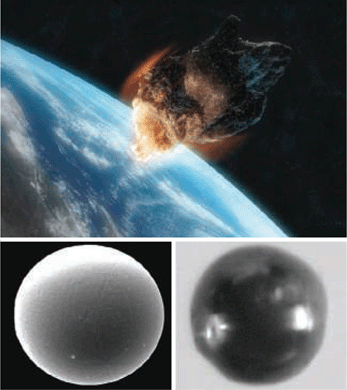
An impactor (top) may have produced magnetic spherules (lower right), but similar spherules (lower left) continually fall from space.

An impactor (top) may have produced magnetic spherules (lower right), but similar spherules (lower left) continually fall from space.

John Hawks has a good writeup about the latest news on the theory put forward a couple of years ago that a comet impacted the Laurentide ice Sheets, overkilling Clovis culture, megafauna, and instigating the Younger Dryas Event to boot.  The new paper by Todd Surovell et al. completely fails to replicate a key bit of support for the theory, namely that magnetic iron spherules, said to be the comet’s smoking gun, were associated with terminal Clovis stratigraphy across the Americas.   Other studies have chipped away at the theory as well. I’m not an expert and it’s hard to judge the state of debate — though as Hawks notes, the paper is unusually unequivocal in its conclusions of ‘no evidence”.

I have to say, I don’t mind seeing more theories of Clovis exceptionalism shot down — it is an unusual archaeological phenomenon to be sure, but it hardly takes white-hot fallout across the Americas to bring it down.  Let’s start looking at Clovis on a more human scale! Enough with the megafaunal overkill models, when the most ubiquitous fauna associated with Clovis are turtles and tortoises.  Enough with the ignoring of plant remains — the Clovis Policemen’s longstanding refusal to accept Monte Verde tells us everything we need to know about their knowledge of ethnobotany.  Enough with the phallocentric failure to look beyond the Clovis Point to see that the rest of lithic Clovis  is pretty much a standard Upper Palaeolithic toolkit.

Smoked mammoth.

Smoked mammoth.

Thinking about that the other day,  I realized that Clovis is (ironically, counter-intuitively) ripe for a post-processualist analysis. Not a critique – an analysis.  Why?  What makes Clovis different is style – widespread projectile point style as a sort of hyperkinetic effort to maintain social cohesion through semiotics, if you like.  When something is so unusual we have to posit its arrival in a river of blood through the parting of a white sea, and then see it off with a rain of fire from heaven, surely it is time to turn it over to the school of archaeology that deals with histories, not generalities.

Surovell TA, Holliday VT, Gingerich JAM, Ketron C, Haynes CV, Jr, Hilman I, Wagner DP, Johnson E, Claeys P. 2009. An independent evaluation of the Younger Dryas extraterrestrial impact hypothesis. Proc Nat Acad Sci USA (early) doi:10.1073/pnas.0907857106 (subscription required)

Annotate This

Surely they could have painted a mammoth on this somewhere.....

Surely they could have painted a mammoth on this somewhere.....

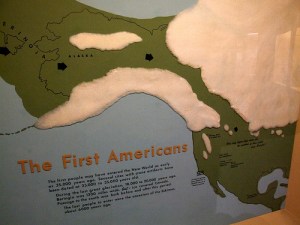
Flickr usr Travis S. does a nice, understated job of annotating this hilarious reconstruction of the “Ice Free corridor” from the Santa Barbara Museum of Natural History.  Click on the image to go to the original.  This picture pretty much sums up the absurdity of the Ice Free corridor — magical parting of the white sea while the coast is socked in under a mile of solid fog.  Funny how such reconstructions were made before serious geological investigation of their truth content, and funnier still how archaeologists just slurped up the ice free corridor as the answer to their need to get the FIRST AMERICANS (nevar forget!)  into Wyoming, well,  first.