Tag Archives: Archaeology

Fieldwork Picture of the Day 9

Danny at the helm,  aaaargh Billy.

Danny at the helm, aaaargh Billy.

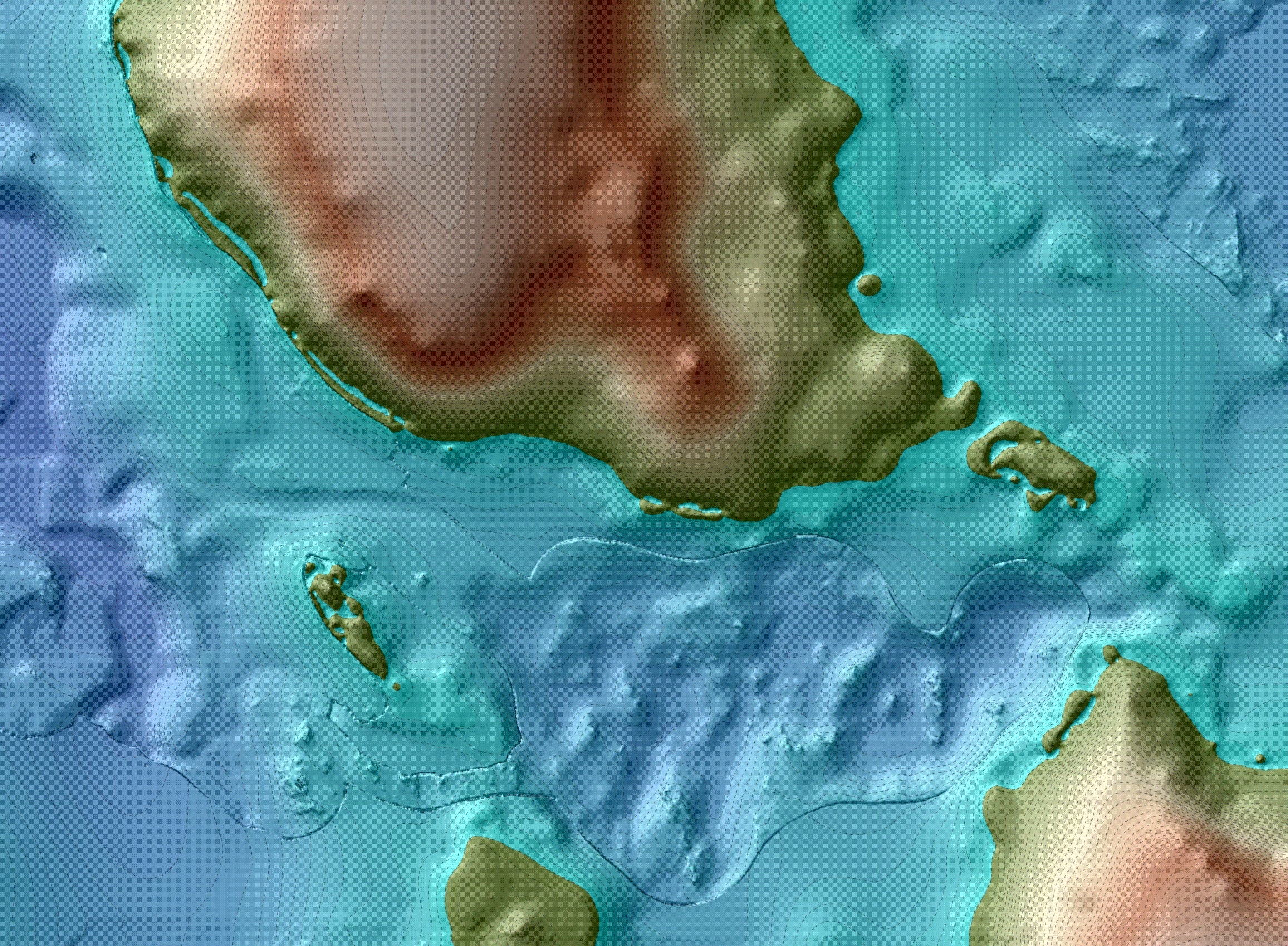
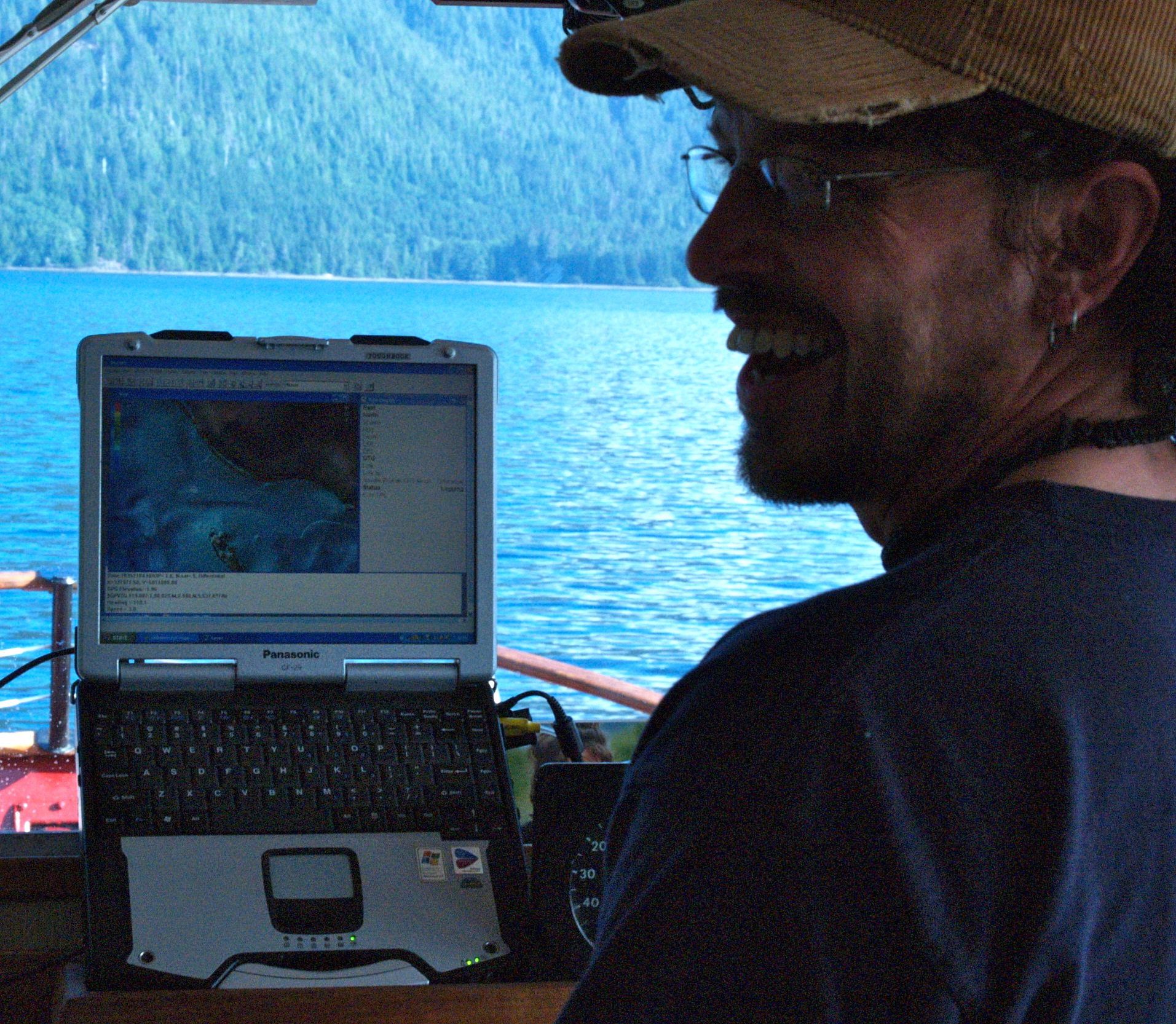
Underwater research at Section Cove, near Gaadu Din. I posted a picture earlier of a diver on the bottom.  Here is a view from topside — Danny, boat skipper, wise-ass and all round rock solid good guy — has a GPS-linked laptop in front of him which is displaying the bathymetry of Section Cove.  (see the image on Danny’s screen here, courtesy of Daryl).  This enables him to tow the sonar fish exactly where required, or, on this occasion, help position a small dredging bucket for bottom sampling purposes.  With differential GPS, you can position the ship to within less than a metre of where you want it, relative to the bottom.  This means measuring the distance between the GPS antenna and the crane and building in an offset, which is trickier than it sounds. The bathymetry is also sub-metre in resolution.  Thus, we can target the bucket exactly where we want it — of course strong currents and bucket flutter can still move it around some.  It has been slow progress on this work but all the pieces are in place for what could be an exciting breakthrough –  a base camp on a small lake, now drowned, dating to sometime older than 11,500 solar years ago would be most welcome considering most of our other sites of this age are rather one-dimensional.

The purpose of the camp could be base camp for bear hunting in the nearby Gaadu Din caves, or more likely sockeye fishing in the lake-stream system that used to flow along the terrain here, under Danny’s  keel.

The lake, the salmon, the cave, the creek.  Green tones are now underwater.

The lake, the salmon, the cave, the creek. Green tones are now underwater. Image prepared by Daryl.

Tla’amin Archaeology

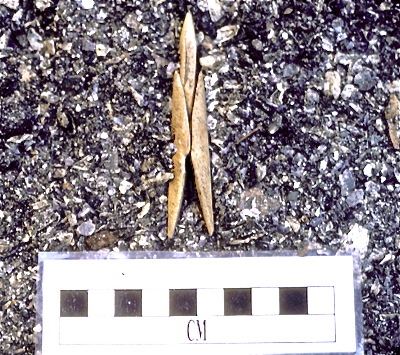
Toggling Composite Harpoon head, articulated in situ.

Toggling Composite Harpoon head, articulated in situ.

The Tla’amin (Sliammon)  First Nation on the Sunshine Coast (map) have been engaged in a wonderful community-based archaeology project with Dana Lepofsky at SFU and her team.  It’s not surprising when you think of what a great person Dana is – brilliant, yet nice, warm, generous. (Hi Dana!)

The website for this project is well worth browsing to see what meaningful partnerships with First Nations looks like.  I think it is a model for the future of BC Archaeology to work together – for then the project becomes not all about the past, but all about the present.  As they say – the past is over; it only exists in the present. Old things exist, but they exist now.   So how can we, as archaeologists, use our particular skills to help communities and the public appreciate the past as a meaningful part of the present, and hence of the future?  This impressive web site shows many great ways how.

Check out this page on Kleh Kwa Num – Scuttle Bay, for example, whih deftly points to the parallel stories of oral history, ethnohistory, and archaeology.  Or, this video of “what happens when an archaeological site is logged?”  As Elsie Paul, a Tl’amin elder says, their ancestral land was hammered for a century and what did aboriginal people get from it?  “Nothing”.  And as Dana says, it became very difficult to find intact archaeological sites around Powell River and the industrial areas, in particular.

These downloadable posters are also really well done, as is their prospectus/report (PDF) – very accessible stuff.   I do wish they didn’t use the silly flash interface for their pictures, though they do allow access to them otherwise – this project is really turning archaeology on its head!

Upside Down Archaeology in Tla'amin Territory.

Upside Down Archaeology in Tla'amin Territory.

Erik the Lost

Erik the Lost

More berzerkness up-island

This site contains an inspired argument that Viking Vinland, Markland and Helluland were on the NW Coast. It’s thought-through to a scary degree, in the way that magnificent obsessions often are.  Though as I always say, if something isn’t worth doing, it isn’t worth doing well. And based on my acquaintance with NW Coast Archaeology, I have to say that the theory falls down at a few key junctures.  Worse, it is part of a long-running narrative in which aboriginal people of the Americas have their finest cultural achievements taken and assigned as the work of Europeans.  See, for example, the Vikings in Minnesota theories, which argue that the great mounds of Mississippian Culture were the construction of White Men from the North.   Do the Minnesota proponents have academic arguments with the Vancouver Island proponents?  Were Vikings everywhere?  Is this a racist narrative?   Too bad all this energy is not put into something worthwhile, there is so much serious work to do.

Harpoon Head from the Hunterian

I have to say, I disagree with your description.  Based on size alone, at 14 cm this is much too large to have been for salmon fishing.  Stylistically, fish harpoons tend not to have a blade bed, but rather some kind of cylinder formed by the two valves.  Flat beds such as this one are more consistent with large arming points made of ground slate or ground mussel shell.  If intended for a fish, this would be more suitable for Fraser River sturgeon, say.
But I doubt it.  I’d suggest in size and manufacture this is much more consistent with a sea mammal harpoon head.  I don’t recall seeing any of this size in Coast Salish archaeological sites.  If your provenance traces to Laskey and thus to Cook, I’d suggest it is much more likely to be from the Nuu-chah-nulth (Nootka) area of western Vancouver Island, where Cook occupied himself much of the time he spent on the NW Coast proper, and with which it is stylistically consistent.  Indeed, even without provenance that is where I would assign it.  And I would suggest in size and manufacture it is more likely to be a large sea mammal – probably whale – harpoon head of a kind we describe out here as “Composite Toggling Harpoons”, composed of two valves forming the barbs with an allowance (usually) for an inset arming point.  Something like a sea lion harpoon I would expect to be about 2/3 of this size.   Further, Cook never really had much interaction with Coast Salish groups.
Normally too I would expect the valves on one of this size to be made of antler or of wood (yew, or Douglas fir) and not bone so that is an interesting difference.
Anyway, all this is by way of saying, it appears the lanyard extends up one side, then crosses through the notch (blade bed) to the other side where it fastens.  I’d be interested in knowing if this is the case since it would be an interesting functional design aspect encouraging the harpoon head to toggle when pressure is put on the lanyard.  If you had higher resolution pictures I would love to see them.
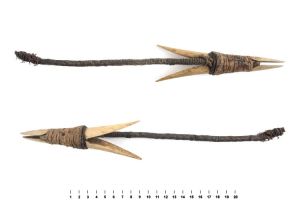
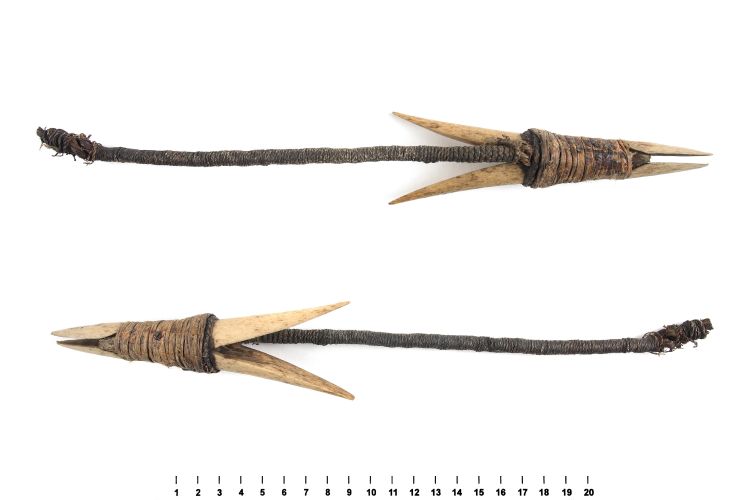
Composite Toggling Harpoon with lanyard.

Composite Toggling Harpoon with lanyard.

This item from the Hunterian Museum in Glasgow traces its provenance provisionally to Captain Cook:

This harpoon head has one large split point, with a curved split socket with pointed tips. It has twisted sinew lashing around the middle and a line of vegetable fibre attached. This type of harpoon would have been used to catch salmon and is stylistically attributable to the Salish people of the North West Coast of America. The harpoon was originally accessioned as donated by Dr. G. Turner, however there are no items from the North West Coast on the 1860 donation list. It may be one of the hooks mentioned by Captain John Laskey in his 1813 account of the museum, in which case it may have been collected on one of the three Pacific voyages of Captain James Cook.

I have to say, I disagree with the description. Based on size alone, at 14 cm for the head, this is much too large to have been for salmon fishing. Stylistically, fish harpoons tend not to have a blade bed, but rather some kind of groove formed by the two valves which supports a cylindrical bone point.  Flat beds such as this one are more consistent with large arming points made of ground slate or ground mussel shell. If intended for a fish, this would be more suitable for Fraser River sturgeon, say.

But I doubt it. I’d suggest in size and manufacture this is much more consistent with a sea mammal harpoon head. I don’t recall seeing any of this size in Coast Salish archaeological sites. If the provenance traces to Laskey and thus to Cook, I’d suggest it is much more likely to be from the Nuu-chah-nulth (Nootka) area of western Vancouver Island, where Cook occupied himself much of the time he spent on the NW Coast proper, and with which it is stylistically consistent. Indeed, even without provenance that is where I would assign it.

And I would suggest in size and manufacture it is more likely to be a large sea mammal – probably whale – harpoon head of a kind we describe out here as “Composite Toggling Harpoons”, composed of two valves forming the barbs with an allowance (usually) for an inset arming point. Something like a sea lion harpoon I would expect to be about 2/3 of this size. Further, Cook never really had much interaction with Coast Salish groups.  These harpoons work by an analogous process to the toggles on a duffel coat: insert the toogle narrow-ways, then it turns side-ways and won’t pull through the loop.  For toggle, read “vicious harpoon” and for loop, read “flesh”.  Because most maritime hunting and fishing technologies require immobilization of the prey and retrieval, the technology tends to quite a bit more complex and intricate and well-engineered than terrestrial hunting technology which is more single purpose (kill!).  The composite harpoons are a great example of this.

Normally too I would expect the valves on one of this size to be made of antler or of wood (yew, or Douglas fir) and not land mammal bone so if these valves are land mammal that is an interesting difference.

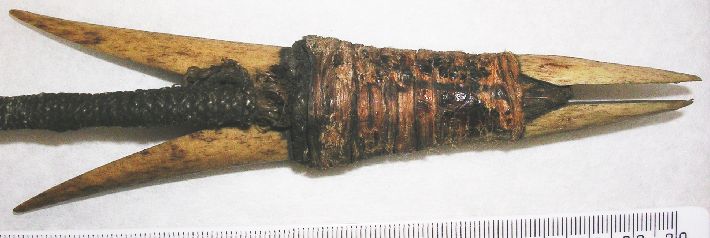
Anyway, all this is by way of saying, it appears the lanyard extends up one side, then crosses through the notch (blade bed) to the other side where it fastens. This would be an interesting functional design aspect encouraging the harpoon head to toggle when tension  is put on the lanyard.  (I emailed the Hunterian to see what they think)
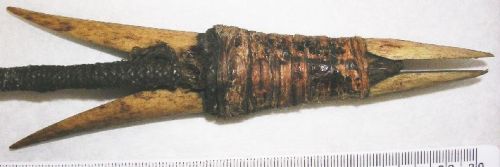
What is that organic matter between the valves? The lanyard?

What is that organic matter between the valves? The lanyard?

dSpace: Labrets by Marina La Salle

Tlingit Woman with Labret, Yakutat 1837

Tlingit Woman with Labret, Yakutat 1837

Labrets, decorative inserts worn in the lip, are an extraordinary artifact type.  It is hard to think of a more intimate or personal artifact, or at least, one that is routinely found.  Further, archaeologists have seized on labrets as status markers and routinely use them for interpretive ends.  Indeed, they are seen as a sign of “achieved status”, since one could (in theory) start wearing a labret at any age, and this has been contrasted with cranial head deformation, which must be initiated in infancy.  This distinction has been claimed to characterize the Locarno Beach to Marpole transition about 2000 years ago in the Salish Sea, for example.   And yet, for all the talk about them, they have languished through the years with only small reports and descriptive accounts of small collections given (an exception after a fashion is Grant Keddie’s catalogue of them downloadable here).  So it is very welcome to see a 2008 UBC MA thesis on labrets by Marina La Salle (4 meg PDF; click on “view/open” near the bottom of the page).  Moreover, this is a thesis which treats them with a suitable dose of social theory and strives for subtlety and nuance vs. the  over-determination of status so often seen in NW Coast Archaeology..

From La Salle 2008 MA Thesis

From La Salle 2008 MA Thesis

Apart from some solid work on their metric dimensions, typology, and a documentation of the astonishing variety of raw materials used to make labrets, there is also welcome and innovative discussion of identity formation and the negotiation of status as active, cultural processes.  This contrasts with earlier studies or casual reference to labrets as simplistic and unambiguous markers of status, worn non-problematically and being basically a badge of identification vs. a negotiable brand.  I wish La Salle had done a few small things, such as always give the artifact numbers in figures and table, and give repositories where possible (follow up work is made so much easier), and her colourful tables are entirely inscrutable, but I credit her very much with taking a fresh approach to an important, perhaps crucial artifact type.  She has a lot to say and I sense a certain frustration (or maybe this is just projection) with UBC’s restrictive 50 page limit on MA theses.  This thesis checks in at over 200 pages anyway, but a limited space for discussion of a lot of data.  Does this mean that MA students now produce more data than they can use and is this a kind of serfdom?  Discuss.

Pickford on Excavation of “Indian Middens”

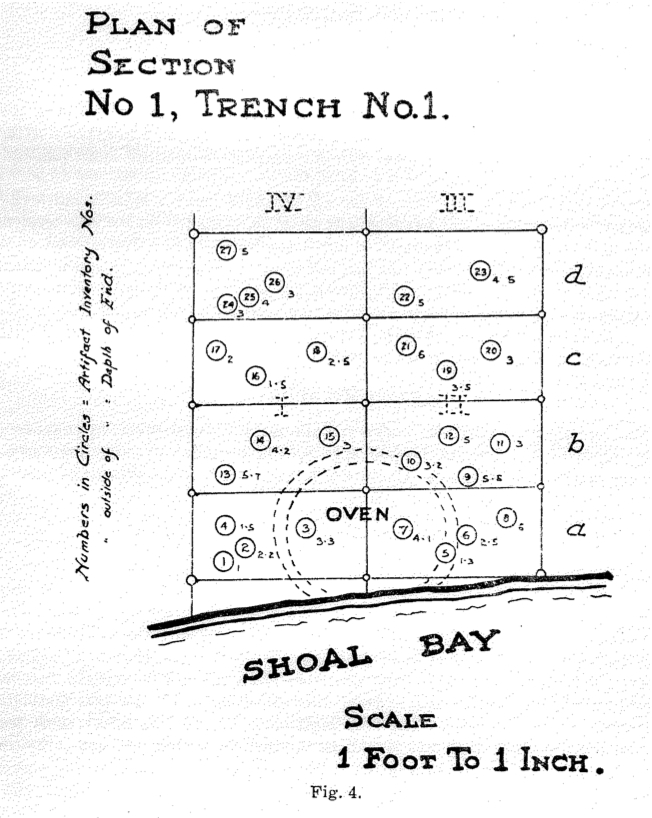
A.E. Pickford's ideal plan of an earth oven.

A.E. Pickford's ideal plan of an earth oven.

A.E. Pickford was the Assistant in Anthropology at the Royal BC Museum, when it was still known by its proper name of the Provincial Museum of Natural History and Anthropology.  Here I link to his indispensible 1947 article, “Archaeological Excavation of Indian Middens” – the examination of such middens by means of sampling.

The rationale for the publication is interesting:  “In case of private ownership, if a person is unable to restrain the impulse to dig on his own land, we urge that he shall adhere to some such principles as those which follow, then he will have the satisfaction of knowing that his work is well done and, when brought into focus with similar undertakings, will help to build up that sound formation of knowledge, without which the correct story of the early population of this country cannot be written.”

After encouraging the study of lofty topics such as racial and cultural origins, foods, housing …. etc., Pickford busts out his inner schoolmarm: “He who digs for relics alone may be likened to the child who tears a book apart in order to secure the coloured plates which it contains, being the while all unaware that in scattering the printed pages to the wind he is losing forever a valuable source of information about those same plates and the life which they represent”.

Reference: Report for the Year 1947.  Victoria: Provincial Museum of Natural History and Anthropology, Province of British Columbia, Department of Education.  [yes, education].

University of Washington Digital Collections

Makah codfish spear (or, more accurately, harpoon)

Makah codfish spear (or, more accurately, harpoon)

The University of Washington has a superb digital collection online, transcending all kinds of different historical, archaeological and popular culture niches.  Searching on “artifact” brings up some 583 images (some of which are links to text etc).  These are downloadable and have stable URLs to which one can link. The resolution could be higher, but the pictures are sharp and clean, at least for those ones they have apparently taken themselves, and they don’t plaster watermarks all over them.  Good work.  The amount of metadata is impressive, and the fact that is is clickable renders this site a fantabulous timewaster of the highest order.  To the left, I was just having a discussion with a student about harpooning fish.  I am under the impression that harpoons were used on large lingcod – after the lingcod were lured to the surface using a cunning little shuttlecock-shaped rising float.  This picture is labelled “Makah codfish spear” though it is self-evidently a harpoon and lanyard.  More (vindication) coming from this excellent site as time goes by.

dSpace: Lundy on Rock Art

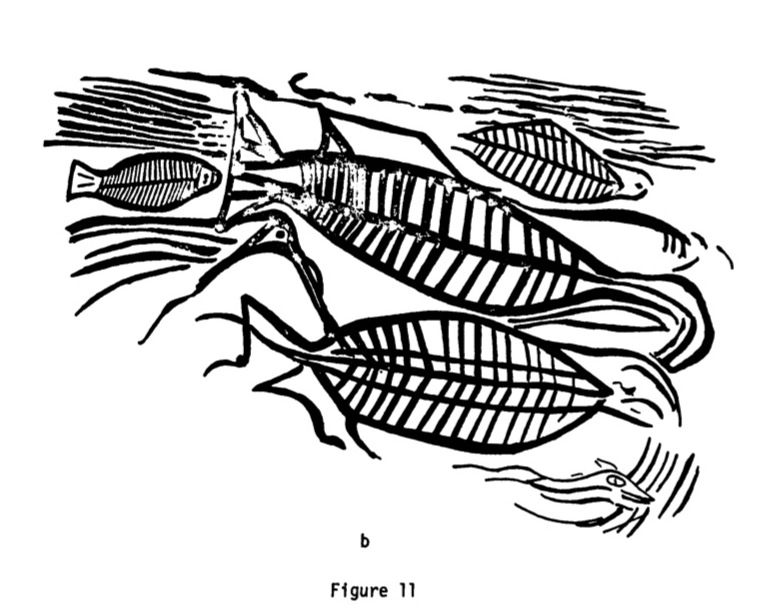
Salmon Petroglyph at Jack Point. From Lundy (1974: 111)

There is a wonderful trend of institutions putting old, grey literature online.  One widely used platform  for doing this is called “dSpace”, though the approach exists under other names.  Some of the best of this material are graduate theses and dissertations.  These are freely available if you walk into the University library, but may be essentially unavailable in any other form.  Unlike a lot of digital initiatives, the majority of these are not limited to students and faculty, but can be accessed by anyone – provided you know they are there.  Consider Doris Lundy’s monumental MA thesis on NW Coast Rock Art, obtained in 1974 from SFU.  Most of this 350+ page thesis was never published in any form.  Now you can download the whole thing from SFU (4 meg PDF). Despite being a rocky scan, the entire text is searchable.  There is some digital protection applied but I found it simple to save a copy to my hard drive.  The image to the left is the famous salmon petroglyph at Jack Point near Nanaimo in Snuneymuxw territory.  This is the petroglyph that would be painted with ochre and adorned with eagle down by ritualists if the salmon runs were late or meagre – one of the only such works which has specific beliefs recorded for it.

Let me know if you have problems downloading this: it works for me on and off campus, so I presume anyone can do it.

Annotate This

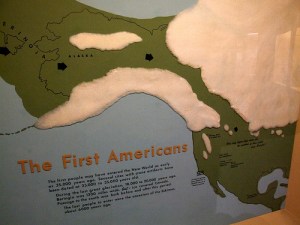
Surely they could have painted a mammoth on this somewhere.....

Surely they could have painted a mammoth on this somewhere.....

Flickr usr Travis S. does a nice, understated job of annotating this hilarious reconstruction of the “Ice Free corridor” from the Santa Barbara Museum of Natural History.  Click on the image to go to the original.  This picture pretty much sums up the absurdity of the Ice Free corridor — magical parting of the white sea while the coast is socked in under a mile of solid fog.  Funny how such reconstructions were made before serious geological investigation of their truth content, and funnier still how archaeologists just slurped up the ice free corridor as the answer to their need to get the FIRST AMERICANS (nevar forget!)  into Wyoming, well,  first.

Crafting an Antler Harpoon Point

Amy Margaris has a nice video online showing the making of a replica barbed bone point, typical of ones used by the Alutiiq People of Alaska’s Kodiak archipelago.  There are lots of flint knapping videos on the web but this is one of the only bone/antler ones I have come across, at least for this area. Shethen  illustrates the different properties of organic materials by hurling them from buildings, which is a nice touch. Following Dr Margaris’ links takes us to the Alutiiq Museum website, which is a very well done set of pages, informative and up to date, covering everything from collections management to repatriation and reburial to mini-reports on digs such as the well-illustrated one at Horseshoe Bay.  My only complaint is, Alutiiq web site folks: don’t bother with the little flash gizmo to make the pictures pop up, they are annoying. They are doubly annoying when the pop-up picture is no bigger than the thumbnail!  What is wrong with people putting these tiny thumbnails up and restricting access to anything finer — you are selling your own research short and making it less likely your website will be visited via links.  If it goes on the web, it is implicit you want people to know, so can the obfuscation and speak in your very best voice!