Tag Archives: alaska

Archaeology in Action: a flickr.com photo pool

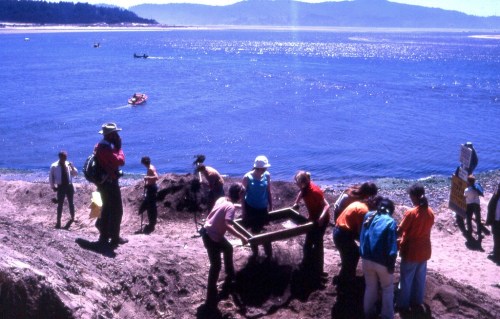
Archaeologists? No -- "Pothunters" destroying a site on the Columbia River, ca. 1966. Source: flickr user gbaku.

Archaeology in Action is a large set of pictures of archaeologists doing archaeology on the photo sharing website flickr.com.  Not too much Northwest Stuff there that I could find with the notable exception of many pictures put up by a former University of Oregon professor under the name of gbaku (you can find his real name easily enough).  His pictures are a wonderful tour of Oregon and Alaskan archaeology of the 1960s and 1970s – these are not sets of pictures of stratigraphy, or backdirt (interesting though those things are) but are predominately of, well, archaeologists in action.  It would be fun to see more NW Coast pictures up here — I know Grant has a large collection of pictures of archaeologists going about their business and I am sure we all have some pictures of people in with the endless pictures of yet another bone.
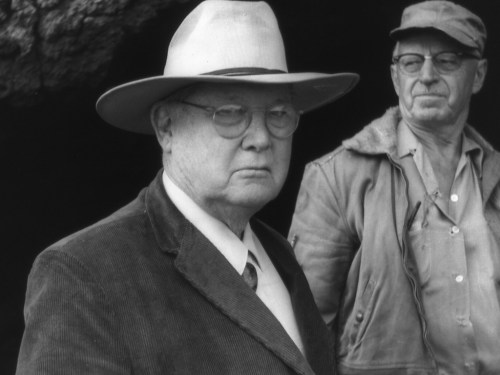
Erle Stanley Gardner, the author of the Perry Mason mysteries and many other books, and Luther Cressman, pioneering archaeologist and ex-husband of Margaret Mead, at Fort Rock Cave in 1966.
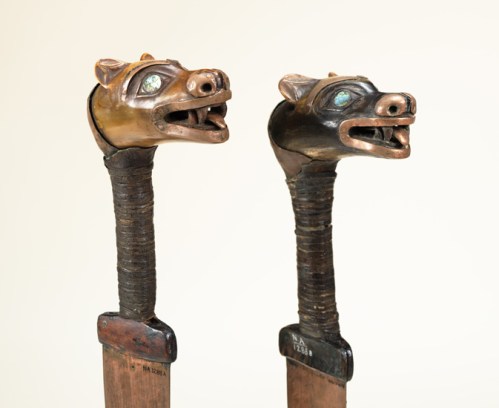
Tlingit, Dene and Eskimo Metallurgy (1969)

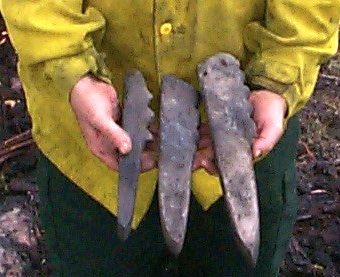
Tlingit dagger hafts, Kluckwan, Alaska. Purchased by George Gordon from Louis Shotridge at the Portland Fair, 1905. Penn Museum Objects NA1288a/b.

From the excellent University of Pennsylvannia Museum website, you can download back issues of their magazine “Expedition”, including this article on aboriginal metallurgy in Northwest North America (PDF).  The caption below is from that article: the two astonishing daggers being described are shown above.  Seriously, this is metalwork of the highest order, reminiscent of, say, Mycenaean pieces.

1969 caption describing the two daggers, above.

Seward Peninsula Mastodon Tusk – “too old”, therefore Too Old.

Worked 35,000 year old mammoth tusk from Alaska. Note scale! Source: Gelvin-Reymuller et al.

This is getting a little out of the area, but I’ve just run across a report by Gelvin-Reymuller et al.  (download PDF) on the finding of a worked mammoth tusk from the north side of the Seward Peninsula.  That is on the west-central Alaska coast near the closest approach to Asia, and hence smack in the middle of Beringia.  The tusk is interesting in its own right, of course, but doubly so when we see that it was dated to well before the last glacial maximum:

Though the age of the tusk is only peripherally relevant to the significance of the reduction described in this paper, the tusk was sampled for dating. A single bone collagen sample from the tusk was dated by Beta Analytic, Inc. following standard pretreatment and analytical procedures. A 5.2 g of sample was first removed from an inner area, well beneath a surficial treatment of Elmer’s Glue-All which the tusk’s discoverer had initially applied to the surface. The resultant AMS date was 35,150 +/- 530 BP (Beta-189092). …… The latest mammoth remains in mainland Alaska are dated to around 11,400 BP.   Since the age of this tusk places it beyond the range of initial human habitation in the New World, as currently understood, we posit that the tusk was worked by later inhabitants of the area.

The authors note that it is possible to diagnose from the reduction strategies used whether ivory was worked when fresh/green or when already subfossilized,  though curiously they draw no such conclusions about this particular piece.  I find it intriguing how a central Beringian artifact made on a 35,000 year old material is so readily characterized as a recent manufacture.  While this piece would pre-date the earliest known record of extreme NE Asia and while I wouldn’t second-guess the authors nor impugn their motives and while it is certainly possible that a fossil mammoth tusk was worked at a much later date, I’m, uh, just sayin’.   This paper is interesting on a number of levels, not least as an example of stickhandling around competing paradigms.

Detail of working method of Alaskan tusk. Source: Gelvin-Reymuller et al

Cache of Celts

tongass stone tools

Cache of stone woodworking tools found in Tongass National Forest

So maybe I am obsessed with ground stone celts, who isn’t, but nonetheless I liked this story of the lucky discovery of a cache of large pecked and ground stone woodworking tools in Tongass National Forest in the Alaska Panhandle.   The  article claims the hafting grooves are finger grips, which I think is unlikely.  More likely these are from elbow adzes, such as this one.

tongass stone tools detail


Annotate This

Surely they could have painted a mammoth on this somewhere.....

Surely they could have painted a mammoth on this somewhere.....

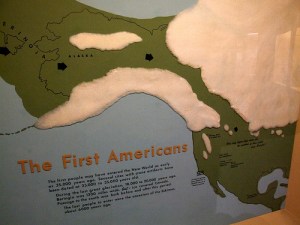
Flickr usr Travis S. does a nice, understated job of annotating this hilarious reconstruction of the “Ice Free corridor” from the Santa Barbara Museum of Natural History.  Click on the image to go to the original.  This picture pretty much sums up the absurdity of the Ice Free corridor — magical parting of the white sea while the coast is socked in under a mile of solid fog.  Funny how such reconstructions were made before serious geological investigation of their truth content, and funnier still how archaeologists just slurped up the ice free corridor as the answer to their need to get the FIRST AMERICANS (nevar forget!)  into Wyoming, well,  first.

NW Conservation Blog

This is a nice site by an Alaskan conservator, Ellen Carrlee. She gives a ton of information about her work. For example, check out her lengthy discussion of the conservation of an archaeological Tlingit fishtrap – scroll down for pictures. Or, look at this mini-essay on waterlogged wood.