Category Archives: Washington State

Memories of Ozette

Makah whaler Wilson Parker posing as a MAKAH WHALER for Edward Curtis, ca.1915

The magazine of Washington State University has a nice article on the archaeological project at Ozette, the UNESCO World Heritage Site on the west side of the Olympic Peninsula.  This Makah village site was covered by a landslide about three hundred years ago (animation), which created preservation conditions highly favourable to preservation of wooden artifacts.  The story begins

THERE’S A WELL-KNOWN PHOTOGRAPH taken by Native American chronicler Edward Curtis in 1915 of a Makah whaler. Dressed in an animal skin, the man is longhaired and wild. He had indeed been a whaler, as had generations of his people. But still, the photograph is a memory of a time already past. Curtis provided Wilson Parker with a hide and a wig to replace the European clothes the Makahs had adopted long before. In spite of Curtis’s fiction, however, there is much to be learned from Wilson Parker, the man in the photograph. As is always the case with a good myth, there is a deeper truth that lies beneath the surface story.

Parker is Sharon Kanichy’s great-great-grandfather, she tells me as we talk in the Makah cultural center in Neah Bay. Kanichy ’01 was born in February 1970. That same month, a powerful storm blew in off the Pacific, eroding the bank above the beach at Cape Alava, on the Olympic Coast, revealing something remarkable.

“All we knew was there was a burial site,” says Ed Claplanhoo of the buried longhouses revealed by that February storm. Claplanhoo ’56 was Makah tribal chairman in 1970, so it was he who got a phone call the first Saturday in February, from a hippie schoolteacher, as Claplanhoo describes him. A dubious character, says Claplanhoo, which is why he didn’t take the fellow seriously when he tried to warn Claplanhoo that “people” were getting in the “house” and taking “artifacts.” Claplanhoo knew everyone in Neah Bay and knew everyone who owned artifacts. He’d heard of no problems.

But the fellow persisted. The next Sunday, the same phone call. “Mr. Claplanhoo, they’re still taking artifacts out of the house.”

“So I said okay,” says Claplanhoo, “I’ll tell you what, you come to my house at seven o’clock tonight and we’ll talk about it.”

From there, the article recounts the story of the Ozette excavations from the point of view of both Makah and the archaeologist Richard Daugherty, who led the decade long excavation of “North America’s Pompeii.”  It nicely captures the importance of the site as well as the nature of the dig and the social relations formed which endure to this day.

Don’t miss the slideshow from the excavations — it’s an awkward interface but some very atmospheric pictures of life on a remote archaeological dig in the 1960s – as well as a few shots of the US Marines who helped airlift supplies in and treasures out.

Digging at the Ozette Site - the hoses were used to gently free the wooden artifacts, such as the house planks shown, from the mudflow which buried them. Source: WASU Magazine.

Photo Essay on the Qwu?gwes Site

EDIT February 22, 2010: Pictures removed after communication from Lee Rentz (see comments).

Dale Croes has been doing great work for years on wet site archaeology, most notably a long association with the Hoko River wet and dry sites on the Olympic Peninsula.  More recently he has spent a decade or so at the Squaxin Tribe’s Qwu?gwes waterlogged site near Olympia, Washington.  I see that Lee Rentz’s Photography blog has a nice photo essay on the Qwu?gwes site called Ghosts Dwell in the Lowering Tide.

Wet sites can produce locally anaerobic (oxygen depleted) environments, preventing or slowing bacterial degradation of organics.  This allows survival of many artifact types which rapidly deteriorate in normal archaeological settings.  At Hoko, there are well preserved wooden artifacts over 2,000 years old, at Qwu?gwes the material is mostly about 700 years old.  Similar sites elsewhere on the Northwest Coast are mostly  less than 5,000 years old, with the notable outlier of Kilgii Gwaay, which is 10,500 years old.  Since some estimates put wood artifacts at 90% or more of NW Coast technology, you can imagine how revealing these rare, and increasingly threatened, waterlogged sites are.

The photos at Lee Rentz’s blog are excellent, and the text is accurate and informative.  Good to see!  If you want to find out more, some scholarly and other articles can be downloaded here, or you can work at Qwu?gwes yourself as part of a field school.

Makah whaling gear

Parts of a Makah whaling canoe. Source: Waterman, 1920.

I posted a couple of days ago about a historic photo of members of the Quinalt Tribe making canoes in the Queets watershed.  Immediately to the north, the Makah tribe at the tip of the Olympic Peninsula are well known for their succesful whale hunting practices, carried out from canoes similar to those being carved.

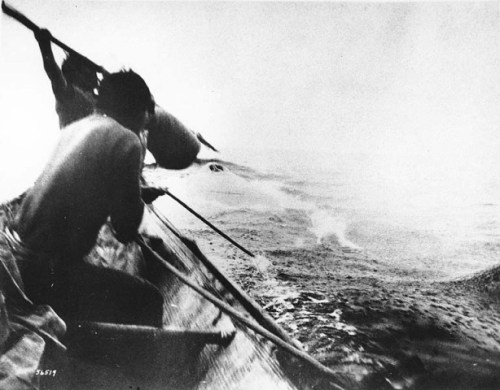
As it happens, in 1920 the Anthropologist T.T. Waterman wrote a detailed account of Makah whaling technology, which you can download in full here (PDF).   Above, I illustrate the nomenclature of the Makah whaling canoe – I like how the small bump on the lower bow is called the uvula.  Below, you can see the seating plan when geared up and loaded for whale.  As you might expect for such a dangerous undertaking as killing whales from a canoe, the division of labour is quite precise:  “float-tender”, “harpoon line tender”, “float inflator” .  The “diver” had the task of swimming to the lower jaw of the dead whale, piercing the skin and flesh, and sewing the mouth shut to prevent the whale sinking on the long tow home.  You can see a vivid picture of some of these people further below.  Descriptions of these tasks and the associated gear is given in Waterman, which contains huge insight into traditional Northwest Coast technology and social practice.   I’ll most likely post more snippets from this book in due course.  The Makah have, of course, recently re-asserted their traditional right to hunt whales which I fully support.

Seating positions within a Makah whaling canoe. Source: Waterman, 1920.

Makah Whaling: the 2nd harpoon strike. Line tender in action behind the harpooner. Source: Makah Tribe.

Tse-whit-zen whale

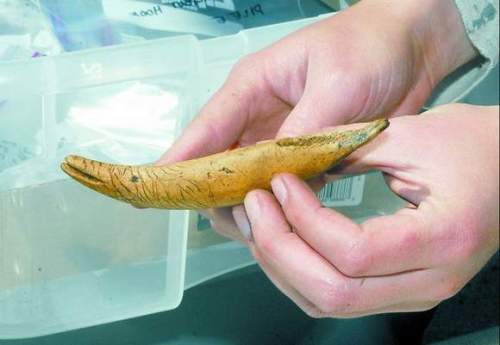
Tse-whit-zen whale sculpture.  Source: Peninsula News, Port Angeles.

Whale sculpture from the Tse-whit-zen archaeological site, Port Angeles. Source: Peninsula News.

The Tse-whit-zen site is a former Klallam Tribe village that was discovered by the construction of a graving dock at Port Angeles, Washington State.  The subsequent disturbance and archaeological project led to an astonishing series of events with over 300 human burials recovered, many more disturbed, 65,000 artifacts recovered and after a huge investment the abandonment of the graving dock project at a cost some estimate in excess of 100 million dollars.  This is a story I want to know more about and will probably post on from time to time.

But for today, set aside the sad history and feast your eyes on the above small sculpture of a whale discovered during the summer of 2009 at Tse-whit-zen during mopping up remediation.  The artist has captured the essence of whale!  The article doesn’t say, but there may be a socket on the lower back of the whale just in front of the tail – perhaps this was the handle for a small chisel, or a knife.  I also wonder if it doesn’t go the other way up — the mouth is asymmetric and the arching back of a diving whale would be a more natural posture.  Either way, this is a happy little sculpture, probably dating from about 2,000 years ago.

One Tree, Four Canoes

"Making 4 canoes from one cedar tree, Olympic Loop, Queets, Washington.

Yesterday I posted on canoe steaming.  In the process of preparing that, I ran across an eye-popping photograph, above.  Seriously, I have been working on Northwest Coast Archaeology for over two decades.  I have a pretty good memory.

But I’d never seen this picture before, which shows four dugout canoes being made from a single red cedar felled on the Queets River, Washington State.  Click it for pretty high resolution.  This would presumably be territory of the Queets Tribe, who are now part of the Coast Salish speaking Quinalt Indian Nation.  Imagine the complex and revealing archaeological site left behind: the wood shavings, the planks, the skids, broken tools, coffee cups … years ago I worked on an excavation of a Culturally Modified Tree Site in Clayoquot Sound and we found superbly preserved wooden wedges, woodchips and other evidence of intensive logging and carpentry — evidence which, given the durability of cedar, could easily last for centuries.  Such a contrast to those sites dominated by stone tools: wood was where it was at on the Northwest Coast and yet archaeologically we see much less of it, and think about it less, than we ought to.

I don’t know much more about this picture than the caption.  If you do, then leave a comment!

Makah whaling canoes on the beach at Neah Bay. These are stylistically similar to the ones being made above and to the one being steamed in yesterday's video.

Captain Vancouver and Camas

Saranne, or lily, harvesting on the Strait of Juan de Fuca in May 1792.

I am sure it is well known to local ethnobotanists, but I don’t recall seeing the above account of plant cultivation reference before.  It is from page 123 of Captain Vancouver’s “Voyage of Discovery …. ” (1801 edition, which you can browse online here).

I didn’t figure out the exact locale of this camp but it is probably very close to Port Discovery, near Port Townsend at the north end of Puget Sound.  The camp is carefully noted as a plant-harvesting camp and also a place where shellfish were being processed. The houses are mere lean-tos.  It is interesting to see that the considerable number of “eighty or a hundred” women, men and children were engaged in turning over the earth here, “like swine” (!).  It gives a vivid impression of a well-orchestrated, community-level harvesting event.  Vancouver comments favourably on the product, a sort of paste or flour.

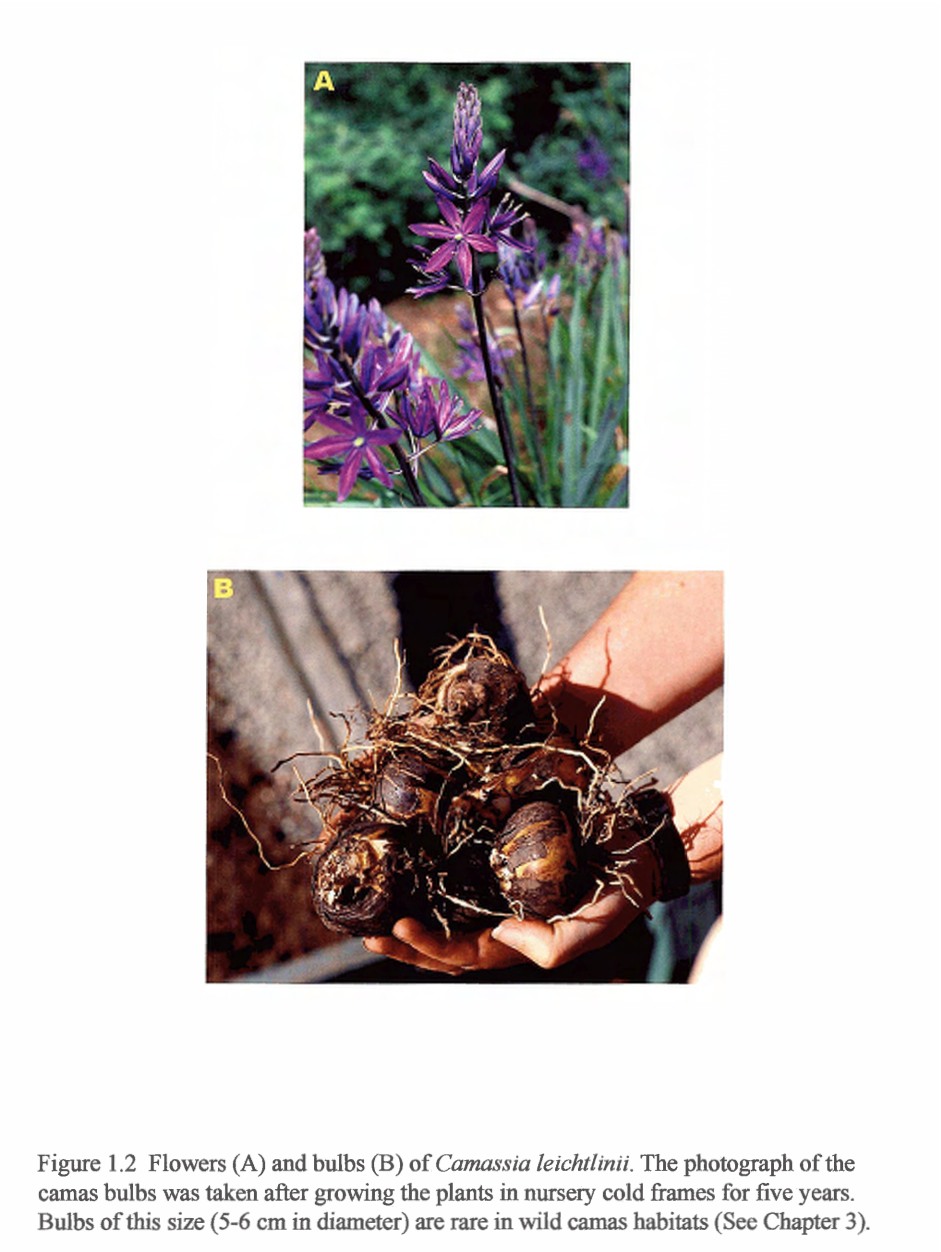
Vancouver refers to one plant as a species of wild onion, while the other two plants being cultivated are termed as resembling “saranne”.  That being a new term to me, I turned to the OED only to find it not listed, which is quite surprising.  Googling turned up some interesting historical references though, in which it is clearly a term used for members of the Lily family (camas is also a member of this family).  For example, see this 1792 clip from Pennant’s Arctic Zoology Volume 3, on the use of Saranne, or Lilium kamchatschense, by the inhabitants of (yes) Kamchatka (let your eyes skim, gentle reader, over the foregoing section on the use and abuse of hallucinogenic mushrooms). Perhaps this term, Saranne, was in use around the North Pacific at that time but it strikes me as odd it did not find its way into the OED.

Anyway, a few pages down from p. 123 you can also find a nice description of the Coast Salish wool dog, which is described as being much like a Pomeranian.

Camas flowers and bulbs. Source: Brenda Beckwith Ph.D. thesis, 2004. http://hdl.handle.net/1828/632

Haida, Argillite, and the Pig War

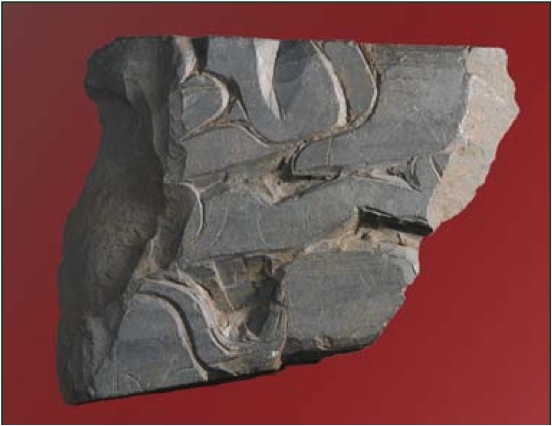
Carved argillite from Belle Vue Sheep Farm, San Juan Island. Source: NPS.

I don’t know as much about the 1859 Pig War as you might think, having spent an awful lot of time on San Juan Island. This “war”, which was more of an armed standoff between British and American troops, was a key event in the various mid-19th century boundary disputes.  One key location was Belle Vue Sheep Farm, near the southern tip of San Juan Island, where there has recently been some interesting historical archaeological work by the U.S. National Parks Service.

One interesting find at this dig is a piece of carved argillite, shown above, which most likely stems from Haida Gwaii (see page 7 of this PDF report, browse other NW NPS reports here).  Around this time there were plenty of Haida and other North Coast Nations around the Victoria area, and so it is not surprising, really, to see this piece.  And yet, it is also a stroke of massive good fortune to have such a distinctive piece of the turbulent 19th century history of First Nations.

Intriguingly, a key figure on the American side of the Pig War was George Pickett, who later achieved substantial fame for leading Pickett’s Charge at the Battle of Gettysburg in the American Civil War,

Ironically for someone who later fought for the racist Confederacy, Pickett was once married to a Haida woman by the name of Sâkis Tiigang.   (More often known as “Morning Mist”, this site gives her Haida name as beSakkis Tiigang while the Pickett Society in a detailed article gives her the slightly more authoritative-seeming name Sâkis Tiigang, meaning “Mist Lying Down”).  They had a son together, the artist James Tilton Pickett who, without wanting to generalize overly, certainly looks like a Haida man.  Shortly after the birth of young James in 1857, Sâkis Tiigang passed away.

Probably there is no tangible connection between Morning Mist/Sâkis Tiigang and this carved piece of her homeland, but surely there is a poetic one.

James Tilton Pickett, son of Sâkis Tiigang and George Pickett/ 1857-1889. Source: Pickett Society.

Northwest Anthropology Conference: NWAC 2010

The web site for NWAC 2010, to be hosted at Central Washington University March 24 – 27, 2010 in Ellensburg, Washington,  is up and running.  NWAC is a great conference which we were lucky to host in Victoria a couple of years ago.  In case you are wondering where Ellensburg is (no offence), it’s just to the east of the Cascades from Seattle, north of Yakima, about a 350 km drive from Victoria: map.

The theme of this year’s conference is the very welcome “At a Crossroads”:

Anthropology at the Crossroads” is the theme for the Northwest Anthropology Conference (NWAC), Ellensburg, Washington, March 24 – 27, 2010. While all submissions will be considered, this conference will offer opportunities for multiple perspectives on where we are as a discipline, society, and species, with a special emphasis on people and the environment. The “Anthropology at the Crossroads” conference will include symposia and presentations on subjects from archaeology, cultural and linguistic anthropology, paleoanthropology, primatology, medical anthropology, visual anthropology, and others. We invite submitters to use their own preposition in describing their presentation/symposia as “Anthropology at/of/on/etc the Crossroads.” Studying the past, understanding the present, and preparing for the future, makes Anthropology even more relevant today as the discipline continues to assert the importance of an appreciation for culturally diverse modes of interacting with our environment. Thus, this conference is a crossroads where the exchange of ideas better prepares us, our students, and our work to serve the communities we live in as we maintain our commitment to exchanging and transmitting our under-standings of all people, in all places, and at all times. “Anthropology at the Crossroads” also implies interaction among sub-disciplines and communities in an integrated fashion and in this manner encourages self reflection on the relevance of Anthropology today at a moment when we appear to be at several global crossroads.

Mt. Rainier Archaeology

Some artifacts from Mt. Rainier. Source: Tacoma News-Tribune.

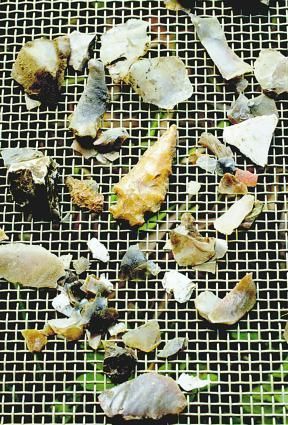
The Tacoma News-Tribune has a nice story about high-altitude archaeology on the flanks of Mt. Rainier.  Sites date back to over 9,500 cal.BP (presumably cal. BP, that is) and some include microblade technology.  If I read the article right, the microblade component dates to about 7600 years ago.  There is an older report on Mt. Rainier archaeology here by Greg Burtchard, but it seems this recent work is what has produced the older dates.  It’s also very intriguing to see ancient “cooking pits” including some that the authors suggest were continuously used for the full 9,600 years of occupation:

The site has also produced other ash evidence, coming from cooking pits.

“They’re small and not elaborate, but pretty clearly they were cooking with hot stones. But I don’t know what they were cooking,” Mierendorf said. “That implies more than just traveling through the area.

“These are repeatedly used, including one individual pit used and reused for all 9,600 years. I’ve never seen anything like that in 40 years of professional archaeology.”

It’s good to see work done in the higher elevations, and is reminiscent of Rudy Reimer‘s more theoretically-driven  work in the highlands of Squamish territory. It will be great to see if there is a full report put out soon so I can see the microblades and the cooking pits – if it is put on the web like the earlier report, so much the better!

University of Washington Digital Collections

Makah codfish spear (or, more accurately, harpoon)

Makah codfish spear (or, more accurately, harpoon)

The University of Washington has a superb digital collection online, transcending all kinds of different historical, archaeological and popular culture niches.  Searching on “artifact” brings up some 583 images (some of which are links to text etc).  These are downloadable and have stable URLs to which one can link. The resolution could be higher, but the pictures are sharp and clean, at least for those ones they have apparently taken themselves, and they don’t plaster watermarks all over them.  Good work.  The amount of metadata is impressive, and the fact that is is clickable renders this site a fantabulous timewaster of the highest order.  To the left, I was just having a discussion with a student about harpooning fish.  I am under the impression that harpoons were used on large lingcod – after the lingcod were lured to the surface using a cunning little shuttlecock-shaped rising float.  This picture is labelled “Makah codfish spear” though it is self-evidently a harpoon and lanyard.  More (vindication) coming from this excellent site as time goes by.