Category Archives: Shell Middens

ASBC Victoria – Public Talk Tue Oct 18: Daryl Fedje on Gulf Islands Archaeology

Parks Canada - UVIC Archaeological Project in the Intertidal Zone, 2010.

Next up for the local (Victoria) branch of the Archaeological Society of B.C. is a Tuesday, October 18th talk by Daryl Fedje of Parks Canada Archaeology. Details below; it is free and open to the public.  I know of some of this research to be presented and if I can add an editorial comment:it is now clearly demonstrated that the intertidal zone has very high potential for un-disturbed archaeological deposits, some of which show exceptional preservation.  These include not only classic “waterlogged sites” with woody preservation, but also numerous water-saturated shell middens, and even the remains of intact house features.  I think it’s probable that in the Salish Sea at least, the intertidal zone is a hugely unappreciated zone of interest and I hope the Archaeology Branch and Consulting Archaeologists are working together to make sure it gets a thorough examination. And, if they aren’t, then it would be welcome if First Nations were to apply pressure by demanding routine subsurface testing in intertidal zones as a minimum requirement for shoreline archaeological assessments, perhaps commenting to this effect when reviewing permit applications.  Anyway:

Intertidal Archaeology in the Gulf Islands National Park Reserve

October 18th, 2011, 7:30
pm Pacific Forestry Centre,
506 West Burnside Road (Map)

FREE AND OPEN TO THE PUBLIC.

Abstract:  Recent investigations in the Gulf Islands National Park Reserve included a focus on the intertidal zone. Analyses of cultural and paleoecological data obtained from these investigations has resulted in a more detailed sea level history for the area and, discovery of a suite of archaeological sites associated with sea levels slightly lower than modern. These now-intertidal sites include intact shell middens and apparent house features dating as early as 4,000 years ago.

Bio: The Victoria ASBC Branch president writes,  “Daryl Fedje is a long-time archaeologist with Parks Canada, now based in Sidney, B.C.  He is widely published, with a respected international reputation.  Research in the Gulf Islands that he directs, co-directs, or facilitates is some of the most current work relevant to the Victoria region – but of course with wider ramifications.

Old site on Calvert Island, Central Coast of B.C.

UNBC student Cory Hackett excavates a unit in shell midden (photo credit: B. Alway, via UNBC)

There’s a good, recent article in the Globe and Mail (PDF) on some exciting preliminary findings by Dr Farid Rahemtulla of UNBC at a site on Calvert Island (map).

The site, thought to be the “lost village” of Luxvbalis, is in territory of the Heiltsuk and Wuikinuxv (formerly Oweekeenow/Awikenox) peoples.  The project was intended to re-locate this village, which figures prominently in Oral History.  Continue reading

Waatch River: a raised beach site on the Olympic Peninsula

View from West up Waatch River Valley to Neah Bay; Vancouver Island in the distance. Source: Panoramio user Sam Beebe.

The Waatch River flows in a low valley that connects Neah Bay across the Olympic Peninsula to Makah Bay.  When sea levels were higher, it would flood with sea water and turn Cape Flattery into an island.  Interesting, then, to see that an old raised beach site has been found on the Waatch River at an elevation of about 13 metres above, and 2 km away from, the modern shoreline.

Continue reading

Tse-whit-zen interactive pages and slide show

Whale vertebrae modified into a spindle whorl, from the Tse-whit-zen site. Source: Seattle Times

I mentioned the Tse-whit-zen site a few days ago, in reference to the recent discovery of a small whale sculpture found there in 2009.  The Seattle Times had a superb web site on this ancient Klallam village, but unfortunately, many of the links are broken (how does that even happen, anyway?).  But the four part illustrated slide show with extensive audio commentary by Klallam, archaeologists and other people is still available and is well worth watching – in fact its one of the best such slideshows I’ve seen.  The Interactive Village component of the site is still active as well, and also definitely worth checking out.

As with so many of these sad stories of site disturbance through development, there is a silver lining as the dig itself, and the objects found, have contributed to a vitalization of Klallam traditional practices and increased interest in Klallam traditional culture within their younger generation.  At a severe price, though: over three hundred burials were excavated and removed from the site before the project, a massive graving dock, was brought to a halt – a halt which, according to some, cost over 100 million dollars.  I’m posting some of the pictures in case the Times site loses even more functionality.

Comb recovered from Tse-whit-zen site. Source: Seattle Times.

One of the more than 800 remarkable etched stones found at Tse-whit-zen, some in association with human remains. Source: Seattle Times

More than 300 human burials were disturbed by the graving dock project. Here, some await reburial in a warehouse on site. Source: Seattle Times.

Tse-whit-zen whale

Tse-whit-zen whale sculpture.  Source: Peninsula News, Port Angeles.

Whale sculpture from the Tse-whit-zen archaeological site, Port Angeles. Source: Peninsula News.

The Tse-whit-zen site is a former Klallam Tribe village that was discovered by the construction of a graving dock at Port Angeles, Washington State.  The subsequent disturbance and archaeological project led to an astonishing series of events with over 300 human burials recovered, many more disturbed, 65,000 artifacts recovered and after a huge investment the abandonment of the graving dock project at a cost some estimate in excess of 100 million dollars.  This is a story I want to know more about and will probably post on from time to time.

But for today, set aside the sad history and feast your eyes on the above small sculpture of a whale discovered during the summer of 2009 at Tse-whit-zen during mopping up remediation.  The artist has captured the essence of whale!  The article doesn’t say, but there may be a socket on the lower back of the whale just in front of the tail – perhaps this was the handle for a small chisel, or a knife.  I also wonder if it doesn’t go the other way up — the mouth is asymmetric and the arching back of a diving whale would be a more natural posture.  Either way, this is a happy little sculpture, probably dating from about 2,000 years ago.

Capital Regional District Report

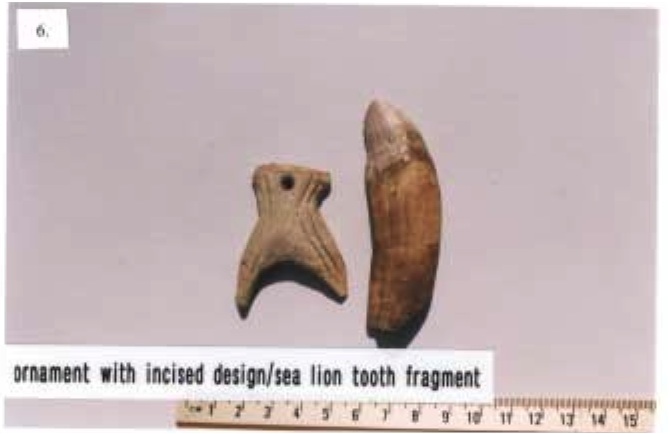
Decorated antler?, and a worked sea lion tooth from the Elchuk collection, Mill Hill.

I just came across this interesting document from 1999 by Liz Crocker (PDF) which is a cultural history of three CRD Parks: Mill Hill, Francis/King and Thetis Lake.  While I wouldn’t put a lot of stock in the archaeological component of this report, there are at least two notations of considerable interest.

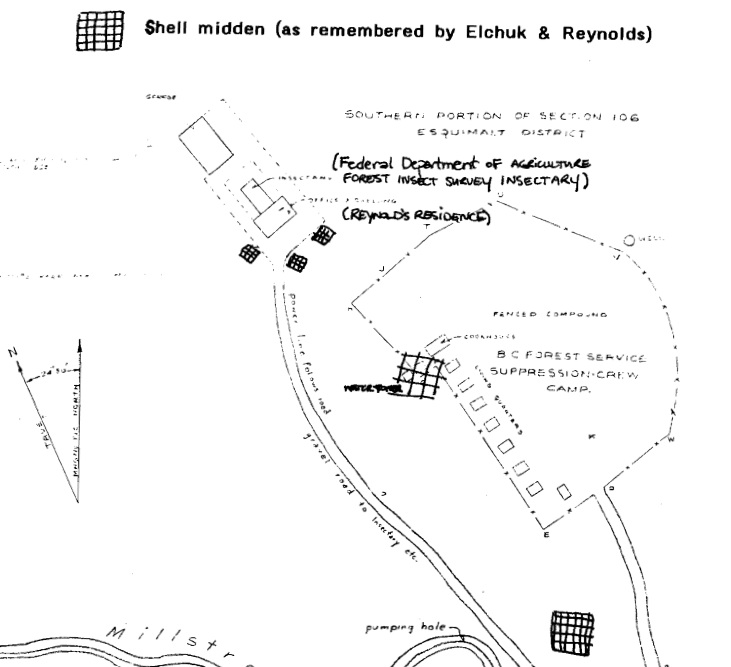
The first is the documentation of an unrecorded shell midden at Mill Hill, not DcRu-70 but another site, including a sketch map of the location which is about 2 to 3 kilometres inland.  There are also reports of unrecorded inland shell middens at Thetis Lake Park. Since such sites are rare and poorly know,  then this is something worth following up.  Indeed, I wish the CRD took their stewardship role seriously enough to commission an intensive, comprehensive, and professional inventory of the archaeological heritage of all their Parks.  This kind of baseline information is so essential that I honestly don’t understand how they think they can discharge their duties without it.

The other point of interest in Crocker’s report is the documentation of a fairly large private collection, also from Mill Hill and also well inland.  Included in this collection are Locarno-style artifacts as well as more recent ones such as a flat-topped handmaul.  Appendix 2 of the linked report includes some snapshots  of this collection.  Despite the poor quality, it is great to see private collections being documented.  The small decorative piece shown above is interesting and unusual, and the abundance of organic remains suggests again that these were collected from or near a shell midden.  Again, something to follow up. If only there were a Ph.D. student at UVIC, say, who was interested in inland shell middens…..

Sketch map of reported but unrecorded inland shell midden patches at Mill Hill.

Somenos Creek CRM

Diagonal exposure of apparent 2000 BP house at Somenos Creek.

I don’t know too much about the Somenos Creek development in the Cowichan Valley which is discussed in this column in the Times-Colonist:

The North Cowichan story goes back to 1972, when Schmidt was among the developers who bought 100 acres of farmland. About 300 homes eventually arose on what became Timbercrest Estates. Not developed was a six-acre piece where human remains were found in 1992, and where archeological investigations later turned up a feature — a hearth, perhaps, or a house foundation — dating back to the time of Christ.

The Cowichan Tribes think there’s more to be found, that it is important to preserve all six acres, perhaps use it for educational purposes, but Schmidt thinks a dozen houses can be built around the perimeter of the area of proven archeological significance. The natives’ hope now is that government will recognize the importance of the property and buy it, an idea they pitched to cabinet minister Kevin Krueger last week. His reaction? “It wasn’t negative, so I think that’s positive,” says Cowichan Tribes lands-research director Diane Hinkley.

Krueger says there isn’t money to buy such lands outright, but he wants to see what can be done to work things out.

For his part, Schmidt just wants to be done, one way or the other. Either the province or Ottawa buys the land, or he applies for a development permit. “I’m into it too deep to just let the land sit there.”

One of the researchers sent me a copy of the report, and there is a fairly compelling set of features unusual in (a) being inland (b) including an inland shell midden component and (c) including a large subsurface sub-rectangular, sharply defined feature which appears to be the remains of a house dating to ca. 2100 BP.  This makes the site of unusually high archaeological significance – not to mention there are numerous human burials (analysed in Doug Brown’s MA thesis) and extensive archaeological deposits of other kinds.  The house feature is remarkably similar to a contemporaneous feature I saw being excavated a few years back at Esquimalt Lagoon.  We know very little about houses from this period, particularly houses found in inland contexts.  What is striking about the newspaper column above is that it reports the developer has managed to put houses onto 94 of 100 acres, and is now champing at the bit to develop, or be compensated for, the last 6 acres.  I mean, seriously, George Schmidt of Timbercrest Estates, you have achieved 94% of the development you sought.  How about leaving the burial ground alone?  You bought the land in the 1970s.  Surely you have made your money back many many times over. A donation of this small parcel as a heritage park would be a classy move.

Somenos house? feature

Somenos feature - note sharpness of vertical section indicating probable use of plank retaining.

dSpace: Caldwell on Comox Harbour Fishtraps

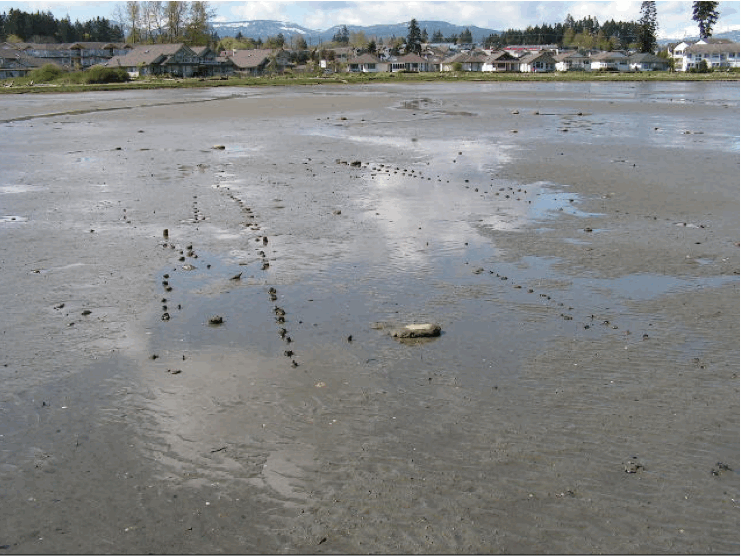
Chevron-shaped fishtraps in Comox Harbour. From Caldwell 2008.

The University of Manitoba is in on the dSpace trend.  The most notable thesis I found there was Megan Caldwell’s excellent analysis of some Comox Harbour fishtraps in relation to the Q’umu?xs Village site (DkSf-19).  Sixteen carbon dates are now available on these traps, thanks mainly to the work of Nancy Greene.  Caldwell takes a theoretical stance of Optimal Foraging Theory, arguing that fishtraps amount to “artificial patches” which can alter choices made under Patch Selection principles.  Essentially, a similar and more holistic argument could be made using principles of the “built environment” in an Ingoldian sense, but OFT is more structured and maybe more suitable for an MA thesis.  Interestingly, Caldwell’s work on auger sampling of the Q’umu?xs Village site shows a preponderance of herring, which is also interpreted as the target prey of the fishtraps.  This runs against the grain of the ethnographic work she conducted, where she was told that salmon were more important — mind you, salmon have difficult taphonomy and site formation processes, which she acknowledges.  In any case, this is a well organized, focused thesis which reflects a lot of high quality original work and while I haven’t read the whole thing I intend to do so!  Caldwell mentions Nancy Greene is still working on her fish trap study and I hope to see the results of that soon as well — these Comox Harbour trap complexes are very likely the finest of their type anywhere on the Northwest Coast and may well offer key insight into cultural construction of the landscape and its resources.  Download her thesis here!

Map of Fishtrap Stakes in Comox Harbour. From Caldwell 2008.

Schematic of two basic fishtrap designs. From Caldwell 2008.

Single Hook

Pomeroy polynesian hook 1

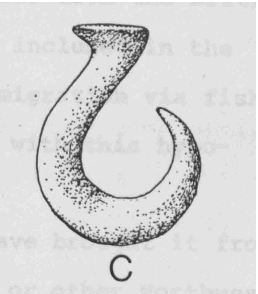
Polynesian-style fish hook found at McNaughton Island

John Pomeroy found this unusual shell (“scallop”) artifact at McNaughton Island (ElTb-10) on the central coast in 1972 (Pomeroy 1980: 321b).  It strongly resembles some Polynesian fish hooks, and is also similar to some Californian ones.  While no scale is given, by comparison to the text it appears about 5 cm long by 4 cm wide. Pomeroy offers three suggestions:

Pomeroy polynesian hook 2

Polynesian fishook from Beasley (1928) via Pomeroy (1980)

1. That it was traded from California

2.  That it was brought from Polynesia by early European explorers.

3. That it arrived inside a tuna.

He notes that there are no tuna remains at this site, which makes (3) less likely though not impossible.  While trade from California is possible, Pomeroy  notes that this specific artifact most closely resembles some from Polynesia and not from California – namely the one to the right from Beasley (1928).  The fact that it was found at a depth of 1.7 metres suggests that (2) is unlikely.  There is a date for about one metre below the surface at this site of 900 BP.  While the exact relationship of the date sample to this artifact is uncertain on my brief reading, it is most likely the date is above the artifact and thus more recent.  Certainly this general time frame of less than 1500 years is the time when eastern Polynesia is being settled and there may have been greater opportunity for drift items or other accidental contact to occur.  On the other hand, this is also said to be the time that the Californian examples arise.

Pomeroy leaves the matter unresolved.  I’m going to keep my eyes open for other examples including fragments that might be misclassified.

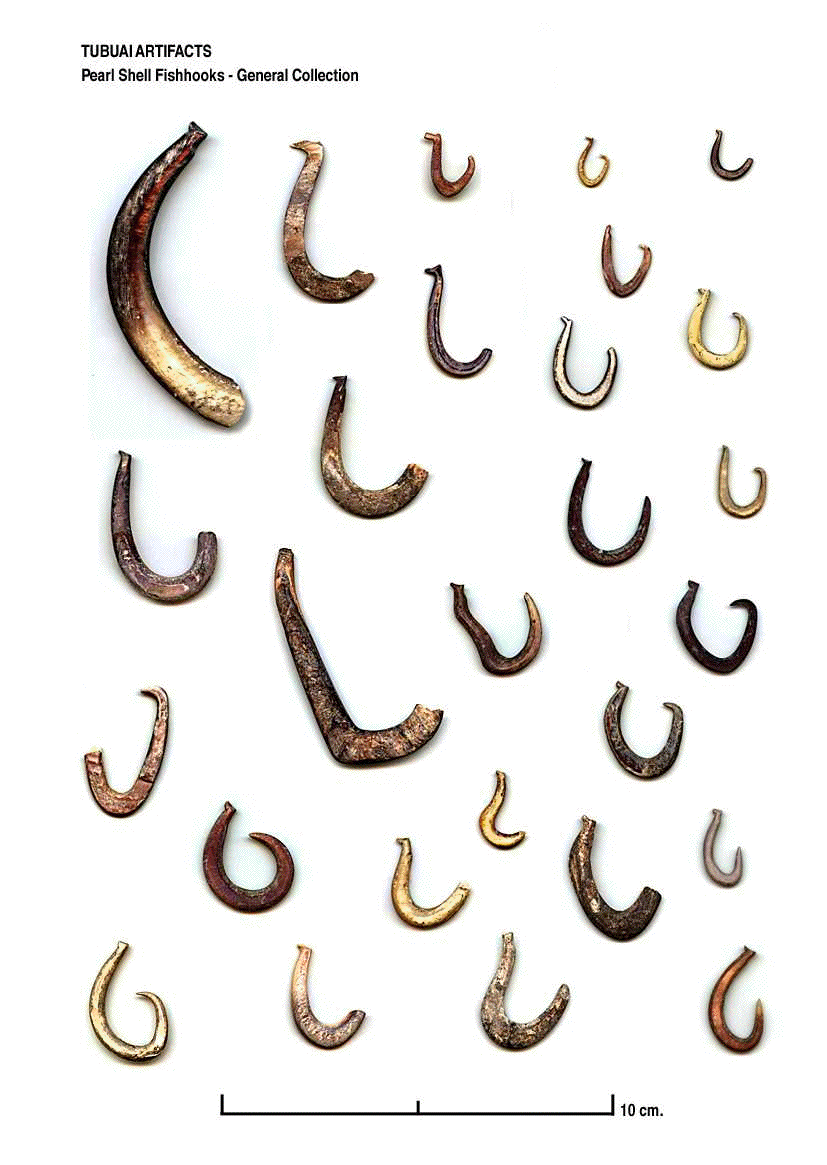
polynesian fishhooks

Polynesian Fish Hooks.

Pickford on Excavation of “Indian Middens”

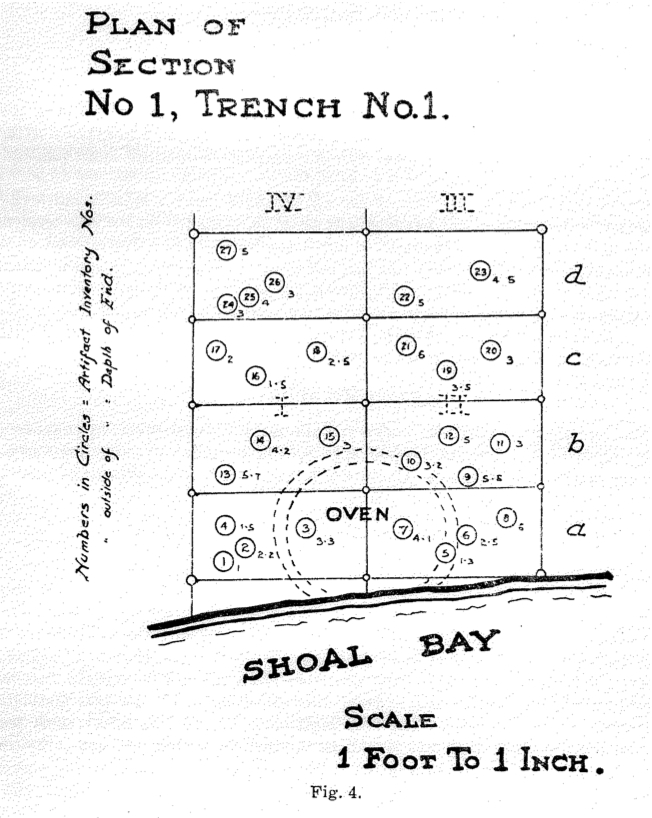
A.E. Pickford's ideal plan of an earth oven.

A.E. Pickford's ideal plan of an earth oven.

A.E. Pickford was the Assistant in Anthropology at the Royal BC Museum, when it was still known by its proper name of the Provincial Museum of Natural History and Anthropology.  Here I link to his indispensible 1947 article, “Archaeological Excavation of Indian Middens” – the examination of such middens by means of sampling.

The rationale for the publication is interesting:  “In case of private ownership, if a person is unable to restrain the impulse to dig on his own land, we urge that he shall adhere to some such principles as those which follow, then he will have the satisfaction of knowing that his work is well done and, when brought into focus with similar undertakings, will help to build up that sound formation of knowledge, without which the correct story of the early population of this country cannot be written.”

After encouraging the study of lofty topics such as racial and cultural origins, foods, housing …. etc., Pickford busts out his inner schoolmarm: “He who digs for relics alone may be likened to the child who tears a book apart in order to secure the coloured plates which it contains, being the while all unaware that in scattering the printed pages to the wind he is losing forever a valuable source of information about those same plates and the life which they represent”.

Reference: Report for the Year 1947.  Victoria: Provincial Museum of Natural History and Anthropology, Province of British Columbia, Department of Education.  [yes, education].