Category Archives: Haida Gwaii

Fieldwork Picture of the Day 6

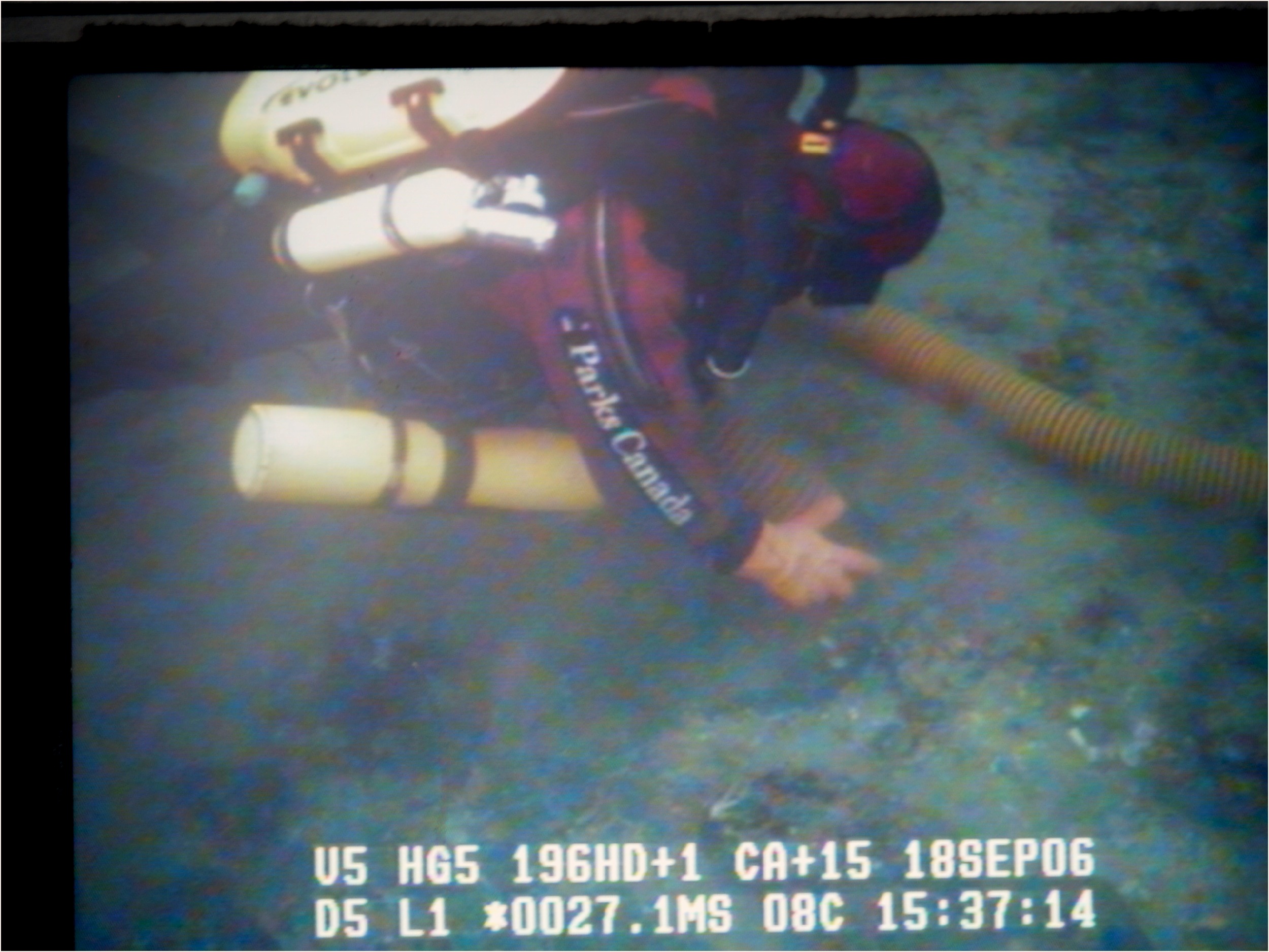
Parks Canada Underwater Archaeologist at Section Cove, 2006

Parks Canada Underwater Archaeologist at Section Cove, 2006

Parks Canada has a great underwater archaeology unit.  They have been coming out to dive on targets we’ve identified on the drowned terrestrial landscape of Haida Gwaii.  This picture shows an archaeologist with a suction hose on the bottom near (though, sadly, not on) the target we identified at the outlet of the lake that formerly sat in Section Cove, near Huxley Island. This target is at about 33 metres below the surface, while the diver here is at about 27 metres down, so on a small bump above ancient landform of interest – not a place with zero potential, but not a huge amount either, we don’t think. The hose sucked out the bottom sediments into a mesh bag which could then be lifted by crane onboard the mother ship, and screened on deck.  Therefore, it was not really a lift hose, but the system worked pretty well though as I say, it was not applied to the precise location of the high potential.  In future years once this dive team perfects their procedures for working in this difficult location and at challenging depths we hope to find some very cool archaeological stuff dating to the terminal Pleistocene / end of the last ice age.

Fieldwork Picture of the Day 3

Profiling the south wall of the Richardson Island site 2002

Profiling the south wall of the Richardson Island site 2002

The Richardson Island site (map) is a deeply stratified raised beach site.  In this picture, Duncan’s feet are at about 9300 14C years ago, while the top of the gulch is about 8400 14C years ago.  The horizontal 2 X 4 more or less demarcates the lower “Kinggi Complex” from the “Early Moresby Tradition” – the latter being marked by the introduction of bifacial technology to the stone toolkit, but also characterized by continuity between the two in many other regards.  There are some 20 major depositional units in that span, and more than 100 separable layers.  We think the site formation process is of a supra-tidal marine berm which was “pushed uphill” during a period of rising sea level — people lived on top of this berm but would periodically come to the site and find a fresh dump of finely-sorted pea gravels.   Although high-energy, the berm formation was also surprisingly gentle, allowing for numerous features such as hearths and post-moulds to preserve, not to mention pristine flakes which, in some cases could be refit one to another.  The thick reddish band just above Duncan’s head is a major berm deposit which was dumped as a single event, or several shortly-spaced events, around 9200 14C years ago.   Digging this site was a challenge – some of the layers were concreted together like iron and required some chiseling, and colour differences between some layers were often very slight.  Indeed, it became a full body experience as the texture and looseness of the gravels was very important, and on occasion, it was noted that some layers smelled differently than others.

Fieldwork Picture of the Day 2

Daryl watching the tide flow at Kilgii Gwaay.

Daryl watching the tide flow at Kilgii Gwaay.

Another fieldwork picture form the archives. This shows Daryl watching the tide come into our units at Kilgii Gwaay (map) – this is Operation 8a and 8b, if I recall, from 2001.  At first we tried to completely dig out a unit during a single tide window but this was quite rushed, and limiting.  So we tried lining the units with bubblewrap and then just before the tide reached them we would pump them full of water (hose into a bucket in the bottom of the unit) to provide outwards pressure on the sidewalls and to prevent erosion of the unit edge.  This actually worked really well: for the most part the units survived the tidal change and could be pumped out with no trouble.

Fieldwork Picture of the Day

Duncan with his feet in a 12,000 year old bog

Duncan with his feet in a 12,000 year old bog

While doing the Anthro 449 site, I’m finding a lot of pictures I haven’t seen lately, so I might as well post some of them here.  This one shows Duncan digging at Kilgii Gwaay (map) in 2002.  This was an unusual project, working in the intertidal zone between tidal windows — so about 6 hours per day of frenzied activity (read: poor napping) until the unit flooded again.  In this instance, the unit was 4 foot by 4 foot to accomodate the dimensions of plywood shoring.  There wasn’t a lot down in this unit, at least not archaeologically, but we do have a huge sample of woody bits from the organic deposits at the bottom.  In essence, the unit was placed on the edge of an ancient pond that formed post-glacially and  then lived a quiet life in the anonymous southern forests of Haida Gwaii – only to be rudely interrupted around 9450 14C years ago by rising sea levels, which made it attractive for a brief window of human occupation.  So – from a small pond in the forest, to a busy camp site, to a beach, all in a span of about 50 years.  And now, with falling sea levels, back to a beach.  The archaeological site is eroding somewhat, but nonetheless there are patches of intact shell midden and as it shows here, a large amount of terrestrial freshwater-saturated pond splooges under this beach.