Tag Archives: archives

Archives of “The Native Voice”

Native Voice banner

2018 edit: it appears the PDFs are now only available through the Internet Archive here.

The Native Voice is the official organ of the Native Brotherhood of British Columbia, an organization which has been active since 1931 and continues to do good work, especially in relation to aboriginal fishing rights, and aboriginal fishers themselves.  The NBBC has put PDF copies of  many editions of the Native Voice online from the years 1947-1955.  These archived issues offer a fascinating glimpse into the the mid-20th century state of First Nations politics, and everyday life besides.

To the right, for example, click on the text image to go to an issue wherein the NBBC riffs (positively, in this case) on  a Ruth Benedict article.

The Dionysians Strike Back

The Dionysians Strike Back

It is rare to see such responses (positive or negative) to the Anthropological Literature. Scroll lower in that article for 1947 ‘News from Ahousat”, a statement on segregation in PRince Rupert cinemas, and an odd “humour” column which seems rather offensive and patronizing in retrospect.    I am looking forward to trawling, or trolling, through these archives as the days go by.  Kudos to the NBBC for not only putting these documents online, but for the excellent, clear digitization — clearly someone took care making these files.

Heritage Burnaby

Ground stone wants to be flaked stone.

Ground stone wants to be flaked stone.

Billing itself as “personal history – collective memory”, the Burnaby Archives is a professionally presented and slick website.  As usual, the parochial frame extends only to non-aboriginal settlement.  Curious about whether the land on which Burnaby sits was occupied in more ancient times?  Well, they do link to 42 objects associated with aboriginal people.  Wondering if there might still be aboriginal people there today?  I couldn’t find anything.  I sure wish small town archives, and not so small ones as well, would wake up to the millennia of history under their feet.  Time did not start in 1892, Burnaby, much as some might like to think it did.  Or maybe it is just the prominent epigraph this site cites:  History is made with documents. Documents are the imprints left of the thoughts and the deeds of the men of former times. For nothing can take the place of documents. No documents, no history*.

No archaeology means a big honking hole in history, we might add, a hole shaped like colonial guilt.

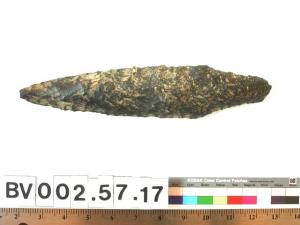
Elongate contracting stem point from Burnaby.

Elongate contracting stem point from Burnaby.

Having said that, two unusual artifacts are illustrated on their site.  Above left is a very distinctive ground stone point with a zig-zag motif.  I don’t recall seeing another one like it.  It almost appears to be a ground stone point designed to resemble a flaked stone point, something of a skeuomorph.   To the right is an elongate, contracting stem  flaked point or “dagger” that  appears to be about 14cm in length.  In size and appearance it is not the most common artifact in the world.

PS: Heritage Burnaby — your web site is nice and all, but breaking direct links to pictures is pretty lame.  Has there been that much bandwidth from hot-linked pictures?  Or are you so possessive about these artifacts you hold in trust for the Stó:lô, Musqueam, and Tsleil-Waututh First Nations?  Higher resolution would be nice as well — surely you have more than 72 dpi, 30 kb versions already taken?

* Incongruously cited as, “Charles Seignobos, Histoire de la civilisation contemporaine (1920). Translated by Eamon de Valera in a letter from prison to his personal secretary enjoining her to safeguard his papers.”

Chilliwack Museum and Archives

Chilliwack Museum Accession number 1957.019.084

Chilliwack Museum Accession number 1957.019.084

The Chilliwack Museum (map) has a large, searchable collection of photos online, which they ruin with a huge watermark in the middle.  Seriously, guys, these are ancient artifacts that you are lucky to be curating.  And, your pictures aren’t very good in the first place – many out of focus, or with extensive shadowing.  In any case, for archaeologists, you can click for artifacts made of, or records containing the word,   “stone” (they have a huge number of celts, mauls and abrader stones, as you might imagine since the Fraser Valley is known for these, perhaps because of extensive plowing of former woodlands).  Oddly they don’t seem to have any aboriginal artifacts made of bone, shell, or antler.  Search term “Sto:lo” returns one empty field.  Further they make it almost impossible to link to a specific record or picture. I am putting in a picture I downloaded from their site of an unusual artifact – a ground stone point with a very unusual morphology and material.  They list it made out of serpentine, but from what I can tell, it shows signs of being readily worked, and so may be a softer verson of serpentine, perhaps soapstone.  The shape is like a bronze age arrowhead or something — highly unusual.   Too bad there isn’t a better picture available.  So, all in all, Chilliwack Museum people: you put a lot of time and energy into a resource that is not particularly useful nor does it readily promote the heritage of the Fraser Valley.  I suggest you rework your URL system, remove the watermarks, and update your keywords by adding Sto:lo to appropriate records.  Double-check your raw material “horn” as well.  You have a fantastic collection, share it!

West Vancouver Archives

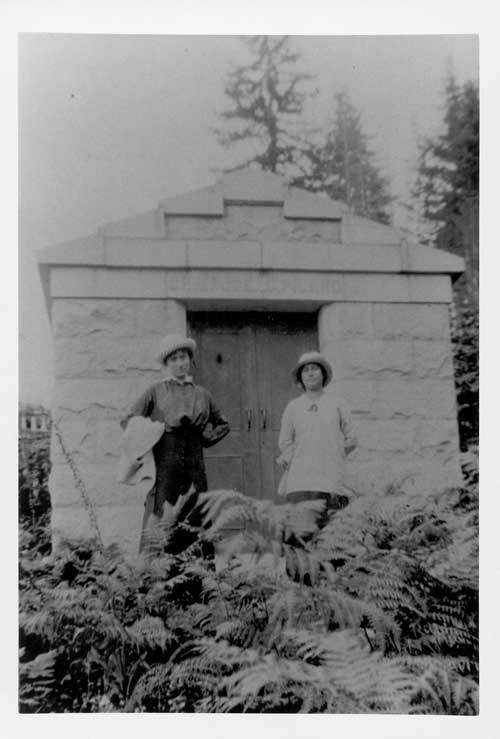
Tomb of Chief Joe Capilano ca. 1917

Visitors to the Tomb of Chief Joe Capilano ca. 1917

Stumbling on the Vancouver Public Library’s photo site the other day got me poking around smaller museums and archives for archaeology and First Nations related stuff.  It turns out there’s a lot out there.  First up is this picture I found at the West Vancouver Museum and Archives.  They have a searchable collection, within which a fair number of digitized historic photos.  A fair amount of stuff is under “First Nations” and “Indian”.  To the left is a remarkable picture of Chief Joe Capilano’s tomb (map).  It’s quite a slab, house-shaped (though not a shed roof house!), but surely it is as close to a mortuary house as it is to traditional Christian mausoleum.     Joe Capilano was a leader of the Sḵwxwú7mesh (Squamish) nation, to whom he was known as Sa7plek.

Sa7plek: Chief Joe Capilano

Sa7plek: Chief Joe Capilano

Apparently, he recieved the title of ‘Chief”  (via recieving the name Kiyapalanexw (Capilano), in order to facilitate his trip to Ottawa and to London, to meet King Edward VII.   The name bestowal was in the belief that he would need a title in order to speak “Chief-to-Chief” with the Prime Minister and the King, or so says wikipedia.  These smaller archives have fairly idisoyncratic interfaces and often the context given is poor.  Nonetheless, I will occasionally, or even frequently, post pictures or other material from them.

Vancouver Public Library Archives

beach-grove-dig

"Archaeologists at Beach Grove, 1962"

The Vancouver Public Library has a nice collection of historical photos online, though the resolution is not great.  Interestingly, there are a number of historical archaeology pictures I had never seen before.   I’m sure someone knows these faces, presumably they include Duff and Borden?  Another picture from Beach Grove (map) shows someone sitting at an ASAB desk (Archaeological Sites Advisory Board).  When surveying at the Milliken Site in about 1986 I remember finding an old desk that was presumably Borden’s – reputedly he had a desk at his digs.  Also, there was a bookshelf out there, in the middle of the woods above the tracks.  The VPL site also has a few pictures of the Eburne (Marpole) midden, including this disturbing closeup one of the human remains visible in the link above.

You can go here and enter the search term “archaeol*”