Tag Archives: CRM

Songhees claim to Cadboro Bay

Songhees claim to Cadboro Bay lands promised by Douglas. Source: TImes-Colonist.

The Douglas Treaties have stood up well in court but the fact remains that the rights to hunt and fish are severely compromised by urban developments.  Further, it is a widespread shameful pattern that the government went out of its way to reduce the sizes of the few, small reserves that were established and to eliminate some altogether.  It is very welcome to see the strong assertion of the Songhees Nation that they have the rights to 200 acres surrounding Cadboro Bay.

Lawyer Rory Morahan said the band is not trying to reclaim the land promised to it in one of the Douglas Treaties, but is asking for compensation and a declaration that it is Songhees land.

A statement of claim was filed in B.C. Supreme Court yesterday, but it is likely to be at least a year before the case is heard.

The key to launching the lawsuit was finding historical documents, Morahan said. “There’s oral tradition about the village site, but in the courts you need more than oral tradition. We have been working on this for about a year, getting the details down,” he said.

The treaty with the Chekonein people, ancestors of the Songhees Nation, specifies that they would have 200 acres (80 hectares) around their Cadboro Bay village site, adjacent to the beach, and about 40 acres (16 hectares) of camas and potato fields.

“Under the treaty, the Songhees ancestors were promised that their village sites and fields would be protected for their use and the use of future generations, and that their villages and fields would be properly surveyed,” Morahan said.

Clearly, the Songhees are not asking for the land to be returned, but for compensation for its unlawful and duplicitous preemption.  The were successful in obtaining compensation a couple of years ago for the land under the legislative assembly, ironically enough and I imagine they have a good chance of success with this case as well. There is certainly an inarguable case for the archaeological significance of Cadboro Bay.

The comments in the Times-Colonist article are some of the most pathetic, racist, ignorant drivel I have ever seen, though.

Stephen Hume kicking ass (but whose?)

Desecrated spiritual site: the Big Rock at Campbell River

Stephen Hume has written some great columns on BC archaeology and history over the years and he comes out swinging in this recent piece:

Beside Highway 3 near Keremeos, a large glacial boulder has myths attached that extend far into B.C.’s past. It’s our own Stonehenge but it’s defaced with graffiti. Not far away, somebody jackhammered out of a cliff face one of the most significant ancient rock paintings in North America. Near Campbell River, another cultural site of great significance to first nations — the Big Rock — is also covered with graffiti. On Saltspring Island, effluent filters through a grave site with government approval. Near Qualicum, the bones of persons of great importance were mixed into paving material for a parking lot.

We pay lip service to first nations culture; we trot it out when we’re on the world stage — at the Olympics, for example — but our actions betray our venal hypocrisy. When conflicts arise between private commercial gain and public protection of our now-shared ancient heritage, money seems to trump culture almost every time.

I use the term “our” to describe this heritage because we are all citizens of B.C. together, first nations and settler society, fused by our braided history. We have one shared narrative in this province. It is composed of many stories. They begin not with the recent arrival of European adventurers or Asian monks but in a far more ancient past.

When we permit the desecration of important first nations sites, it’s our shared history that we abuse and our children’s legacies that we steal.

I am not convinced that the private member’s bill to which he is refers is the answer, and in any case it died on the vine – more on that later.  And the BC Archaeology Branch is kept on a short leash through the expedient of under-funding.  But I certainly appreciate Hume’s  take-no-prisoners attitude – we need a few vocal bulldogs on the case.  Incidentally, in a parallel universe to this blog, Hume’s brother is in a UVIC archaeology class right now, so maybe another bulldog can be raised – it seems to run in the family.

Notably,  it looks like there is a move afoot to designate the Big Rock, spearheaded by Frank Assu of Cape Mudge.  Let’s hope this succeeds, and maybe we won’t see it get dressed up again as a pumpkin.

Vandalized Pictograph Boulder near Keremeos.

CRM Problem in Cadboro Bay

cadboro bay mess

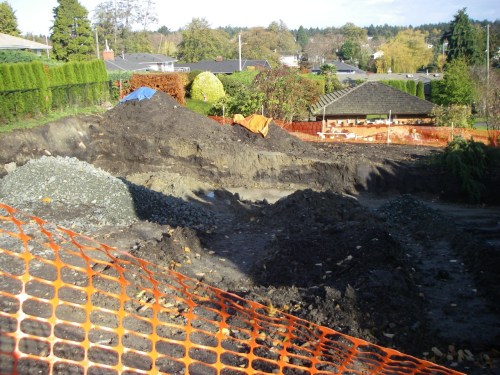
Uncontrolled destruction of Archaeological Site in Cadboro Bay, Victoria.

This week saw an all-too-familiar case of human remains disturbed by residential construction, this time in Cadboro Bay close to the University of Victoria. There are two major known sites in Cadboro Bay and many others must be there as well (I haven’t checked to see what has and has not been recorded). In addition to these known very large sites, it has been known since the 19th century (e.g.,  Cadboro Bay: Ancient City of the Dead — 6 meg PDF) that the slopes leading down from the top of Gordon Head were favoured places for human burials. So, no one could be surprised to find human remains in this area and indeed this is what happened.

A twist on the usual story comes with the reporting that the landowner, identified as Henry Ravenscourt, had had an archaeological impact assessment done and yet then excavated out almost the entire soil and subsoil of the lot in question. According to the Times-Colonist:

The property had been designated an archaeological site in Oct. 2008 when an Archaeological Impact Assessment was conducted there. Under the Heritage Conservation Act, the landowner was required to obtain a permit before digging, however, it appears no permit was granted for the new-home construction.

The Globe and Mail reports that,

Provincial [sic – probably consulting] archeologists who had been monitoring the property alerted police last Wednesday after discovering that workers digging the foundation for a new home had unearthed a human skull, knee and leg bone.

VicNews.com has added information: the Police say the landowner was in possession of the Archaeologist’s report:

Sgt. Julie Fast with Saanich police said the homeowner could possibly face charges through the Heritage Conservation Act because an Archaeological Impact Assessment was done on Hibbins Close in October 2008. That assessment designated it an archaeological site, which means, before any digging or building takes place, a permit issued through the Provincial Archaeological Branch is required.

“From what I understand, the homeworker is supposed to be in possession of the (permit). We are determining if they were aware (of the Archeological Impact Assessment), and if they had the letter,” Fast said.

The permit would designate how deep digging can be done and where a structure can be built without disturbing any remains on the property.

It is hard to say what is really going on here. If an AIA was conducted in October 2008, then surely the landowner had a copy of the report. Were there archaeologists monitoring the site? That would be consistent with a development process whereby archaeologists routinely watch backhoes and then jump in when the skulls start rolling. But surely the archaeologists would not have allowed such complete removal of material in such an uncontrolled way? I visited the site last week and saw how several, perhaps 10, dump trucks worth of material from almost the entire lot had been removed and there were only token piles of backfill. Where did this soil go? It undoubtedly contains human remains and archaeological material.  I trust the Archaeology Branch is tracing its whereabouts.

It is very welcome that the Police are considering charges in this case and I certainly hope that if a landowner or developer ignores an AIA recommendations that they get the book thrown at them as firmly as possible. Contrary to what the newspapers are reporting that the owner is subject to a 2,000 dollar fine, there appears to be a contravention under Section 13(2) of the Heritage Conservation Act, for which the maximum penalty under Section 36(3)a is $50,000 and six months for an individual, and 1,000,000 for a corporation. It is essential that the justice system starts to deal with these people in a serious manner. By completely removing the archaeological material from the property a landowner could in effect raise the property value by more than 50,000.

I share Songhees archaeologist Ron Sam’s cynicism though:

“They know full well there’s bones under there and they just go ahead and do it anyway because they know there’s no penalty,” Mr. Sam said, adding that the band is seeking legal advice. “We can say what we want, but at the end of the day it’s private property and we can’t stop it.”

Perhaps not. But those charged with managing and enforcing the Heritage Conservation Act and those responsible for gathering evidence and laying charges must start to make examples of those who flagrantly destroy the collective heritage.

Also check out this busybody’s letter to the Times-Colonist complaining about the costs incurred and implying the archaeologists are just making work.  Chris Harker of North Saanich, you officially have no idea what you are talking about.

cadboro bay mess 2

Note how close the excavation is to the property line.

Karst Mismanagement in British Columbia

Karst destroyed with approval of karst consultant.

Karst destroyed with approval of karst consultant.

The protection of BC karst landscapes falls into a sort of legal limbo.  There is only weak protection afforded through regulation, and only in some contexts.  If a cave can be shown to have archaeological deposits, it can be afforded very strong protection under the Heritage Conservation Act.  In theory, the HCA can also protect the cave if it has spiritual values to First Nations.  Nonetheless, the practice of karst assessment is controlled by a small cabal of self-appointed experts.  These folks make a living by doing impact assessments, mainly for forestry companies.  The picture at the left shows the results, a magnificent karst bluff destroyed after the karst consultant wrote the area off – from an office 500 miles distant, based on notes provided by a forest company employee.  In the report, archaeological values are dismissed from afar, doubly ridiculous since the karst consultant is notably ignorant about archaeology.  Continue reading