Tag Archives: Cultural Resource Management

Alaskan Ice Patches

Barbed bone or antler point with copper tip from Alaskan Ice Patch. Source: Dixon, NPS

All over  Northwestern North America, from Colorado to the NWT, global climate change is rapidly melting glaciers, and their less mobile cousins, permanent patches of ice which accumulate and never completely melt.  Some finds from these ice patches have revealed exceptionally-preserved organic technology dating from recent times to more than 8,000 calendar years ago.  Additionally, of course, there is the remarkable story of Kwädąy Dän Ts’ìnchį, Long-Ago Person Found, a man who died on a glacier in the Tatsenshini area hundreds of years ago.  All of these would make good posts for the future!

For today, though, I found an article online (PDF) about the lesser known Alaskan ice patches, which have been researched primarily by E. James Dixon.  Continue reading

One more update on the Museum of Vancouver’s Petroglyph.

Interior Petroglyph now at Museum of Vancouver, while still in Stanley Park ca. 1980. Source: DanLeen.org

I have posted several times recently on a superb interior petroglyph boulder languishing in a shady courtyard at the Museum of Vancouver.  Together with Heather Pringle’s posts on this topic, we seem to have caught the attention of the Board of Directors of the Museum.

One of the Directors, Anthropology Professor Bruce Miller of UBC, called me the other day.  He consented to me posting notes from our conversation.   Continue reading

More views of the Museum of Vancouver petroglyph problem

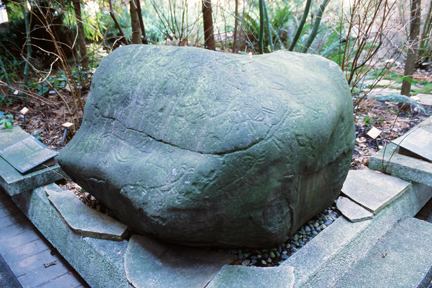
Petroglyph from Lone Creek Cabin, Stl’atl’imx Territory, now in an outdoor courtyard at the Museum of Vancouver. Source: Squamish-Lil'wat Centre.

I’ve posted before on the large petroglyph boulder from the central Fraser River that is being kept in a sub-standard context at the Museum of Vancouver.  I found some more pictures of it, from the website of the Squamish-Lil’wat Cultural Centre (which is excellent).  These additional pictures confirm there is a serious conservation issue at the Museum of Vancouver.  I don’t want to beat a dead horse but I am still mad about this situation. Continue reading

Lousy conservation at the Vancouver Museum?

Shoddy conservation of magnificent petroglyph boulder at the Vancouver Museum. Screenshot from VM website.

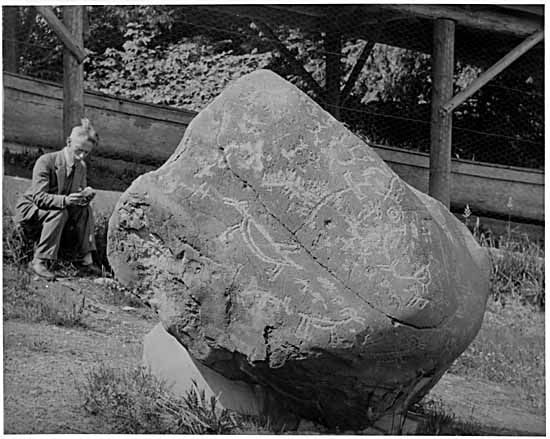
For some reason mistreatment of rock art just makes me spitting mad.  I posted the other day about a magnificent petroglyph boulder that was removed from its home on the central Fraser River near Lillooet in 1926.  Bad enough that this work of art was ripped from its setting to be a curio in an urban park.  Petroglyphs are not ornaments for your outdoor rock garden any more than they are lifestyle amenities deployed as advertising copy, even if you are a museum.

Now my spies tell me that this petroglyph boulder was moved to the Vancouver Museum in 1992.  Pictures of the boulder on the VM website show it to be in absolutely appalling shape.  It is covered with moss, the designs are visibly eroded and faint, there are signs of exfoliation, and the large crack seen in 1926 seems to be getting larger.   The Vancouver Museum appears to be keeping this treasure in a damp, shady, spot in the outdoors (as they say, it is in a “lower level garden courtyard”) and there is no sign of any attention to basic, fundamental conservation responsibilities. They even have the gall to note in their website description “Today archaeologists are reluctant to reveal the locations of petrogylphs, lest they be disturbed.”  Well I am revealing the location of this petroglyph, which is being disturbed by careless curation!

Seriously: this boulder is one of only a few petroglyphs from that part of the province, where pictographs are much more common.  It was in pristine condition in 1926.  Now it is a moss-ridden crumbling mess.  This boulder is a cultural masterpiece.  It is a provincial treasure.  It is a national treasure.  It is of international significance.  And yet it is being absolutely neglected by a leading cultural institution.  Imagine an Emily Carr painting being treated so poorly.  Imagine a Bill Reid sculpture  treated so shabbily.  It would never happen.  Yet this boulder is as important, is MORE important, and is consigned to rot away metres from state of the art curatorial facilities which are being devoted to white leather pant suits (!!).  It is astonishing to me that they put this boulder on the web at all, suggesting that they don’t see a problem and are therefore unworthy to be in possession of it.  They should make arrangements immediately to have it transferred to a suitable institution or have it returned to its original setting, in what I take to be St’at’imc territory

Vancouver Museum, you have a responsibility of professional stewardship.  Are you living up to it?

Note the eroded engravings and extensive moss/algae cover. Source: VM website screenshot.

The boulder in the early 1930s, soon after it was brought to Stanley Park. Note the crispness of the designs and the lack of moss.

Gabriola Petroglyphs at Elaine Seavey’s blog

Anthropomorphic petroglyph on Gabriola Island. Note how the patina of the rock has been disturbed by tracing.

Gabriola Island has some of the most spectacular and important petroglyphs in the world — and unfortunately, they are just as threatened by developers and development pressures, as I have noted before.  Since these sites seem to not always matter as much as I think they should, it is nice to see an awestruck first person account by a person with no vested interest.  Why on earth would those who purport to love and respect Gabriola Island and  Snuneymuxw culture be so intent on diminishing this kind of experience?

Even so, I must comment on the destructive practice of rubbing, not so much through cloth but the scraping of the lines to remove weathering patina and lichen in order to take clearer photographs.  This is a very unfortunate practice which hastens the disintegration of the rock art.

CRM Problem in Cadboro Bay

cadboro bay mess

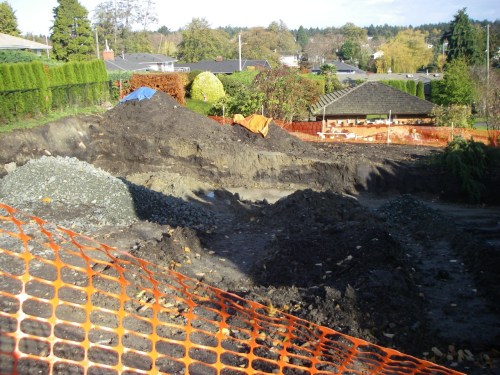
Uncontrolled destruction of Archaeological Site in Cadboro Bay, Victoria.

This week saw an all-too-familiar case of human remains disturbed by residential construction, this time in Cadboro Bay close to the University of Victoria. There are two major known sites in Cadboro Bay and many others must be there as well (I haven’t checked to see what has and has not been recorded). In addition to these known very large sites, it has been known since the 19th century (e.g.,  Cadboro Bay: Ancient City of the Dead — 6 meg PDF) that the slopes leading down from the top of Gordon Head were favoured places for human burials. So, no one could be surprised to find human remains in this area and indeed this is what happened.

A twist on the usual story comes with the reporting that the landowner, identified as Henry Ravenscourt, had had an archaeological impact assessment done and yet then excavated out almost the entire soil and subsoil of the lot in question. According to the Times-Colonist:

The property had been designated an archaeological site in Oct. 2008 when an Archaeological Impact Assessment was conducted there. Under the Heritage Conservation Act, the landowner was required to obtain a permit before digging, however, it appears no permit was granted for the new-home construction.

The Globe and Mail reports that,

Provincial [sic – probably consulting] archeologists who had been monitoring the property alerted police last Wednesday after discovering that workers digging the foundation for a new home had unearthed a human skull, knee and leg bone.

VicNews.com has added information: the Police say the landowner was in possession of the Archaeologist’s report:

Sgt. Julie Fast with Saanich police said the homeowner could possibly face charges through the Heritage Conservation Act because an Archaeological Impact Assessment was done on Hibbins Close in October 2008. That assessment designated it an archaeological site, which means, before any digging or building takes place, a permit issued through the Provincial Archaeological Branch is required.

“From what I understand, the homeworker is supposed to be in possession of the (permit). We are determining if they were aware (of the Archeological Impact Assessment), and if they had the letter,” Fast said.

The permit would designate how deep digging can be done and where a structure can be built without disturbing any remains on the property.

It is hard to say what is really going on here. If an AIA was conducted in October 2008, then surely the landowner had a copy of the report. Were there archaeologists monitoring the site? That would be consistent with a development process whereby archaeologists routinely watch backhoes and then jump in when the skulls start rolling. But surely the archaeologists would not have allowed such complete removal of material in such an uncontrolled way? I visited the site last week and saw how several, perhaps 10, dump trucks worth of material from almost the entire lot had been removed and there were only token piles of backfill. Where did this soil go? It undoubtedly contains human remains and archaeological material.  I trust the Archaeology Branch is tracing its whereabouts.

It is very welcome that the Police are considering charges in this case and I certainly hope that if a landowner or developer ignores an AIA recommendations that they get the book thrown at them as firmly as possible. Contrary to what the newspapers are reporting that the owner is subject to a 2,000 dollar fine, there appears to be a contravention under Section 13(2) of the Heritage Conservation Act, for which the maximum penalty under Section 36(3)a is $50,000 and six months for an individual, and 1,000,000 for a corporation. It is essential that the justice system starts to deal with these people in a serious manner. By completely removing the archaeological material from the property a landowner could in effect raise the property value by more than 50,000.

I share Songhees archaeologist Ron Sam’s cynicism though:

“They know full well there’s bones under there and they just go ahead and do it anyway because they know there’s no penalty,” Mr. Sam said, adding that the band is seeking legal advice. “We can say what we want, but at the end of the day it’s private property and we can’t stop it.”

Perhaps not. But those charged with managing and enforcing the Heritage Conservation Act and those responsible for gathering evidence and laying charges must start to make examples of those who flagrantly destroy the collective heritage.

Also check out this busybody’s letter to the Times-Colonist complaining about the costs incurred and implying the archaeologists are just making work.  Chris Harker of North Saanich, you officially have no idea what you are talking about.

cadboro bay mess 2

Note how close the excavation is to the property line.